
In the summer of 2023, I followed behind families toting floaties and foam coolers, trudging up an incline on the side of a levee. As I fumbled over a fence and down a ladder, the families walking ahead of me nimbly stepped over long and wide railroad tracks. In the distance, a canopy of oak trees blocked the sun, and from behind them came sounds of gentle waves and laughter. Without knowing, I walked past remnants of a boardwalk, a restaurant, and filled-in swimming pools—features that were once central to Lincoln Beach, a now-shuttered segregated beach on the shores of Lake Pontchartrain in New Orleans East. Near the sandy shore, boys and girls held hands while balancing on a deteriorating brick wall. Other visitors cast fishing rods from the rocky headlands flanking the beach, and kids waded joyfully into the low water under their parents’ watchful eyes. Barbecues blew out steady trails of smoke. Here, past the concrete floodwalls, grassy levees, and railroad tracks, people had created their own oasis.
The city of New Orleans officially opened Lincoln Beach to the public on June 29, 1955. Earlier that year, a federal court held that segregation at public beaches and bathing houses was unconstitutional, but the Louisiana state legislature passed an act mandating segregation for all public and recreation areas. The beach quickly became a cultural touchstone. People flooded in. The Louisiana Weekly, a Black-run newspaper, dubbed Lincoln Beach “a Mecca for [a] Million.” With its wooden roller coaster, Ferris wheel, Whip, merry-go-round, diving pools, and picnic areas, it was called “the South’s Coney Island,” and it attracted major musical acts like The Ink Spots, Fats Domino, Ike and Tina Turner, and Nat King Cole. The earliest records in the 1880s show the beachfront as a weekend destination for families who wanted an accessible and affordable place to swim, and over the decades it became the largest Black public venue in segregated Louisiana.1
Despite the city’s segregationist agenda, people made Lincoln Beach their own. New Orleans native Mercedes Jackson celebrated her 1957 high school graduation at Lincoln Beach and remembers it as “the only beach for Black people.” Her daughter later went on to write a book on segregated recreation, inspired by Mercedes’s experiences. When interviewed for a local museum dedicated to Lincoln Beach, former beachgoers recalled the cultural meanings the location held for them. Lower Ninth Ward resident Reverend Richard Bell remembers it as a place the local Black community had to themselves, where he always felt at ease. “You didn’t have no violence,” he said. “You didn’t have no fighting.” Karen Coaxum, who grew up in the lakefront Pontchartrain Park, had a neighbor who was a lifeguard at Lincoln Beach and remembers the pools as the biggest attraction, “a place where you just felt happy all the time.” She stressed the importance of Lincoln Beach as a “safe place” to swim or to learn how. For families who otherwise did not have access to pools or lifeguards, Lincoln Beach was a lifeline. Brent Mickens, the grandson of Lincoln Beach lifeguard Edward X. Dunn, was born after the beach closed, but he remembers hearing his family talk about Lincoln Beach as an integral part of New Orleans’s segregated history. “I hear nothing but great things about it,” said Mickens, who was sorry that he was never able to go himself. He remembers his grandfather, floating in a pool with a cigar in his mouth, as the man who “taught a whole generation how to swim.”2
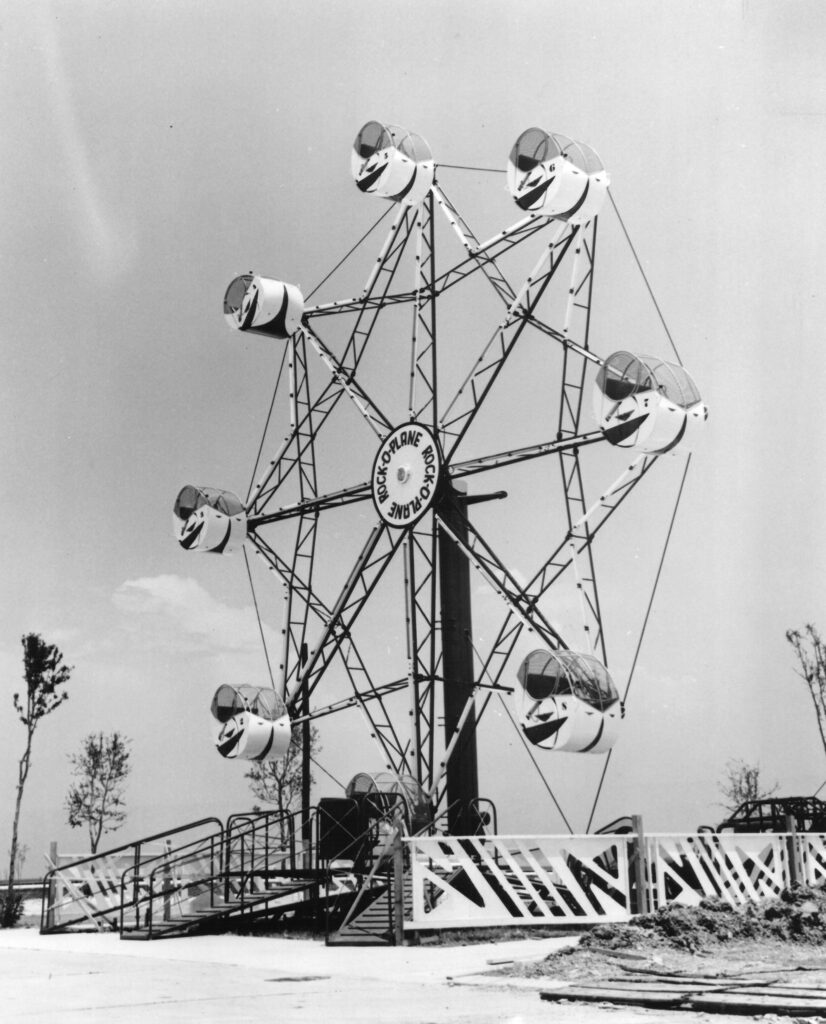
Today, Lincoln Beach survives as a cultural memory of the glory days of New Orleans’s Black community, but little is written about it. The beach appears in various Black histories of New Orleans, but mostly as a brief mention that reduces it to a general example of segregation in the city and region. Keith Medley’s Black Life in Old New Orleans compares it to Seabrook, an unofficial Black beach in New Orleans, bordering a white beach, and focuses on Lincoln Beach’s short-lived fame. Historian Andrew Kahrl’s The Land Was Ours mentions Lincoln Beach as an example of coastline communities but does not interrogate its history. The archives, however, preserve a story of control over Lincoln Beach and its visitors, of deliberate neglect by its owners, and of a people’s struggle to find a place of relaxation and rest.3
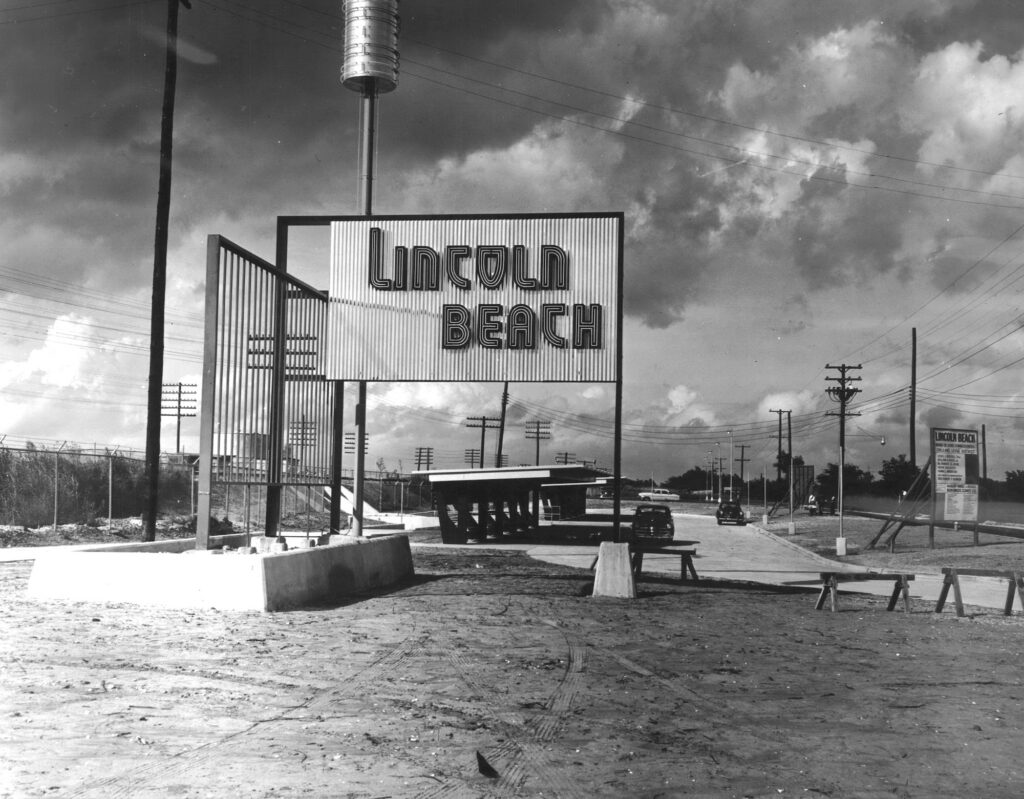
Lincoln Beach is a part of a larger swath of land known as Little Woods (Petit Bois), named by French settlers for its shrubby, low landscapes. It sat in the eastern portion of the curved womb of Lake Pontchartrain, a bulging, briny mass connected by a strait to Lake Borgne, which flowed into the Gulf of Mexico. Neither lake is actually a lake—they are simply named and understood as such.
After Spain acquired French Louisiana at the end of the Seven Years’ War in 1763, the King of Spain granted Eastern New Orleans to Gilberto Antonio de Saint-Maxent, a merchant and militia commandant of French and Spanish heritage. The land offered timber, cypress logs, sugar, and furs, but no oil. Far from the metropole and eventually unprofitable, the swamp remained a playground for duck hunters. It sat, undrained, bound by the lake and the railroad. At the meeting place of these boundaries was a sandy plot of land, which the state eventually called Lincoln Beach.
The story of Lincoln Beach, like much of Louisiana, begins with levees—embankments built to prevent flooding. The end of the Civil War had displaced the plantation economy and the infrastructure of labor that ran levees, and the frequency of floods throughout the 1850s and ’60s called for a new system. The levees were in such poor condition that the state had to effectively “bribe creditors to buy its bonds,” and it borrowed money to pay off interests. The state was not prepared for the transition from plantation-funded to public works construction. In 1871, the Louisiana House of Representatives incorporated the Louisiana Levee Company, running levee construction projects with a convict labor system. The Levee Company marked the beginning of a government apparatus for land and social control with little oversight. Louisiana’s Constitution of 1879 subsequently created “levee districts” as state agencies with the power to levy taxes to fund development, effectively making districts another level of local governance.4
The districts’ power over parish-level governments was part of a statewide reassertion of centralized white rule after Reconstruction to “redeem” the Old South. The wealth and prosperity of the state depended on flood control and drainage, and thus the state depended on its levee districts’ control over people and land. In 1890, a state statute formed the Orleans Levee Districts, with jurisdiction over leveed land on the shorelines of Lake Pontchartrain, including Little Woods. This constitutional power, which was integral to the Levee Districts’ profit, became a foundational element in allowing the Levee Districts to secure tidal land and to mold it as they pleased. Louisiana’s Levee Districts were able to own, acquire, and sell beach land without local public input. As long as the Levee Districts described their plans as being in the public interest, they could shape the landscape to serve their purpose.5
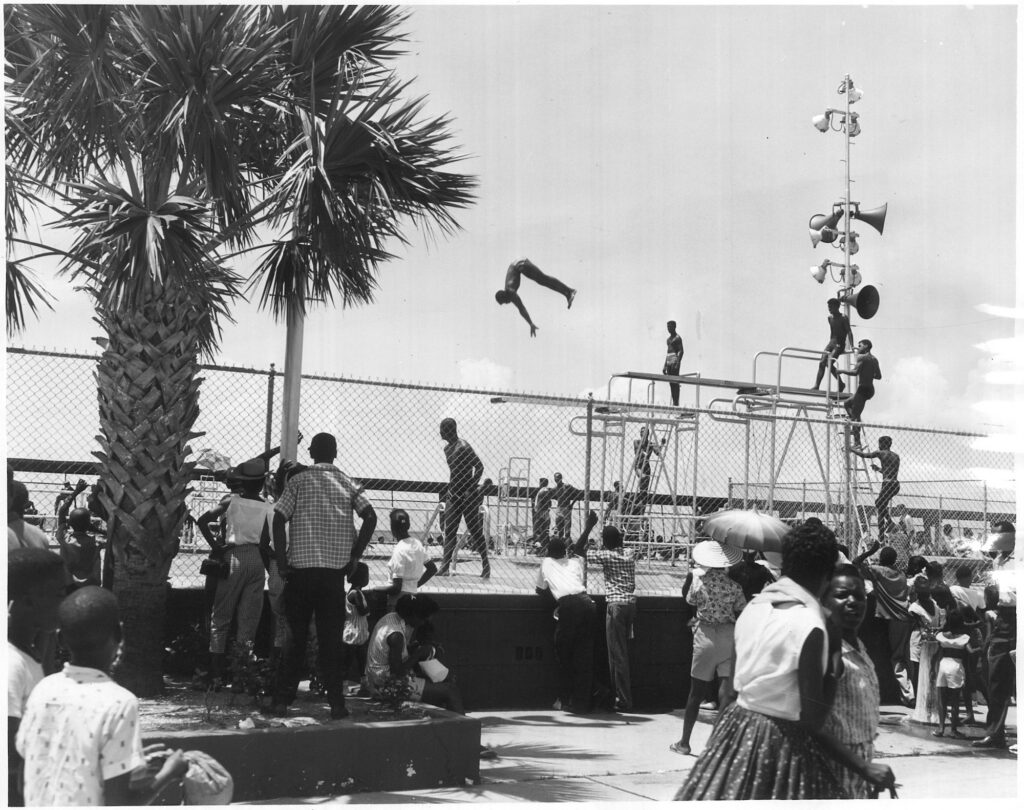
By 1890, the Northeastern Railroad Company had purchased Little Woods to lay down lines of track and build a resort. Restaurants and entertainment businesses popped up along the coast. Crowded trains ran on Sundays, with more than five hundred people venturing out of the city to Little Woods on a given day, and people still advocated for a higher frequency of trains. The lower-tier resort became a day-trip destination for working-class families unable to afford the lakefront closer to New Orleans—and the distance from the city meant the beach was relatively unregulated. Little Woods was not segregated; both white and Black residents lived there and visited.6
In 1921, a new Louisiana Constitution gave the Orleans Levee District ownership of the beds of navigable water, restraining all transfers of property titles except for reclamation purposes. Land reclamation became a primary means for the Levee Board to generate profit: Create useable land and sell it. And through reclamation, the District acquired the title to the beachfront at Little Woods. The Levee Board had been reclaiming the entire southern lakefront. Imprisoned Black laborers pumped sand, earth, and shells from the bottom of the lake to fill in land eight feet tall. The Times-Picayune, New Orleans’s paper of record, described it as one of the most important reclamation projects for the city.7
Legal scholar Robert Cover once described law as a “projection of an imagined future upon reality” and an attempt “to build future worlds.” The Orleans Levee Board used its nearly unmitigated control over lakefront land to project a segregated world onto Lake Pontchartrain’s shoreline, ensuring that the lakefront resorts attracted white beachgoing customers. Near the city of New Orleans proper, there was the all-white Pontchartrain Beach and the bordering beachfront Seabrook, popular for Black residents. Throughout the 1920s, the Levee Board had been working on a seawall to build back eroding and receding shorelines. Under the guise of protecting New Orleans from floodwaters, the Levee Board worked to improve the “untidy lakefront area.” They attempted to prevent white flight at Pontchartrain Beach and to protect its profitability by imposing a concrete border, doubling as a line for racial separation. This seawall blocked Seabrook beachgoers from passing over to Pontchar-train Beach, a man-made boundary in the water that also created deadly currents at Seabrook, killing Black swimmers who got caught in sinkholes in the lakebed. Black citizens advocated for a safe place to swim, and the Orleans Levee Board voted in 1937 to build a Black bathing beach in the rural location of Little Woods. The Levee Board finally opened Lincoln Beach in 1941, legally segregating what had been an integrated working-class space.8
In October 1941, Frederick H. Osborn, Chief of the Morale Branch for the US War Department, chose the beach as the site to build a recreational camp for Black soldiers. A founding member of the American Eugenics Society, Osborn ran the War Department’s recreation program by treating leisure as a segregated activity for Black Americans. With the National Park Service, the War Department began construction at Lincoln Beach immediately. Workers poured concrete for the base of a recreation tent and started construction on a projected five hundred smaller wooden-frame tents to house soldiers who would be camping there, actions that indefinitely delayed the site’s opening as a city beach. Judge William H. Hastie, the first Black US federal judge, appealed to the Secretary of the General Staff, expressing his belief that “without Negro officers in command,” Lincoln Beach would be “no more than a place to eat and sleep.” The Secretary responded to Hastie’s concern with a solution to “have a white commanding officer and a colored morale officer in order to provide adequate contact with both white and colored groups in the community adjacent to the recreation center.”9
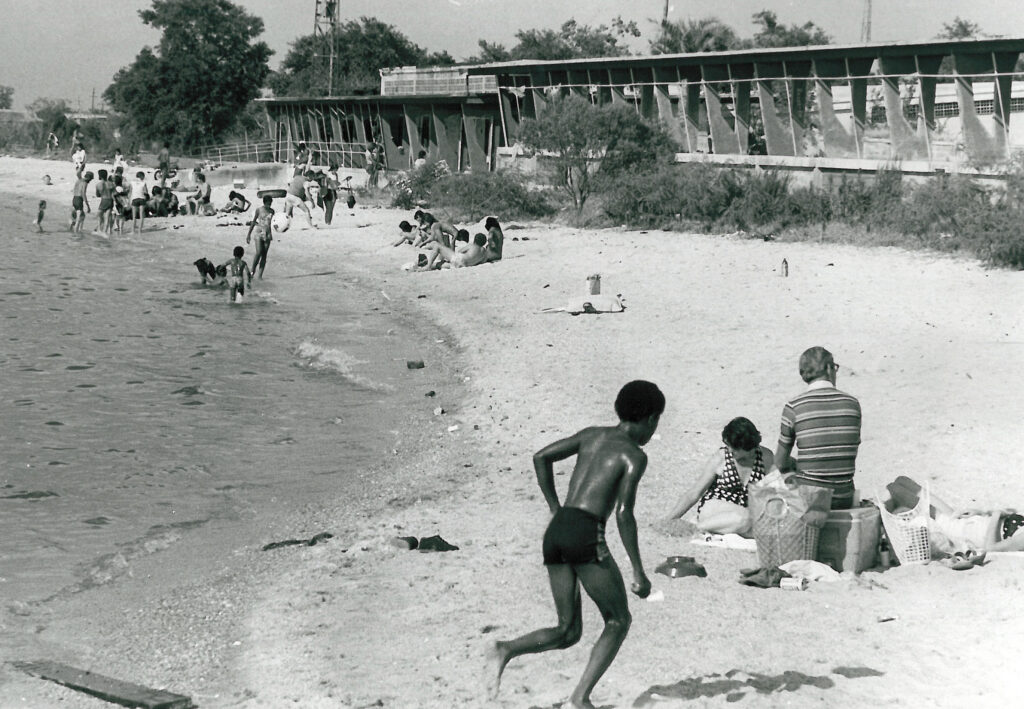
Hastie’s correspondence is among the few archival traces noting the diverse population in Little Woods. Any other mention of who lived or worked in Little Woods was found in real estate sections or job listings in newspapers, items about beautiful homes for sale or a restaurant looking for a Black waitress. The 1940 Census’s Enumerated District Map did not depict any housing in the area at all. This gap in the archive marked Little Woods as an apparently desolate area, uninhabited and visited only by commuters, ideas reinforced by the city and state governments. In contrast, Hastie’s letter reveals the Orleans Levee Board’s failure to segregate and evict Little Woods residents, as they claimed they would do by 1941.10
Hastie had outlined concerns about the recreation camp, specifically its location and natural environment. There was no form of public transportation serving the area. A highway had replaced the train, and the army camp was stranded. The War Department was also troubled by the water conditions at Lincoln Beach, noting that it was “condemned several times by the State Health Department because of pollution with sewage and human waste although it is still designated by the city for Negro use.” With these problems in mind, Hastie recommended immediate suspension of the work on the Lincoln Beach recreation camp. Even the segregationist Osborn quickly came to see that Little Woods was not conducive to a large recreational development and that Lincoln Beach was unsuitable for cultivating morale in the Black soldiers. In November 1941, one month after selecting the site, the War Department officially ordered the transfer of the recreation camp and halted construction at the beach. No other segregated army recreation facility ever opened in New Orleans.11
Meanwhile, as some Black families ventured out to enjoy the small amusement park and the bars, casinos, and dance halls in Little Woods, thousands still went to Seabrook, where routine police sweeps sought to deter people from swimming. In the postwar period, the Levee Board and the city planned for more development at Lincoln Beach, ignoring Black beachgoers’ wishes to make Seabrook the city’s primary Black beach. (Though the War Department had criticized the beach’s location, the Orleans Levee Board thought it was important that Little Woods stayed rural; it would make Lincoln Beach easier to manage than Seabrook.) A 1953 photograph shows that construction began on an amusement park, a restaurant, diving pools, and a boardwalk. The Orleans Levee Board canceled the leases of the remaining Little Woods lakefront residents and allocated half a million dollars for this development, totaling a million-dollar investment in Lincoln Beach.12
The Orleans Levee Board expropriated and enclosed land in Little Woods, creating a beach that fit its vision of Old South stability. Historian Victoria Walcott, whose work examines urban recreational settings as visible sites of meaning for Black citizens, argues that to broaden our understanding of desegregation we should conceive it “as part of a broader struggle for control of and access to urban space.” Lincoln Beach was one of many such segregated spaces nationwide that Black Americans used to cultivate a cultural identity.13
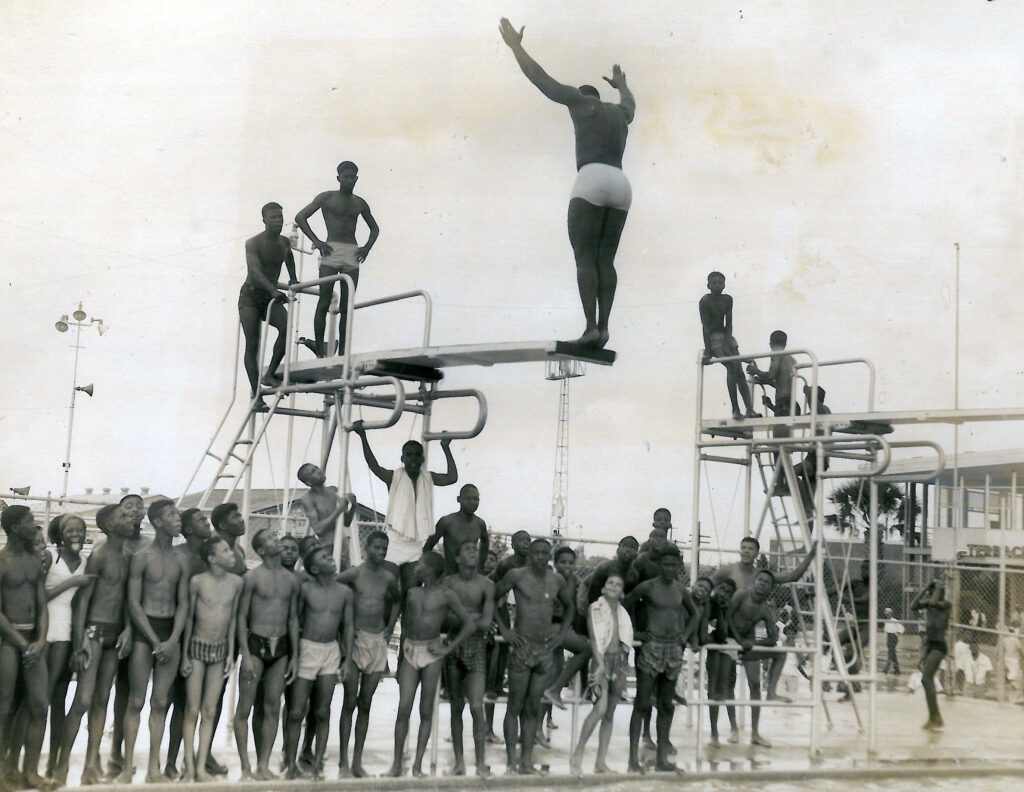
In 1955, the newly formed Lincoln Beach Corporation opened the segregated beach to the public. And as it became the largest Black public space in Louisiana, the city acted as if this growing community was a gift they had bestowed on local Black residents. The city viewed their segregated facilities as superior, lauding Lincoln Beach as a sign of the South’s “success” at segregation. A year after Lincoln Beach opened, a thirteen-year-old Black boy drowned swimming in Baltimore, Maryland’s dangerous Patapsco River, the only alternative to the segregated swimming pools nearby. The NAACP sued Baltimore to desegregate its pools, and the US Supreme Court subsequently ruled that segregation at public beaches and pools was unconstitutional, a decision that a writer in the Times-Picayune criticized. Following the Supreme Court ruling, the number of white swimmers in Baltimore sharply decreased. The Times-Picayune journalist saw this and the integration of public facilities in Baltimore as a failure, contrasting Baltimore with the thriving Lincoln Beach, an embodiment of Louisiana’s legal imagination of stability as segregation.14
Images of Lincoln Beach from family archives emphasize community and preserving memories. Historian Earl Lewis argued that Black Americans modified political language so that “segregation became congregation.” In doing so, public spaces of segregation, especially those of entertainment or leisure, offered an opportunity to cultivate a Black community that subverted the Levee Board’s social engineering. Almost an otherworldly paradise, the beach was the largest place of Black congregation in the city, while also carrying with it the legitimacy of a city-ordained space.15
After the Brown v. Board of Education ruling in 1954 shattered the doctrine of “separate but equal,” many local and state governments resisted desegregation, including the Louisiana Legislature, which passed a law in 1956 mandating segregation in all public parks and recreation areas. Following suit, the Lincoln Beach Corporation amended their lease in 1957, writing that if “separation and segregation of the races” became impossible, they could exit the lease. In allowing this amendment, the Orleans Levee Board appeased the corporation and bet on segregation enduring. Within the decade, however, social and political attitudes had shifted dramatically, and segregation was no longer the law of the land. Just four days after the passage of the 1964 Civil Rights Act, the Lincoln Beach Corporation canceled its lease, with a thirty-day notice on the closure of the site. The Orleans Levee Board took the corporation to court and argued that Lincoln Beach was never a “Black beach,” saying it was meant to be operated for the “benefit of the general public,” nothing less.16
The legal debates over Lincoln Beach, however, meant nothing to beachgoers for whom Lincoln Beach had become the city’s “Black space.” When Lincoln Beach closed, the New Orleans and greater Louisiana Black community lost the largest Black cultural space in the state. In June 1965, Celeste Austin of Crowley, Louisiana, wrote to the mayor of New Orleans with an appeal to reopen “Lincoln Beach for the Colored.” The town of Crowley was 140 miles away from Lincoln Beach, and Mrs. Austin’s family had long been making the annual trip to the beach. There is very little surviving documentation about visitors to Lincoln Beach from beyond New Orleans, but Mrs. Austin’s heartfelt advocacy for this special place for Black Louisianans showed the broad reach of Lincoln Beach. The mayor’s office responded to Mrs. Austin, saying the operation of Lincoln Beach “does not come under the jurisdiction of the City of New Orleans administration.” They outlined the beach’s confusing management, including a private enterprise, the Orleans Levee Board, the Orleans Levee District, and Louisiana State. There was no clear path to appeal the decision. Without Lincoln Beach, Mrs. Austin, her family, and hundreds of other Black Louisianans had no safe place left to swim.17
Robert Cover saw two main ways to understand law: the state’s understanding, which is “the social organization of law as power,” and the community’s understanding, “the organization of law as meaning.” In Lincoln Beach’s closure, two visions of legal meaning arose, framing the decades of fights over and neglect of the beach. The Orleans Levee Board operated on technicalities, claiming that Lincoln Beach was never intended to be segregated, while the Black community saw Lincoln Beach as their own space.18
Despite not being legally required to cancel the lease, the Lincoln Beach Corporation kept the beach closed, neglecting the beachfront and betting on the federal standing of segregation. By 1967, the case had reached the State Supreme Court, which ruled that the original lease did assume the amusement park was on a segregated beach and affirmed the corporation’s decision to cancel its lease of the segregated amusement park. The Lincoln Beach Corporation walked away with a profit, and the Orleans Levee Board’s members, though defeated, were unscathed. And Lincoln Beach, a former epicenter of the Black community, sat empty, an abandoned world where Black leisure once flourished in the face of a failed experiment in segregation.19
Lincoln Beach did, in some ways, end. In a piece titled “The Death of Lincoln Beach,” writer Liz Scott enshrined the closing of the beach, recounting how “the merry-go-round spun for the last time, and the swimmers toweled off and padded away, and Lincoln Beach was left to be reclaimed by nature.” But in preserving Lincoln Beach’s memory, New Orleanians also envisioned a future in which Black leisure would have a place to thrive. Today, across the road from the beach, Janet Tobias runs a museum for Lincoln Beach out of a small yellow house. Her walls are covered with photographs of people dancing, taking swimming lessons, showing off their diving skills, and winning beauty pageants. She never went to Lincoln Beach, but she carries on its memory, reveling in the nostalgia of her city’s and her people’s history. In 2024, as community groups advocated for a new batch of redevelopments, the city secured Lincoln Beach and closed it off, with plans for another official reopening.20
Since then, I have returned once, with a security officer interested in the history himself escorting Mrs. Tobias and me on his regular rounds. Mrs. Tobias took as many pictures as she could, not knowing when she would be able to see the beach again. The loss is both historical and personal. Neighbors who never knew Lincoln Beach when it was officially open or who were born after its time nevertheless long to return. In its past life, Lincoln Beach became a project of control, an attempt to delimit and hide Black joy, but segregation ultimately couldn’t control what it sought to rule. In the memory of congregation, Lincoln Beach persists as more than a dream.
Author’s Note: In 2023, the first time I visited Lincoln Beach, many people were going onto the beach, technically trespassing by crossing federal railroads onto city property. Since the beach was unused and unsecured, however, it was de facto legal to be there, a tension that is consistent in Lincoln Beach’s history. When I went back in 2024, locals had successfully pushed the city for redevelopment of the beach, which meant that the city had newly secured the area, allowing only designated members of the New Orleans for Lincoln Beach group, city officials, and security guards. I was able to convince a security guard with a similar interest in history to take me along on his round of the property. I have visited the area from time to time since, seeing little security or construction development. Unsurprisingly, the main updates to the beach seem to be No Trespassing signs in both English and Spanish, reflecting the large Hispanic population that visited as well. I am sure people still go despite this. I just have not risked it.
Shruti Gautam is a writer based in New Orleans. She graduated from Harvard College in 2025, where she was the president of Harvard Radio Broadcasting and won the Thomas T. Hoopes Prize for her thesis on Lincoln Beach. She writes narrative histories.
NOTES
- “Compact, New Amusement Center Opens Here Tonight,” New Orleans Item, June 29, 1955, 32; Dawson v. Mayor City Council of Baltimore, 220 F.2d 386 (4th Cir. 1955); Charles A. Reynard, “Legislation Affecting Segregation,” Louisiana Law Review 17, no. 1 (December 1956): 117–118; “Lincoln Beach Mecca for Million in ’56,” Louisiana Weekly, September 1, 1956, 15; “Ink Spots at Lincoln Beach Today,” Times-Picayune, April 8, 1956, 12; Antoinette T. Jackson, Heritage, Tourism, and Race: The Other Side of Leisure (Taylor & Francis, 2020), viii; “Are You Going to Little Woods?” Times-Picayune, June 18, 1887, 2. See Charles L. Black Jr., “The Lawfulness of the Segregation Decisions,” Yale Law Journal 69 (1960): 426. It is evident that Lincoln Beach was well known in New Orleans and Louisiana. But, outside of attendance numbers from newspapers and NAACP political activity, there are a few sources that exemplify how known Lincoln Beach was nationally. Legal scholar Charles Black investigated the legality of continuous segregation in states. In his article, Black specifically points to Lincoln Beach as an example of a segregated space that is clearly not separate but equal, meaning that the beach had some national recognition as a Black space. See also “Lincoln Beach Mecca for Million in ’56.” Lincoln Beach attracted large crowds from across the state and was the only documented place of Black leisure in Louisiana able to accommodate and provide entertainment for such numbers.
- Jackson, Heritage, Tourism, and Race; Richard S. Bell, “Interview with Rev. Richard S. Bell, Sr.,” Ideational Media, video recording, 22:26, June 10, 2024; Karen NaBonne Coaxum, “Interview with Karen Na-Bonne Coaxum,” Ideational Media, video recording, 10:10, 10:33, 10:48, June 10, 2024; Brent Mickens, “Interview with Brent Mickens,” Ideational Media, video recording 38:24, 37:52, June 10, 2024.
- Keith Weldon Medley, Black Life in Old New Orleans (2013; repr., Pelican Publishing, 2020), 159–168; Andrew W. Kahrl, The Land Was Ours: How Black Beaches Became White Wealth in the Coastal South (University of North Carolina Press, 2016), 117–120, 129–132, 139–143, 150–154.
- Cynthia R. Poe, Reconstructing the Levees: The Politics of Flooding in Nineteenth-Century Louisiana (University of Wisconsin–Madison, 2006), 160; Matthew P. Carlin, “The Hydraulic Dimension of Reconstruction in Louisiana, 1863–1879” (master’s thesis, University of New Orleans, 2019), 34, 36–37.
- Isabel Englehart, “The Levee Disservitude: How and Why Louisiana Should Stop Undermining One of Its Most Essential Powers,” Louisiana Law Review 88, no. 3 (April 28, 2023): 854.
- Advertisement in the Times-Picayune, June 18, 1887, 2. For mentions of Black residents and beachgoers, respectively, see “Little Wood’s Claims as a Summer Resort Attract Many Orleanians to Settle on the Peninsula,” Times-Picayune, July 29, 1895, 3; and “The Picayune’s Telephone,” Times-Picayune, August 29, 1894, 6, which relays a quarrel at a “colored-only” excursion at Little Woods.
- Mark E. Borton and Harold H. Ellis, “Some Legal Aspects of Water Use in Louisiana,” Louisiana State University and Agricultural and Mechanical College, Agricultural Experiment Station: United States Department of Agriculture, 1960, 68; Gary G. Benoit, Esq. Senior Legal Counsel, Orleans Levee District, Re: Current Ownership of the “Lincoln Beach” Property, to President of Orleans Levee Board James P. Huey, July 10, 1998, box 2, Councilmember Ellen Hazeur-Distance District E Papers, 1994–2000, Lincoln Beach Property Adjudication, New Orleans City Archives; New Orleans Land Co. v. Board of Levee Commissioners, 171 La. 718, 132 So. 121 (1931); Carlin, “Hydraulic Dimension,” 33; “Reclamation Is Making Progress: Money Market Has Interfered with Placing of State’s Drainage Bonds,” Times-Picayune, September 1, 1913, 17.
- Robert M. Cover, “Violence and the Word,” Yale Law Journal 95 (1986): 1602, 1604; Nicholas C. Kraus, “The Effects of Seawalls on the Beach: An Extended Literature Review,” Journal of Coastal Research (Autumn 1988): 2; Robert W. Hastings, The Lakes of Pontchartrain: Their History and Environments (University Press of Mississippi, 2009), 83; “Two New Orleans Brothers Drown in Lake at Seabrook,” Times-Picayune, July 5, 1931, 1.
- Frederick H. Osborn, “Recreation, Welfare, and Morale of the American Soldier,” Annals of the American Academy of Political and Social Science 220, no. 1 (March 1942): 50; “Concrete Poured for Soldier Unit,” Times-Picayune, October 17, 1941, 29; Hon. William H. Hastie, Memorandum to Secretary of the General Staff from Civilian Aide to the Secretary of War, Memorandum, November 1941, Records of the Secretary of War, Records of the Office of the Assistant Secretary of War, African Americans in the Military, Subject Files of Judge William Hastie, Civilian Aide to the Secretary of War, National Archives, College Park, Maryland; W. B. Smith, Memorandum for Judge Hastie From W. B. Smith, Memorandum, October 23, 1941, Records of the Secretary of War, Records of the Office of the Assistant Secretary of War, African Americans in the Military, Subject Files of Judge William Hastie, Civilian Aide to the Secretary of War, National Archives, College Park, Maryland.
- Job advertisement, New Orleans States, November 12, 1949, 13; 1940 Census Enumeration District Maps – Louisiana (LA) – Orleans Parish – New Orleans – ED 36-1 – ED 36-466 (Department of Commerce. Bureau of the Census. Office of the Associate Director for Decennial Census. Geography Division, 1940), 10, National Archives at College Park – Cartographic, US National Archives and Records Administration.
- Hon. William H. Hastie, Memorandum To Brigadier General Frederick Osborn, Chief of the Morale Branch From Civilian Aide to the Secretary of War, Memorandum, 29 October 1941, Records of the Secretary of War, Records of the Office of the Assistant Secretary of War, African Americans in the Military, Subject Files of Judge William Hastie, Civilian Aide to the Secretary of War, National Archives, College Park, Maryland.
- The photograph caption reads “Farnsworth & Chambers’ work at Lincoln Beach, looking onto construction of the George Carver Washington House, 1953.” Image: Frank Lotz Miller, May 20, 1953, Photograph, May 20, 1953, Project 521 File, Amistad Research Center; “Lincoln Beach Closing Slated,” Times-Picayune, August 4, 1964.
- “Lincoln Beach Closing Slated,” 7; Victoria W. Wolcott, Race, Riots, and Roller Coasters: The Struggle over Segregated Recreation in America (University of Pennsylvania Press, 2012), 3.
- Lincoln Beach Corporation v. Board of Commissioners of the Orleans Levee Board, 195 So. 2d 367 (Louisiana Court of Appeal, 1967); Mayor and City Council of Baltimore v. Dawson (1955); “Swimming Pool Patronage,” Times-Picayune, August 8, 1956.
- Earl Lewis, In Their Own Interests: Race, Class and Power in Twentieth-Century Norfolk, Virginia (University of California Press, 1991), 90.
- Daniel A. McGovern, III, “Report of D. A. McGovern, III, Chief Counsel, Orleans Levee Board Covering His Services from September 1, 1964 through December, 1965” (New Orleans, LA, December 13, 1965), 27, New Orleans City Archives; “Leases Ending on Lake Pools,” Times-Picayune, July 10, 1964, 37; “Lincoln Beach Closing Slated,” 3; Lincoln Beach Corporation v. Board of Commissioners of the Orleans Levee Board, 195 So. 2d 367 (Louisiana Court of Appeal, 1967).
- Celeste Austin, Letter to Mayor, June 11, 1965, New Orleans City Archives; Victor H. Schiro, letter to Mrs. Celeste Austin, June 21, 1965, New Orleans City Archives.
- Cover, “Violence and the Word,” 1602.
- Lincoln Beach Corp., 195 So. 2d at 367.
- Liz Scott, “The Death of Lincoln Beach,” New Orleans Magazine, August 1992.