
Writing about myself, what I do on a certain day, who I meet, ideas I might have, my views on current events or the cultural moment in which we find ourselves; or notes on books I’m reading, frustrations I may or may not have with my career, hopes, dreams, regrets, plans; even the world of love I live in with Laura or anything else that has to do with anything that occurs to me, or happens to me, or happens to someone close to me—I write exactly none of it down. I don’t record, journal about, muse upon, commit to a database of introspection you might could plumb and discover in that investigation some more expansive or intimate view of who I am, or who I see myself as being, or who I wish I was.
I do not keep a diary. Not in the way I have always thought of one.
I would like to. I have tried. I have tried for years. There’s a big box in my attic full of my unfinished journals, most decades old. They all begin in the naïve belief that this time it will take, I will enjoy writing about myself. But most journals die after three or four days, at which point the journal becomes tainted. I put it away and can never write in it again. The next time I give this journal-thing a shot, and there is always a next time, I will need an entirely new, uncorrupted journal.
It is the notebook itself that is at fault, I sometimes think. Maybe if I had one that was just the right size, and the paper of a particular weight or brightness—then I could be a successful diarist. Eternally hopeful, I buy new journals the way an avid collector of things buys the things he avidly collects. So many. I have bought so many. Beyond counting. Every size, color, binding, paper. I have a shelf on my bookcase occupied by unused, gently used, and a few tainted journals. Evidence of nothing other than my failure at keeping one.
(I do not have an eidetic, or even a blurry photographic memory, so in the absence of a diary much of my life experience has essentially disappeared. I would like to know what I did, in detail, with my life, but I would like someone else to write it. I would like to be followed around by an invisible biographer, a small invisible man from the seventeenth century, dressed in black, a string tie, and a stovepipe hat, taking notes.)
Also: I can’t read my own handwriting. Also: I spend most of my writing life rewriting what I’ve already written. Journals seem exempt from editing and revising. I can’t deal with that. I mean, even my texts are pored over!
(Which makes me wonder: does anybody edit their journals as they’re writing them or at the end of the day do they go back and change words or tighten sentences?)
But then something happened. I don’t know how or why and why it hadn’t happened a long time ago. It was that I realized I didn’t have to use words almost at all. I figured out how to keep a record of my days without them: with pictures. I could draw pictures. I could go pre-verbal. I could be that guy drawing on cave walls while everyone else is out hunting and gathering. I could leave hieroglyphic clues for myself as to what might have happened to me that day. I do exactly that. So now, when I look back on the days I’ve already forgotten, I can see the images representing time gone by and wonder, what does that mean? I still use words—turns out we need them—but rarely sentences, and paragraphs almost never.
“Among Subject Discussed Last Night” is an ongoing collection of what I remember being talked about at lunches or dinners or dinner parties or simply parties or maybe eating oysters at an oyster bar, that seek to compile and curate a collection of some of the many subjects, ideas, current events, etc. that come up over the course of two to four to eight people talking, talking, talking. I take sketchy notes at the table (I am sure no one notices) and the next morning illustrate the notes, then share them with whoever else was there. They are time capsules, slices of life. They’re colorful and fun. And for the first time, I can actually look back on the days, the weeks, and the months I have forgotten to see what I did with my life. I never did that before.
We see the world in pictures. Words describe the pictures that we see. In my journals, the way I use them now, I’m just skipping the middleman.*
* Captions are provided as a bonus to readers of Southern Cultures, so for now I am the middleman, but only for the purposes of this essay.
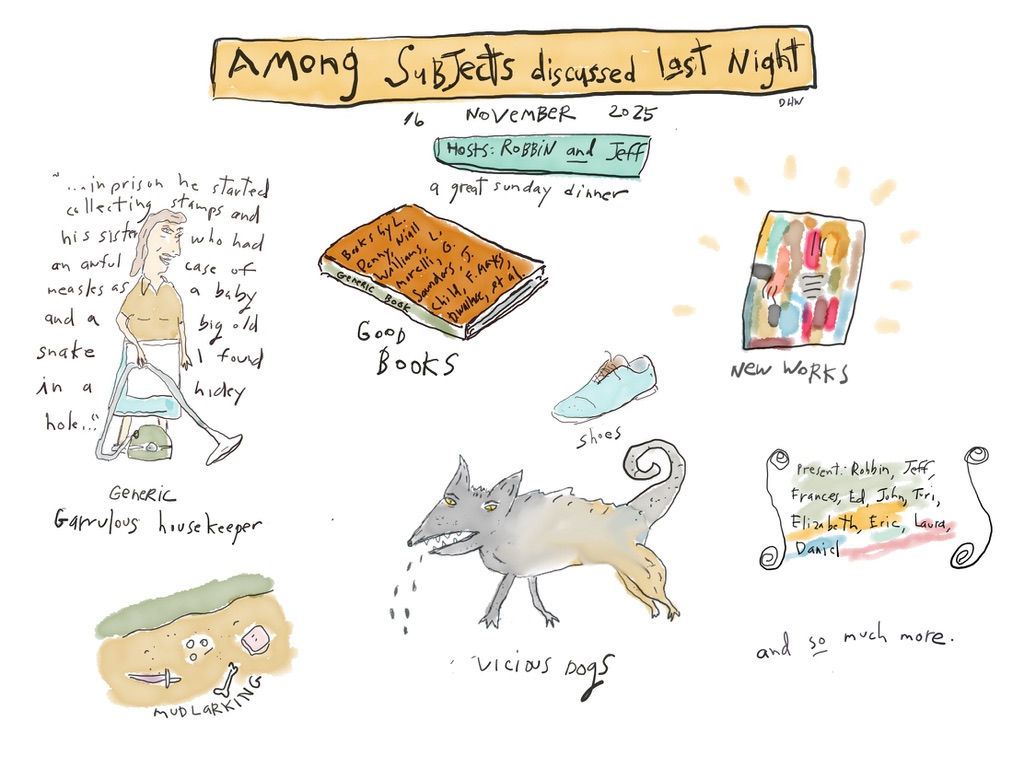
Members of this convocation employed the same housekeeper. She was a well-known palaverer, and, as she knew the dirty secrets of so many, appeared to be in a position of great power. Book talk: I had never heard of Louise Penny and felt left out. Why didn’t I know of this writer who turned out to be quite good? A rare moment, men talking about shoes. Mudlarking—Laura’s dream pastime. Art, dogs—what else is there?
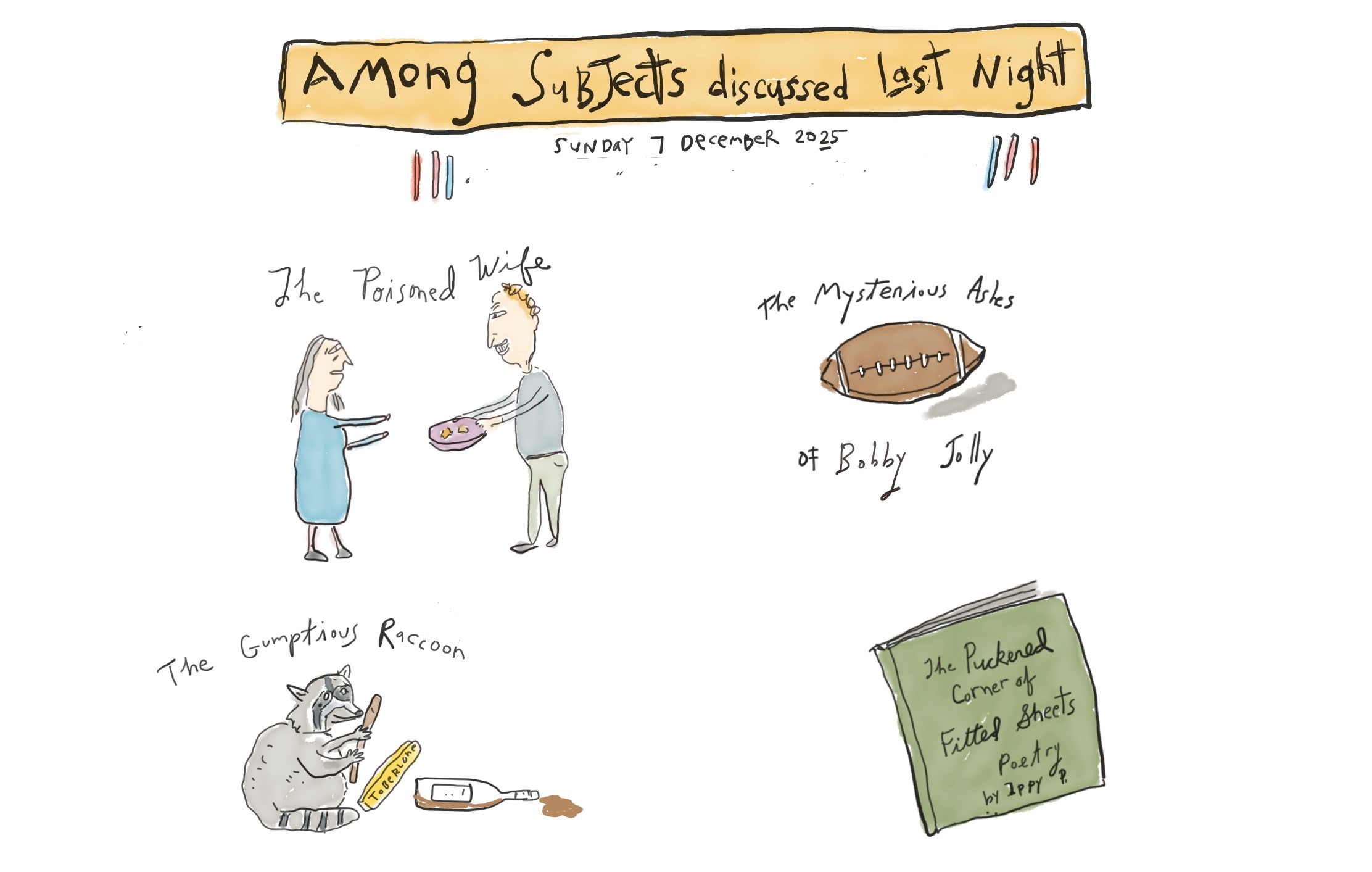
Too much to go into here. The story of “The Poisoned Wife,” “The Gumptious Raccoon,” of “Bobby Jolly’s Ashes,” and “The Puckered Corner of Fitted Sheets”—one of the best story-laden nights of the season.
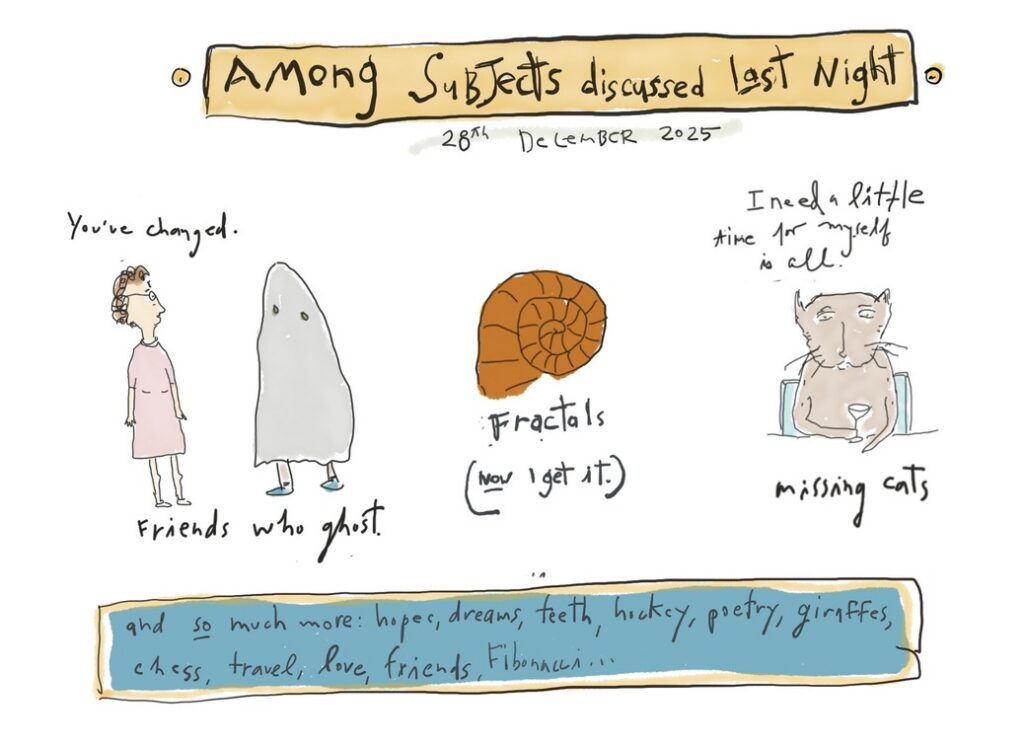
Sad, being ghosted by old friends. It happens, had happened in one way or another to everyone present. Fractals came up, as they will, and I pretended to understand them (I don’t). Where does our cat go at night? Still a mystery.
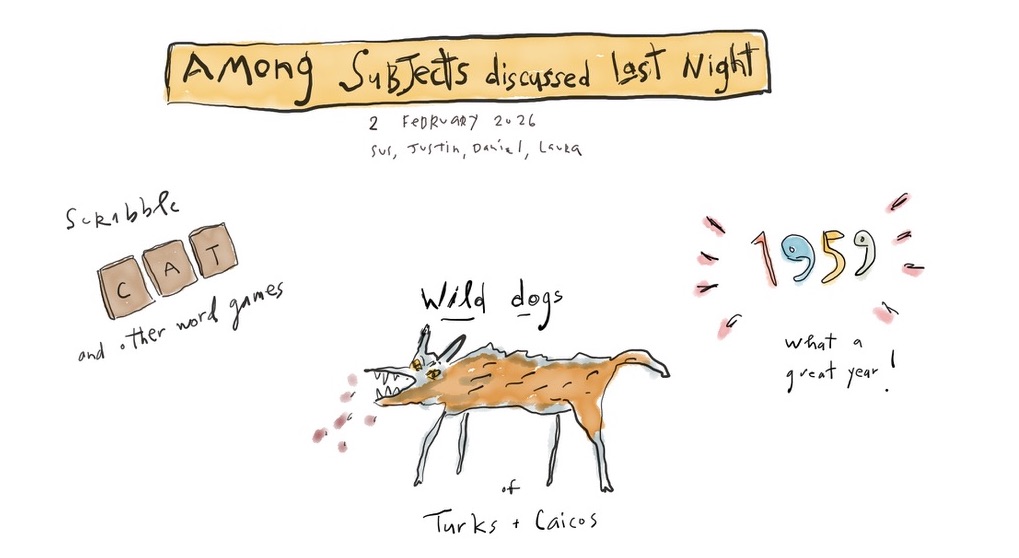
The Wild Dogs of Turks and Caicos are known as “potcakes,” named for the leftover food stuck to the bottom of cooking pots historically used to feed them. They can be a scary bunch of dogs, and there are thousands of them. I never knew this until February 2nd, 2026.
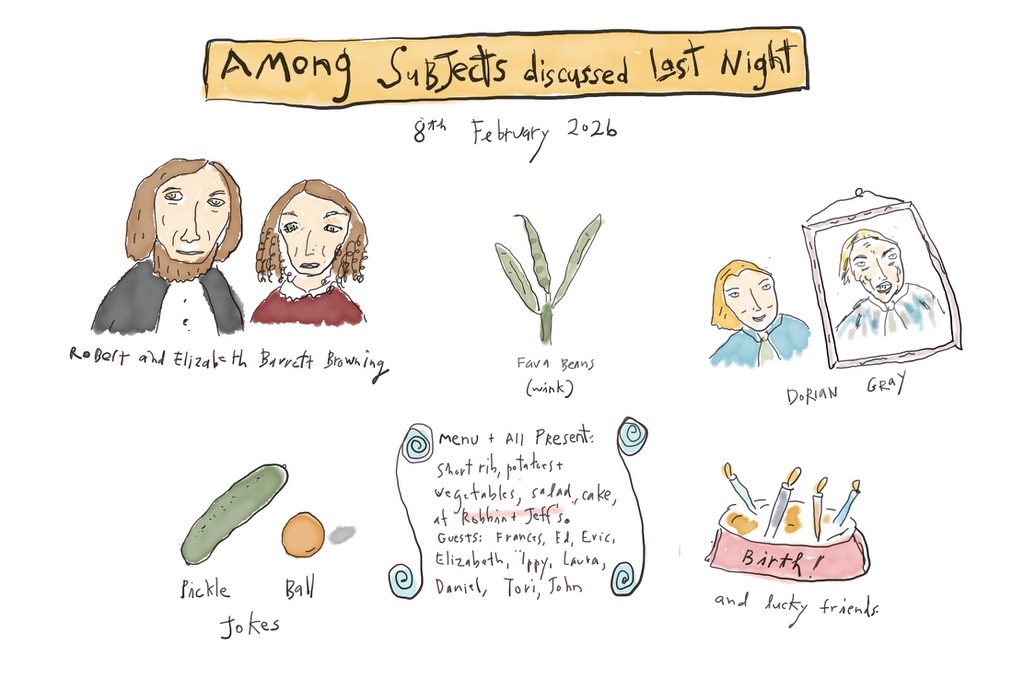
There is, we learned, a Robert and Elizabeth Barrett Browning Library and Museum at Baylor University. We talked about that. Dorian Gray compared and contrasted in the best possible way in reference to a mutual friend. Fava beans and figs, in Italian translation, as well as pickleball jokes, gave the evening a ribald flavor—and the word ribald itself: how is it pronounced? Still a mystery.
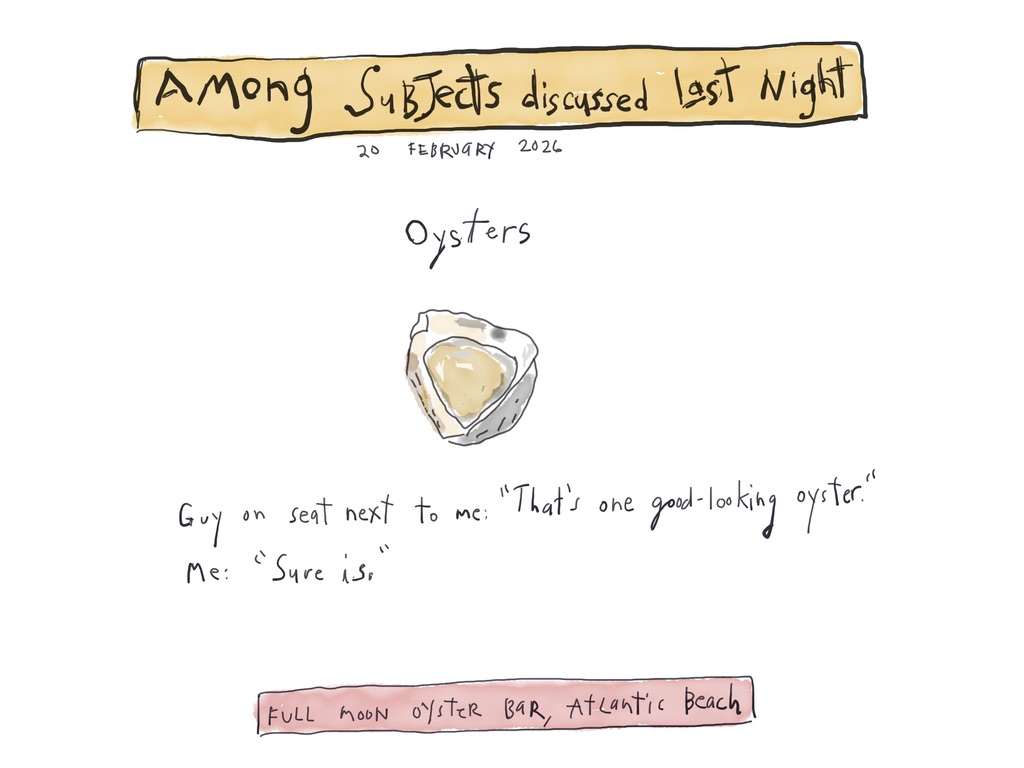
It was a beautiful oyster. Hailing from the Chesapeake Bay, the oyster had travelled fresh, live, and unshucked, flown in overnight in a carefully controlled temperature environment, cushioned with gel packs. The chances are pretty good that it was raised in a cage, and now here it was at an oyster bar in North Carolina. My first of the night—horseradish, cocktail sauce, a cracker, and one good-looking oyster.
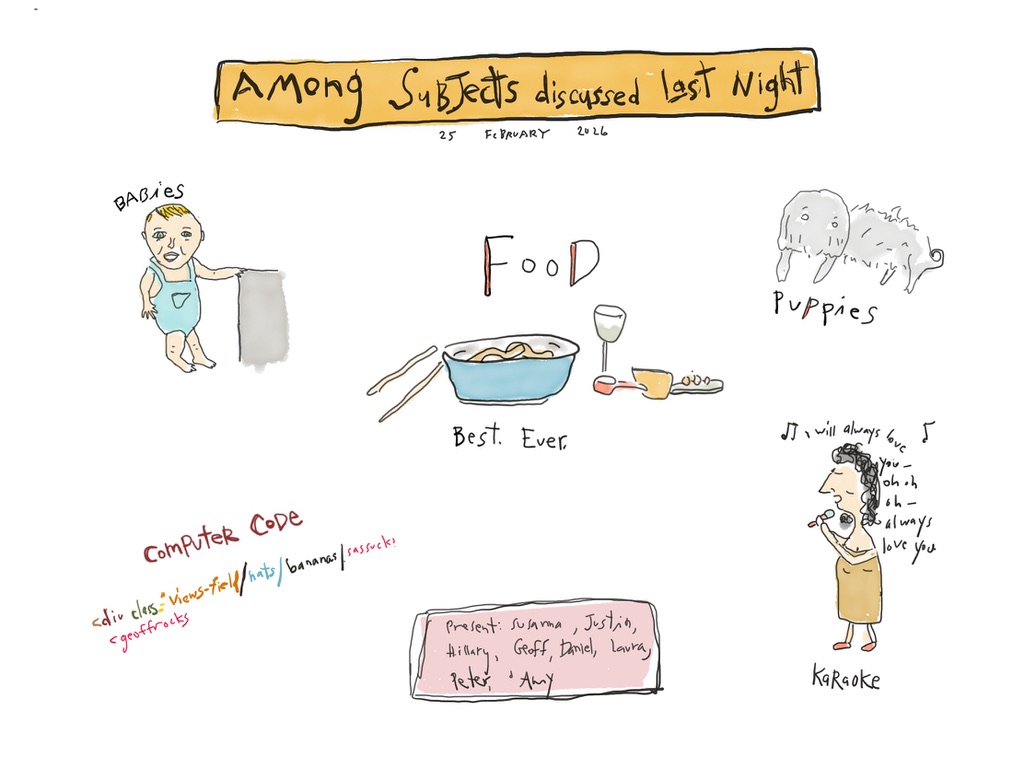
Wide-ranging convo. Babies, puppies, and karaoke. Computer coding came up, as it will, and I pretended to understand it (I don’t).
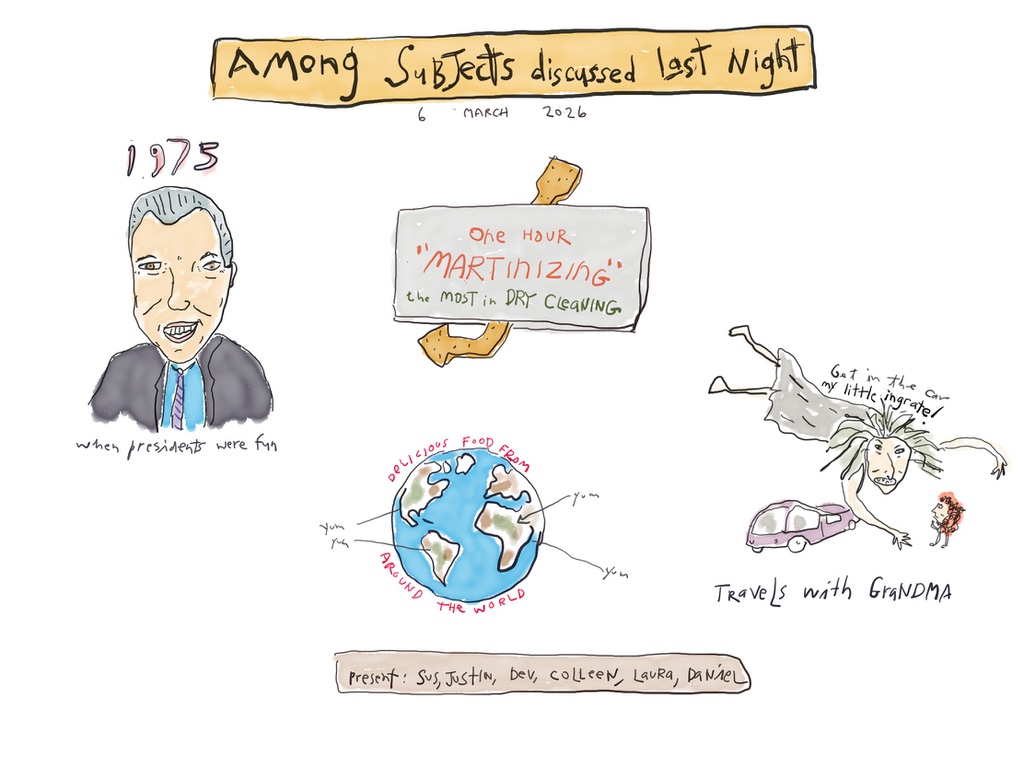
And you thought Nixon was bad! Joke’s on us. And “Martinizing”—what is that? It is the introduction, in 1949, of using nonflammable solvents in dry cleaning. Developed by a chemist, Henry Martin. “Fresh as a Flower in Just One Hour.” An amazing dinner (thanks, Sus!) and a harrowing tale of Laura’s European vacation with her grandmother.
Daniel Wallace is the author of six novels, a memoir, a coloring book (with his chosen second cousin, Emily Wallace) and, most recently, a collection of short stories, Beneath the Moon and Long Dead Stars. He directs the creative writing program at the University of North Carolina at Chapel Hill.