“Often what is hidden in Mitchell’s portraits of New York is a reflection of his life in North Carolina.”
One November day some years ago, at the midpoint of my obsession with legendary New Yorker writer Joseph Mitchell, I drove two hours south from Durham, North Carolina, where I was living at the time, to Fairmont, the little town in swamp country where Mitchell grew up. The roads off the highway ran for several miles along soybean fields and pine woods, abandoned farmhouses and country churches, until I arrived at Main Street—a quiet strip of low buildings, one of which had recently fallen, reduced to a pile of bricks in a vacant lot. A silence hovered over the shuttered storefronts, deserted streets, and derelict warehouses. I had come to see what Mitchell had seen, to understand how this place had shaped his vision, but the town he knew had long been lost, and there was little to suggest that one of the great writers of the twentieth century had been raised here. Bulldog Avenue, once home to a thriving tobacco market, was now a flat, empty field, and several headstones in a cemetery beside the First Baptist Church—where Mitchell used to find Easter eggs under dead leaves on his ancestors’ graves—had fallen face down in the grass. Doubtless I would have driven back in disappointment, having learned what Mitchell had already taught me—the past is irretrievable—had I not made plans to meet his nephew Joey, who lived in Fairmont and had become a kind of ambassador to travelers like me. “Every eight months or so,” Joey had told me on the phone, “someone calls about Uncle Joseph. You’re right on time.”1
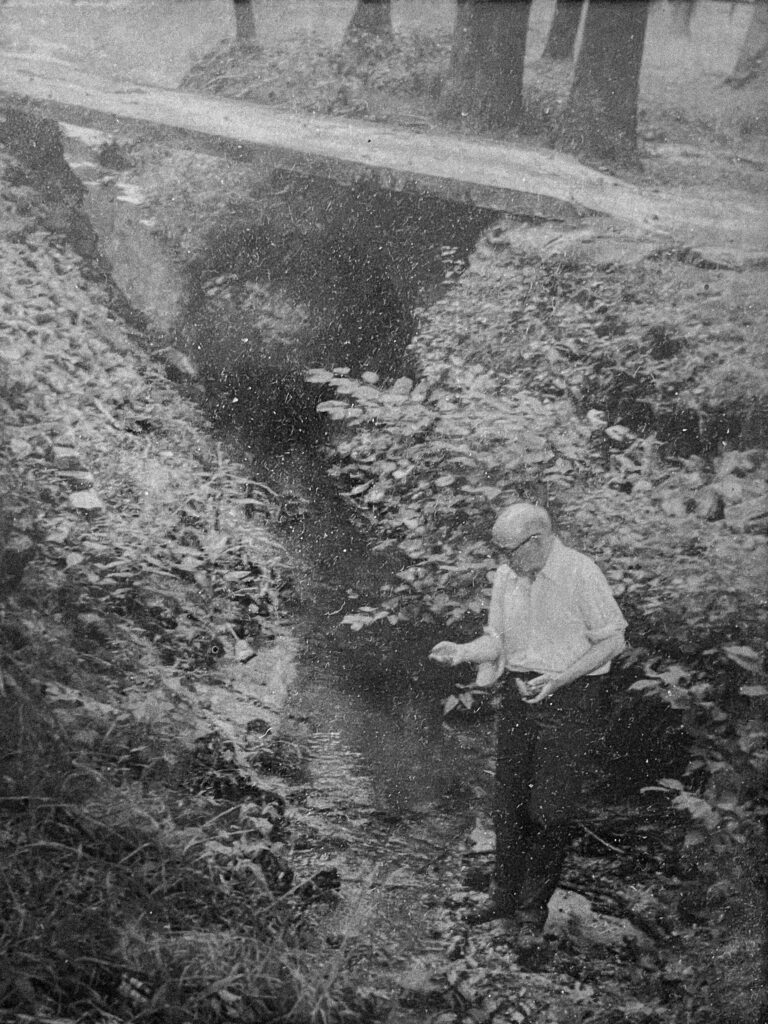
Like other readers before me, I had fallen under the spell of Mitchell’s prose: its incantatory rhythm, its unique blend of the elegiac and apocalyptic, its plain language that preserves the mystery of lives not his own. He was born in 1908 on his maternal grandmother’s farm near Fairmont, fled to New York in 1929 to be a reporter, and joined the New Yorker as a staff writer nine years later. From 1938 to 1964, Mitchell wrote some of the most revered profiles ever published in the magazine, portraits of ordinary people in disappearing worlds on the edges of the city. McSorley’s Old Ale House, whose owners are opposed to change; Mazie, the patron saint of the Bowery, who watches over the lonely and adrift from her ticket booth at the Venice Theatre; Joe Gould, the nocturnal wanderer in Greenwich Village, who claimed to be writing an oral history twelve times longer than the Bible. He wrote about saloon keepers and street preachers; the Caughnawagas, who built the city’s skyscrapers; and a ninety-three-year-old “seafoodetarian” who hopes his specialized diet will allow him to live twenty more years. From 1944 to 1959, Mitchell wrote six stories about the New York City waterfronts and the people connected to them. These stories are descents—down to the Fulton Fish Market on the East River, down to the Sandy Ground cemetery on the South Shore of Staten Island, down to the mysterious, muddy bottom of New York Harbor.2
Each piece went deeper than the last, until, after publishing his last profile in 1964, his byline stopped appearing, and his life became something of a question mark. For thirty-one years and six months, the story goes, he went to his office on West Forty-Third Street almost every day, worked behind his closed door, and never submitted another piece. Some said his standard rose to impossible heights; others thought some great personal sadness had sunk him into silence. “I suspect he made a religion out of literature,” wrote his friend, the novelist William Maxwell. “Writing—the art and practice of writing—didn’t with him take second place to anything.”3
When I came across Up in the Old Hotel, Mitchell’s omnibus of pieces originally published in the New Yorker, I had recently finished three years of theological studies, looking for something I wasn’t finding, and Mitchell struck me as an obsessed seeker in the city. I wanted to know what meaning, if any, he found, so I took a train eleven hours north to the New York Public Library, entered the Brooke Astor Russell Reading Room and dove into the Joseph Mitchell papers—one hundred and twenty-five boxes of the writer’s odds and ends and scraps and crumbs and bits and pieces, as Mitchell noted—and followed whatever caught my eye. There are boxes filled with reporting notes from his New Yorker profiles, boxes of unfinished work labeled “Autobiography Fragments,” drafts of letters and inscriptions, and thousands upon thousands of meticulous daily diary notes, which document his back-and-forth path between New York and North Carolina, longing for one place when he was in the other. Every now and then, when he was in North Carolina, he would write a letter to a friend in New York from his family home—the old, moldy, asthmatic, memory-ridden house in which I grew up and in which I stay when I am down here. More often, he would write in his notes. His New York City jottings are handwritten on loose pages, often folded three times to fit the size of his pocket; his North Carolina diaries are typed and often edited with pen, neatly organized with a folder for each trip. Whatever meaning Mitchell sought, I was convinced some trace of it was in those daily notes, which rescue observed detail or overheard anecdotes that would otherwise have been lost to time. In one entry from 1976, after overhearing two policemen at a diner in Fayetteville discuss a shooting, Mitchell writes: My only interest in the matter was the possibility that one or the other of them might say something worth putting in my notes. I’m afraid it often isn’t the matter itself that interests me even slightly, it is what is said about it. I am always hoping I will hear a vivid or peculiarly accurate remark. Another diary note, from the fall of 1968, lists what he saw while looking for potsherds in the fields near his home: ant hills, brick bats, pieces of glass and crockery, the seed heads of weeds, sandspurs, bird feathers, and bones. How often it has happened, right at the last moment, the best thing I have found all day turns up.4
By the time I visited Fairmont on that day in November, I had been studying Mitchell’s archive and traveling in his footsteps for three years, and I had begun work on a book. I was learning how to write it by listening to the people who were important to him, many of whom urged me to visit Mitchell’s hometown. I first made the trip to see his grave at Floyd Memorial Cemetery, a mowed lawn of newer graves on the northern edge of town, nothing like the old overgrown graveyards he wrote about. But it bordered an ancient-looking swamp, which exerted a strange pull on me. Once he was old enough to walk around by himself, Mitchell spent as much time as he could getting lost in the swamp, sometimes coming home only for meals. One day, deep in the woods, he watched for an hour or so as a pileated woodpecker vigorously tore the bark off a tree, and he considered this (in one of the last pieces he wrote) the most remarkable thing he had ever witnessed. If I had any chance of glimpsing what Mitchell saw, I would need someone to guide me. Eventually, I came across entries in Mitchell’s notes that mentioned Joey. Joey had lived in a cabin by a pond in the woods for more than thirty years, he told me on the phone, and he goes into the swamp every day. “I don’t see the land as separate from me,” he said. “I know every blade of grass.”5
I was in the mood for Joey’s mystical side. November days in Fairmont were once equaled only by Siberia, Mitchell wrote in his notes, but the day of my trip was one of those brilliant fall days, on the cusp of winter, when everything looks gold. “They say the quality of light in this part of the country has the same quality of light as in Paris,” Joey said, as I greeted him in the front yard of his home, a modest brick ranch-style house a mile or so outside of town. He was tall and slightly stooped, with a white wisp of hair, and he was casually dressed in an untucked white polo and jeans. He walked with his hands in his pockets, and I noticed he was wearing a watch with the same red-and-blue-striped nylon strap Mitchell sometimes wore. “Did you see the building that fell?” Joey asked, as he guided me through the front door and into his living room. “It just fell, I guess. Overnight. It used to be a clothing store. They rented the first floor from my grandfather, Uncle Joseph’s father, A. N. Mitchell, who owned the building. A. N. was a farmer—his first suit was made of homegrown wool—who went into the cotton business. He bought cotton from the farmers, straight from the gin, and then shipped it down to Charleston, South Carolina, and Wilmington, North Carolina, and Norfolk, Virginia. Cotton was everything in those years.” Then the boll weevil came, Mitchell once said in an interview, and tobacco, which had been a minor crop but an important one, became the important crop. A. N. was known as the sharpest buyer in town, and with the money he earned he bought property and land, accumulating some five thousand acres and multiple warehouses in town. “There’s a small brick structure on Main Street, I’m sure you saw it,” said Joey. “That’s the office my grandfather used for the family business, and it was the office of my father, Harry, and Uncle Jack, Joseph’s brothers. The brass sign by the door says A. N. MITCHELL & SONS.”6
In Joey’s living room, framed paintings hung above tables of freshly picked flowers. Beside his chair, on a small wooden table, was a cutting of wild ginger in a glass jar, and next to it was a bouquet of zinnias from the garden. Next to the bouquet was a picture of Joey’s father holding zinnias, then a picture of A. N. Mitchell holding a similar bouquet. By the couch, where I sat, was a stack of back issues of the Times Literary Supplement, which brought to mind a 1982 letter Mitchell wrote to a friend during one of his trips home, in which he mentions having packed a copy of the magazine. You can’t imagine how strange a TLS looks in a bedroom in Fairmont, NC, Mitchell wrote. Let alone a stack in a living room. But the more I looked around, the more the bookish magazine seemed right at home among Joey’s things. His bookcases were packed; on the coffee table were books on photographers and artists; and above the mantle hung a large framed print of a Jackson Pollack painting. Joey looked up at it from his chair. “I wanted to know why those paintings were so famous,” he said. “Suspecting nonsense, I went to MoMA on one of my visits to New York and looked for them, starting with Pollack’s early work, going room to room, and when I arrived in the last room, dwarfed by those monumental canvases, I was overwhelmed. I had to leave the museum and go on a long walk to quell my astonishment.”7
He squinted at me in a near-smile. “What is it you would like to know about Uncle Joseph?” I told him I was hoping to understand what Fairmont meant to him, how it shaped the way he looked at the world, and how it influenced his writing. “There’s a generosity and economy in his prose that I’ve only seen in a few other writers,” Joey said. “He was interested in everything. There was an obsessive-compulsive aspect to him. You can hear it in the writing. He wanted to understand things, but sometimes he wished he could turn it off. And speaking of Pollack, I was thinking the other day about Abstract Expressionism, when they moved out of form, stepped completely out of form, into color fields and things. Maybe that’s what my uncle was trying to do in his own way. Maybe he was trying to convey emotion beyond form.”
The New York abstract expressionists sought a truth that lies not on the concrete, visible surface of things but in the silent, invisible world below. Mitchell’s profiles, too, reach for deep-down hidden truths that can only be revealed indirectly. Understatement is not the quality of what goes unsaid, Mitchell once wrote in his notes, but what is nevertheless there, between the lines.8
Often what is hidden in Mitchell’s portraits of New York is a reflection of his life in North Carolina. “When I read his descriptions of the Fulton Fish Market—the stands and sheds heaped high with fish, the racket the fishmongers make, the look of abundance—I see the Fairmont tobacco and cotton markets he knew as a child,” said Joey, “and whenever I return to his profile of Mr. Hunter on the rural South Shore of Staten Island—with its fields and swamps and weedy cemeteries, its steepled churches and southern frame dwellings on wooded back roads—I see the countryside he explored all his life. Janet Malcolm called him the master writer of the city; he called himself a wildflower hunter, a swamp fisherman, an admirer of great-horned owls and red-tailed hawks. He was shy, and shy children like to observe and listen. Everything was alive then. The old tenant farmers quoted from Leviticus before butchering cows and told stories about the stars and the moon.” Like Mitchell’s mother and aunts telling him stories in the graveyard, I said. He heard their voices whenever he read the Anna Livia Plurabelle section of Finnegans Wake.9
“It was a known fact that he loved Joyce,” Joey said. “I would ask him, ‘So you’ve read Finnegans Wake?’ And he’d go off somewhere on a digression and never really answer the question. I tried to read those books, but I couldn’t make sense of them. I guess you have to have read everything else—Homer, the Bible, Shakespeare—then come back to it. Uncle Joseph didn’t talk much about writing; it was just a given, that’s what he did—he was a writer in New York. But no one here ever really mentioned it, except for a man here named Cecil Ashley.” Cecil came from an old family there, but he was an eccentric, the kind of fellow who wears Western hats and boots, Mitchell once said in an interview. He’d been in all different kinds of work but he mostly hung around on the street. He was a sign painter who hung around the post office or the grocery store. “One time, North Carolina State gave Uncle Joseph this medal for literature,” said Joey, “and they had it in the Fayetteville Observer. I met Cecil one day and he said to me, ‘Hey, Joey, I was amazed to read they gave your Uncle Joe a gold medal for literature. I thought he was just some half-assed newspaper reporter.’ Uncle Joseph thought that was wonderful. Of course, that’s what I was, a half-assed newspaper reporter, he said. But maybe I changed a little. He absolutely did. I think my uncle did something important. He conveyed what it is to be a human being. And I guess because of my name I’ve always felt close to Uncle Joseph,” Joey continued. “I remember asking my father, ‘Was I named after Joseph Mitchell?’ He looked surprised. ‘It never came up,’ he said. ‘You were named after your great-grandfather, Joseph Parker.’ Anyway, when I first read Uncle Joseph’s stories, many years ago, I couldn’t understand them, all that detail. But I kept returning to them, and one day they opened up to me, their amazing force of life, and they lifted me. Now, whenever I get the blues, I read his stories like a tonic.”10
Joey got up from his chair—he’d been sitting long enough—and led me to the garage. “You wanted to see the swamp?” he asked, as we got into his white SUV and pulled out of his driveway, into the sun. After making a few turns, he stopped at Mitchell’s family home on Church Street, which runs parallel with Main. “We own a right good part of Church Street,” said Joey. Two houses sat side by side, one of white siding, the other brick. “These two homes were identical when my grandfather built them around the time Uncle Joseph was born. Each house was one story, with six rooms and a porch running around three sides, and the siding was painted white with green trim. Later, a second story was added to the house Mitchell grew up in, the façade was redone in brick, and the roof got new shingles.” It had been improved beyond recognition, but the porches were still there. I could imagine Mitchell as a child sitting on the front porch with his grandmother, talking about the funerals with horse-drawn hearses that processed down Church Street, or as an older man sitting on the back porch in silence with his father, looking out at the pasture, feeling not altogether at ease with him.
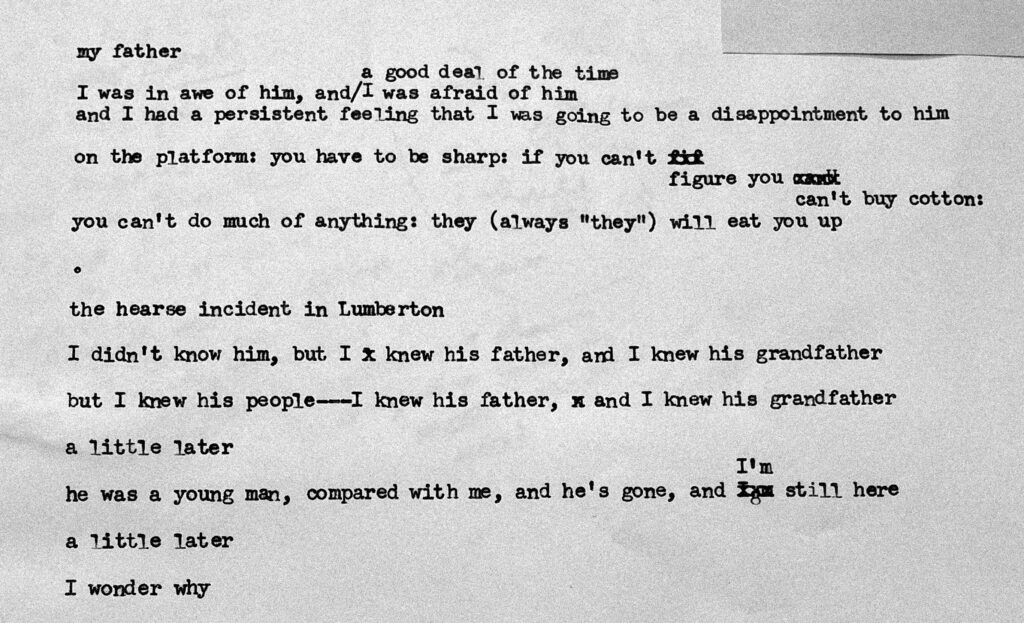
Mitchell was in awe of his father. I was afraid of him, and I had a persistent feeling that I was going to be a disappointment to him, he wrote in his notes. But Mitchell couldn’t figure. When it came to multiplication, he froze, and it troubled his father. If his son couldn’t learn arithmetic, how would he get a job that would amount to anything? They (always “they”) would eat him up. I couldn’t run the warehouse, couldn’t be a doctor, Mitchell wrote. I was a failure before I started. The future was awful to think about. And so was the afterlife. His mother, Elizabeth Parker Mitchell, was a Presbyterian who went to church alone; Mitchell went to First Baptist church with his father and his five siblings—Jack, Harry, Elizabeth, Laura, and Linda—where the subject was always hell. Hell made a stronger impression on Mitchell than it did his brothers and sisters. The vivid images of eternal punishment gave him nightmares of hell that recurred all his life, and not a metaphorical or analogical hell but a bubbling blue-green fire and brimstone hell. “I’m worried about the boy,” he once overheard his grandmother say to his mother. “He’s got hell on his mind, and he broods about it.”11
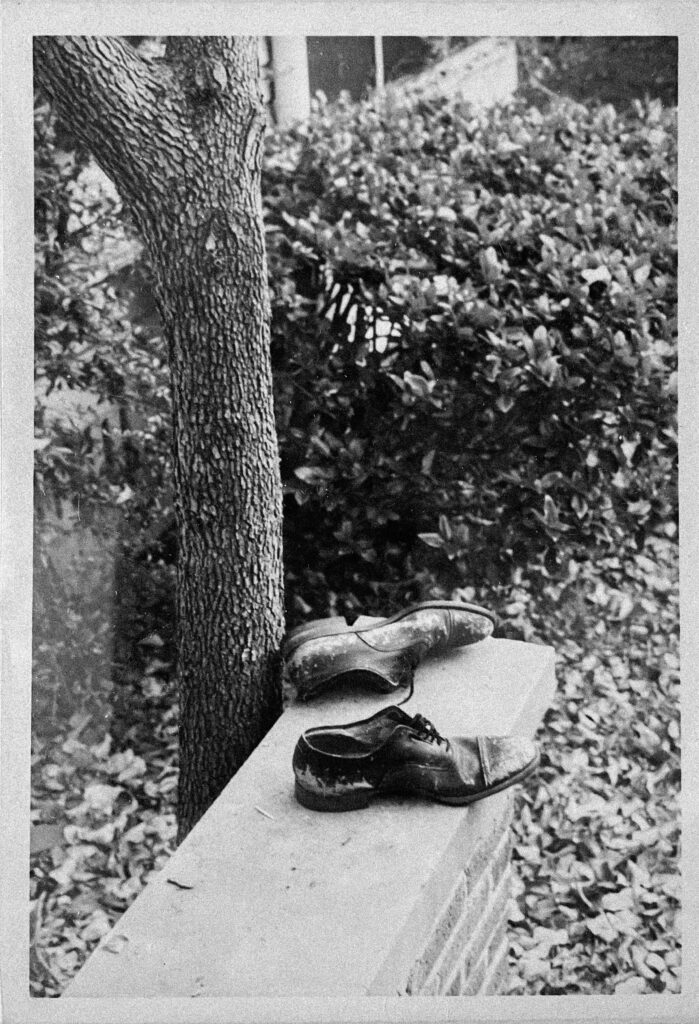
In his 1949 New Yorker piece, “The Bottom of the Harbor,” Mitchell describes the surface of New York Harbor as a kind of hell—the water seethes and spits—while its depths contain considerable life. “Under the paths of liners and tankers and ferries and tugs, fish school and oysters spawn and lobsters nest. There are clams on the sludgy bottom, and mussels and mud shrimp and conchs and crabs and sea worms and sea plants.” At the end of the piece, Mitchell listens to one Leroy Poole, a harbor nut who’s got “the harbor on the brain,” describe his own nightmare. “In this dream,” said Poole, “a great earthquake had shook the world and had upset the sea level, and New York Harbor had been drained as dry as a bathtub when the plug is pulled. I was down on the bottom, poking around, looking things over. There were hundreds of ships of all kinds lying on their sides in the mud, and among them were some wormy old wrecks that went down long years ago, and there were rusty anchors down there and dunnage and driftwood and old hawsers and tugboat bumpers and baling wire and tin cans and bottles and stranded eels and a skeleton standing waist-deep in a barrel of cement that the barrel had rotted off of. The rats had left the piers and were down on the bottom, eating the eels, and the gulls were flopping about, jerking eels away from the rats. I came across an old wooden wreck all grown over with seaweed, an old, old Dutch wreck. She had a hole in her, and I pulled the seaweed away and looked in and I saw some chests in there that had money spilling out of them, and I tried my best to crawl in. The dreams was so strong that I crawled up under the headboard of the bed, trying to get my hands on the Dutch money, and I damn near scraped an ear off.”12
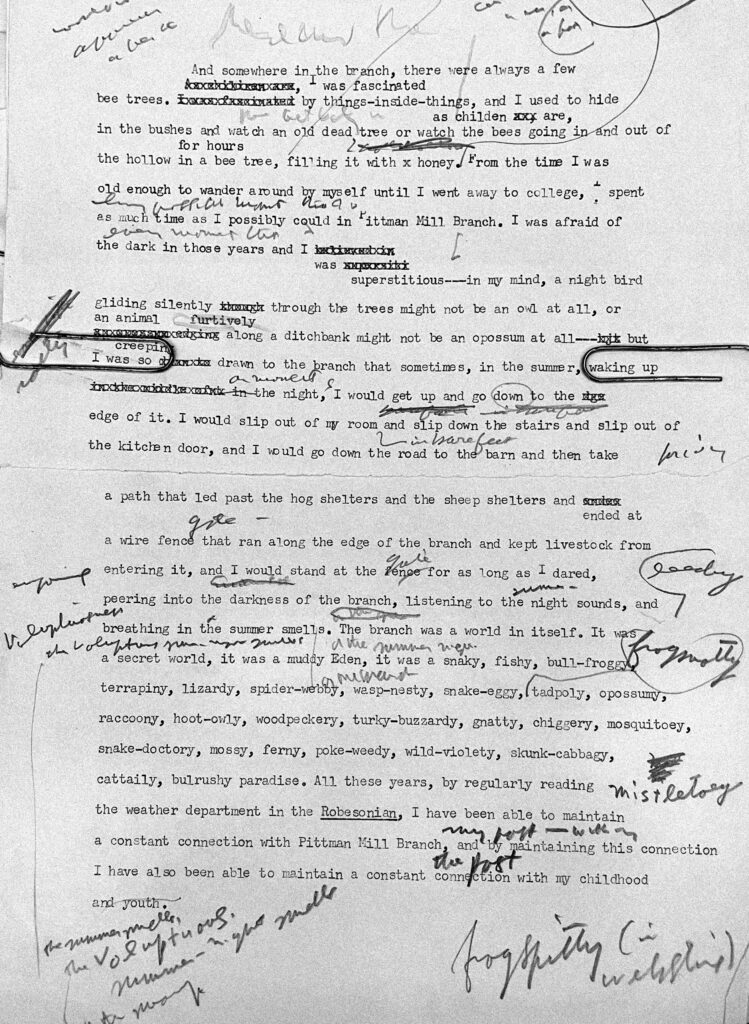
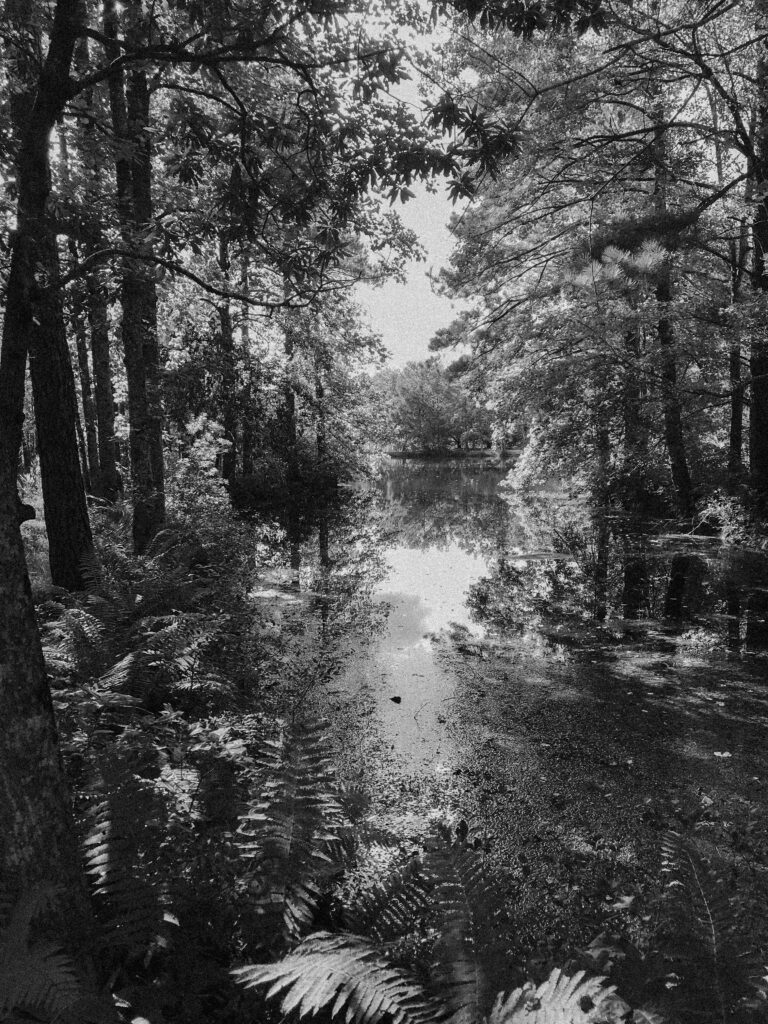
In Mitchell’s recurring dream, he is fishing in the swamp when the water bubbles, mud becoming lava, and Mitchell runs. He tries to escape by diving into a briar patch, then wakes up with his heart in his mouth. To escape his tormented thoughts, he would go into the pasture behind his family home, where he found not hell but the world in all its fascinating and enigmatic detail. I would consciously open all my senses, Mitchell wrote, and let as much as I could sense enter in. “Behind the pasture runs Pittman Mill Branch, a tributary of Old Field Swamp,” said Joey. Mitchell felt so drawn to the branch that sometimes, in the summer, waking up at night, he wrote, I would slip out of my room and slip down the stairs and slip out of the kitchen door, and I would go down the road to the barn and then take a path that led past the hog shelters and the sheep shelters and ended at a wire fence gate that ran along the edge of the branch and kept livestock from entering it, and I would stand at the gate for as long as I dared, peering into the darkness of the branch, listening to the night sounds, and breathing in the summer smells, and looking. When I was a child, the branch was not only lovely; it was primeval, he continued in another note. The stream ran in the same bed it had run in for a thousand years, or ten thousand, and along the banks of the stream and out in the bottoms were giant trees—virgin cypresses and virgin black-gums and virgin tulip-poplars. And in among these old live trees were a good many old dead trees in the holes and hollows of which several kinds of birds and animals had their nests and dens. I was fascinated by things-inside-things and by liveness-inside-deadness, as many children are, and I used to hide in the bushes for hours and keep a watch on an old dead tree, hoping to see a raccoon come out of it with her young. The swamp was his secret world, his sacred grove, his muddy, snaky, fishy Eden, surrounded by woods and fields.13
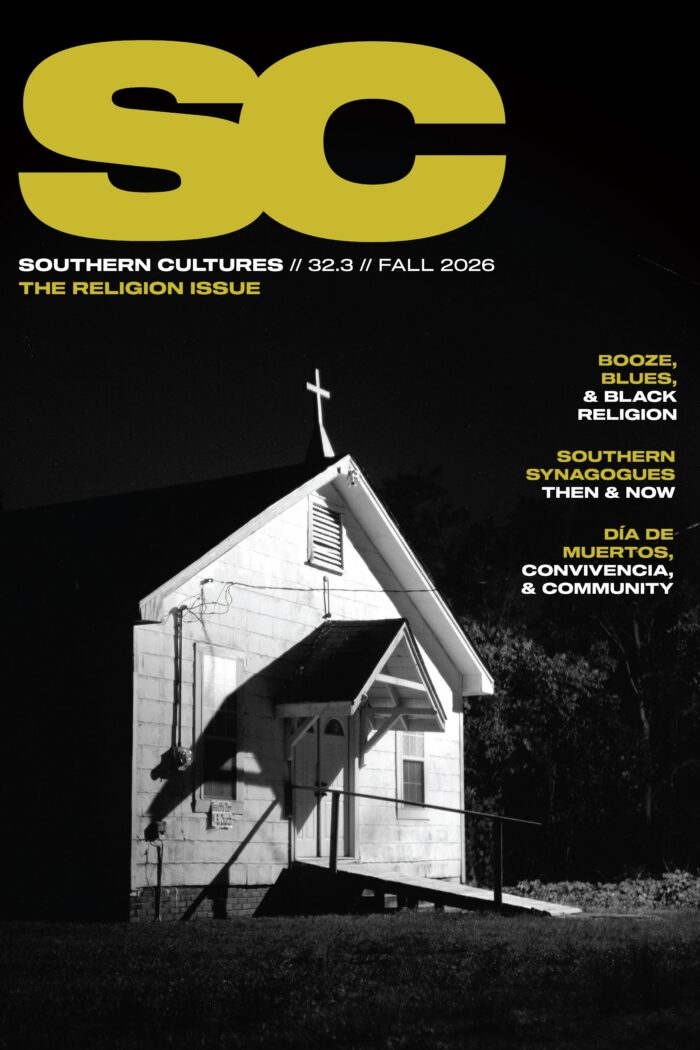
From the house, Joey drove us along country roads, passing field after field of soybeans. “Once the tobacco industry declined and fell,” he said, “southern farmers tried to farm corn to compete with the Midwestern farmers, but we couldn’t, so we started to farm soybeans.” During Mitchell’s time at the New Yorker, I told Joey, someone wrote a piece about soybeans. There was information in the story, but there weren’t any soybeans in there, Mitchell once said about the piece in an interview. But how does one put a soybean in a sentence? I asked Joey. “By stepping outside of form!” he said. Then he pointed to a small country church just off the road, bordered on three sides by woods. “When he was a boy, Uncle Joseph would come out here on a wagon to these woods. This was a cedar forest back then, and the farmers would cut planks from the bark that were used in the processing of tobacco. Uncle Joseph would sit in the wagon as it went up this road, and far away, he would begin to hear singing from that church. Loud, rapturous singing. It must have been a tent meeting. And he would hear the singing getting louder and louder as the wagon approached, and when they passed the church, it was as if the wagon passed through a wall of sound. For an instant, he was inside of it. It’s like in a Eudora Welty story, when the characters watch a storm come in. They anticipate it, then go through it—through a wild, pouring-down rain, a kind of rain that people around home call a stump-mover—and watch it fade into the distance.”14
Joey slowed to a stop by a row of towering magnolia trees. In front of us was a makeshift metal gate attached to brick posts on either side. We had reached the entrance of the swamp.
“When Uncle Joseph was older, I would drive him to this entrance,” Joey said, “and when I picked him up in the afternoon, his pockets would be filled with found objects. I remember a blue feather he put in a jar. He saw something it took me a long time to understand.” The significant in the insignificant, the unusual in the usual, the magic in the commonplace, I thought, as Joey and I walked between a row of live oaks that Joey’s father Harry had planted. A. N. Mitchell bought this plot of land for $400, and Harry took care of it. “I think he would have said he felt guided to work the land. He felt it physically nourished him, and Uncle Joseph felt that way, too,” said Joey. “For a long time, we called this land the Hog Swamp Place, but my father, who died a few years ago, didn’t like the name Hog Swamp Place, so I renamed it Bethesda Road, a place of healing.” We walked through a field of pines, until we arrived at a small pond.15
The water was glassy and dark. “The roots of cypress trees turn the water that color,” he said. “People around here call it rooty-water.” I am drawn to certain old trees in the swamps and branches of eastern North Carolina, and I am strongly drawn to the bald cypress, Mitchell wrote. One reason is that it is tall and straight; it often goes straight up a hundred feet. It has lovely feathery ferny pale-green needles. Its upper limbs are often festooned with Spanish moss. It sends its roots deep in the mud and the base of its trunk is usually surrounded by water, and some fish—they are called root-knockers—like to nest and feed around its trunks. It gets to be very old; trees over a thousand years old are not rare. A live oak’s limbs bent down toward the pond. “When the live oaks drop acorns into the water,” Joey said, “hundreds of ducks come to feed here. They talk to each other in high-pitched voices, like children, and sometimes I like to listen from behind the trees, trying not to be noticed.” Beside the pond was a white wildflower his father and uncles used to find, which reminded Joey of a flower he wanted to show me, and he set off into the woods. I walked behind him. The trees got denser and the path narrower, until it seemed to disappear, and I simply put my feet in Joey’s shoe marks, following him until he stopped.16
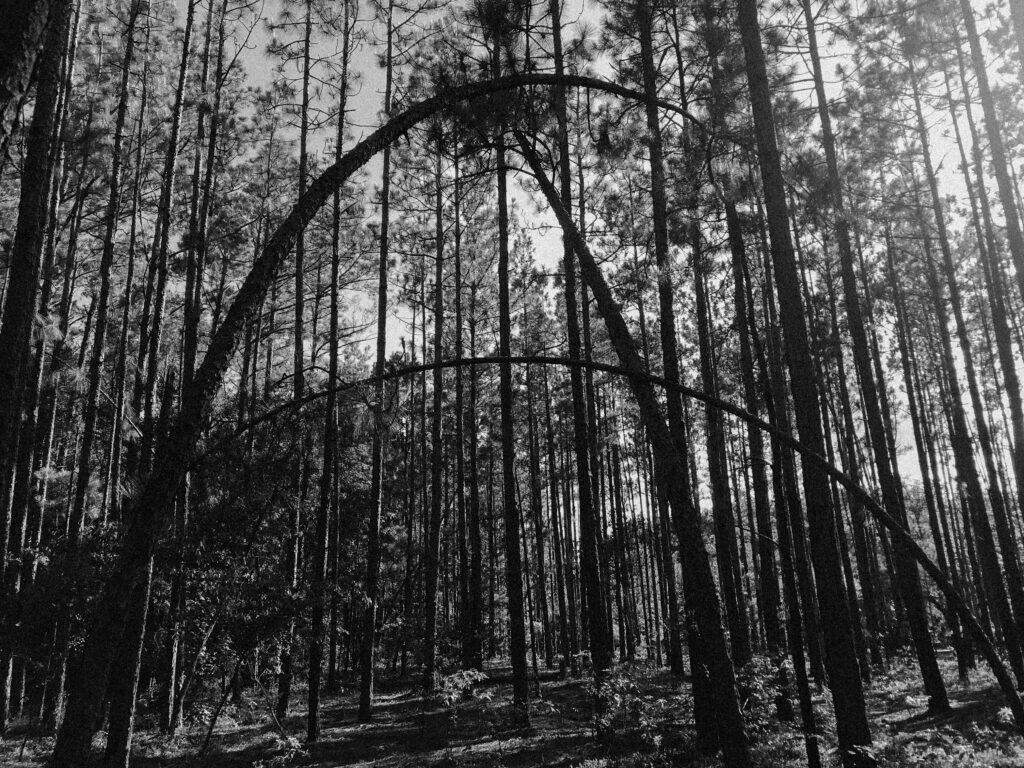
He was looking at a pile of dead leaves. There were various shades of brown, and I tried to see their gradations the way Mitchell might: broom-straw brown, oak-leaf brown, soybean brown, cornfield brown, and dog fennel brown. Joey lifted the leaves to reveal a small, blue, bottle-shaped bloom almost exactly matching the color of the sky. The flower and stem were only a few inches tall, and its petals opened up and out to show tiny yellow filaments inside. “It’s a fringed gentian,” Joey said. “It’s hard to get that blue in the garden. I found it here the other day and remembered a poem to the fringed gentian by William Cullen Bryant. ‘Blue-blue as if the sky let fall / a flower from its cerulean wall.'”17
We walked deeper into the woods, crossing a short wooden bridge his father built, until we arrived in a muddy, snaky, fishy grove. This was the oldest swamp in the woods. Up from the water grew the tallest cypress trees I’d ever seen. “My father used to say they go back to the time of Christ,” Joey said. Spanish moss drooped from their branches, and wiry bushes grew around their trunks, hiding much of the murky, still surface of the water. Was this Mitchell’s secret world, his sacred grove? He once told the famous literary critic Kenneth Burke that when he worked on a story about a person or place in the city, he was trying to find something more than a distillation or compendium of facts. He asked Burke if he believed there might be an enigmatic presence, something ineffable, hovering above old graveyards or below harbor waters, some trace of which he could conjure in his prose. (“These are the questions a poet asks,” said Burke.)18
I stood a long time, looking at the water, feeling at ease with not knowing what lies beneath its surface. Joey, standing beside me, registered my calm. Afternoon light slanted through the trees. “Every cell in your body will change,” he said, “but you will always remember that light. Change is constant, and everything is connected.” That’s what I had come to Fairmont to learn. Mitchell wanted to understand the root of things—”why we’re put here, why we’re taken away,” as one of Mitchell’s subjects puts it—but sometimes he wished he could stop his restless search. Maybe that’s why he came here. Maybe it offered him a place where he could quiet his thoughts and sense, even for a moment, some unutterable whole to which everything is joined: the past to the present, life to death, even Fairmont to New York City. “Uncle Joseph could stand here and follow the water in his mind’s eye all the way back to New York,” Joey said.
Hog Swamp runs into Ashpole Swamp and Ashpole Swamp runs into the Lumber River and the Lumber River runs into Little Pee Dee River and the Little Pee Dee River runs into the Big Pee Dee River and the Big Pee Dee River runs into the Waccamaw River and the Waccamaw River runs into Winyah Bay and Winyah Bay runs into the Atlantic Ocean, which runs into New York Harbor. “At the New York Public Library,” I said, “Mitchell’s notes are stored in a vault below Bryant Park, which takes its name from the poet who wrote to the fringed gentian. And below the vault is a subway tunnel, which features a mosaic of tiles that includes a quote from the Anna Livia Plurabelle section of Finnegans Wake, an echo of the voices of Mitchell’s mother and his aunts. The connections go all the way down.”19
“They also go all the way back,” Joey said. Then he took two long steps to the edge of the dark water. “Supposedly there’s a fish in here with a lung-like pocket in its esophagus. I’ve been trying to find it for years and years. It might be the fish we all come from.”
Scott Schomburg’s work has appeared in the Paris Review, Harvard Review, Public Books, The Millions, Hyperallergic, and elsewhere. The recipient of a writing fellowship from the Virginia Center for the Creative Arts, he holds a Master of Divinity from Duke Divinity School. His first book, The Lost Years of Joseph Mitchell, is forthcoming from New York Review Books.
NOTES
- All quotes from Joey Mitchell come from interviews with the author in 2019.
- Joseph Mitchell, Up in the Old Hotel (Pantheon Books, 1992).
- William Maxwell, Introduction (1996), in Mitchell’s Joe Gould’s Secret (Vintage, 1999), xv. Joe Gould’s Secret was originally published in 1965, by Viking Press.
- Joseph Mitchell, undated note. The Joseph Mitchell papers, New York Public Library, Manuscripts & Archives Division, Box 71.1. (In subsequent references to the Joseph Mitchell papers, I abbreviate the citation as “Mitchell papers.”) Mitchell, from a letter to Marie Winn, dated December 3, 1982, Winn’s Mitchell file, courtesy of the Mitchell estate; Mitchell, diary note dated Saturday, April 10, 1976. Courtesy of the Mitchell Estate; Mitchell papers, Box 3.1; Box 6.6.
- Mitchell papers, Box 72.1; Joseph Mitchell, The Bottom of the Harbor (Modern Library, 1994), vi–vii.
- Mitchell papers, Box 3.6; Mitchell, transcript of interview with Norman Sims, dated October 14, 1988, Mitchell papers, Box 40.9.
- Mitchell, from a letter to Marie Winn, dated December 3, 1982, Winn’s Mitchell file, courtesy of the Mitchell estate.
- Mitchell papers, Box 114.1.
- Mitchell papers, Box 70.2.
- Mitchell papers, Box 40.9.
- Mitchell papers, Box 6.4; Box 80.1; Box 71.2.
- Mitchell, “The Bottom of the Harbor,” in Up in the Old Hotel, 485.
- Mitchell papers, Box 71.2; Box 9.3; Box 70.4.
- Mitchell papers, Box 40.9; Box 71.1.
- Mitchell papers, Box 78.
- Mitchell papers, Box 70.4.
- Mitchell papers, Box 5.9.
- Mitchell papers, Box 9.3; Box 40.9.
- Mitchell papers, Box 21.8.