I grew up in a place where being Jewish meant you noticed other religions before you fully understood your own. In Mississippi County, Arkansas, faith was not a private matter tucked away for Sunday mornings—it was the air everyone breathed. During grade school, my Christian friends were saved now and again. We visited Black churches for funerals. And evangelism was insistent and ever present, aimed squarely at a Jewish girl like me.
In a minority denomination in a landscape thick with other people’s certainties, that position—watching, comparing, translating—turned out to be my life’s education. Long before I began to study the Jewish South, I observed how religion organized a southern sense of who belonged and who was tolerated. The South has taught me that Judaism can be rural and small-town, that storytelling can substitute for Jewish doctrine, and that racial ambiguity is a lived condition.
That this issue on Religion is in Shari Rabin’s able hands inspires gratitude. As a distinguished scholar of religious history, Shari argues that the Jewish South is not a regional footnote but a place where religious life reveals both southern achievements and pathologies. In her seminal book, The Jewish South: An American History (2025), Rabin notes the privilege and vulnerability of Jewish southerners, and the challenging process of crafting a democracy as race trumped religion in determining one’s access to freedom. The Jewish story and the southern story entwine as Shari broadens our historical and cultural lens.
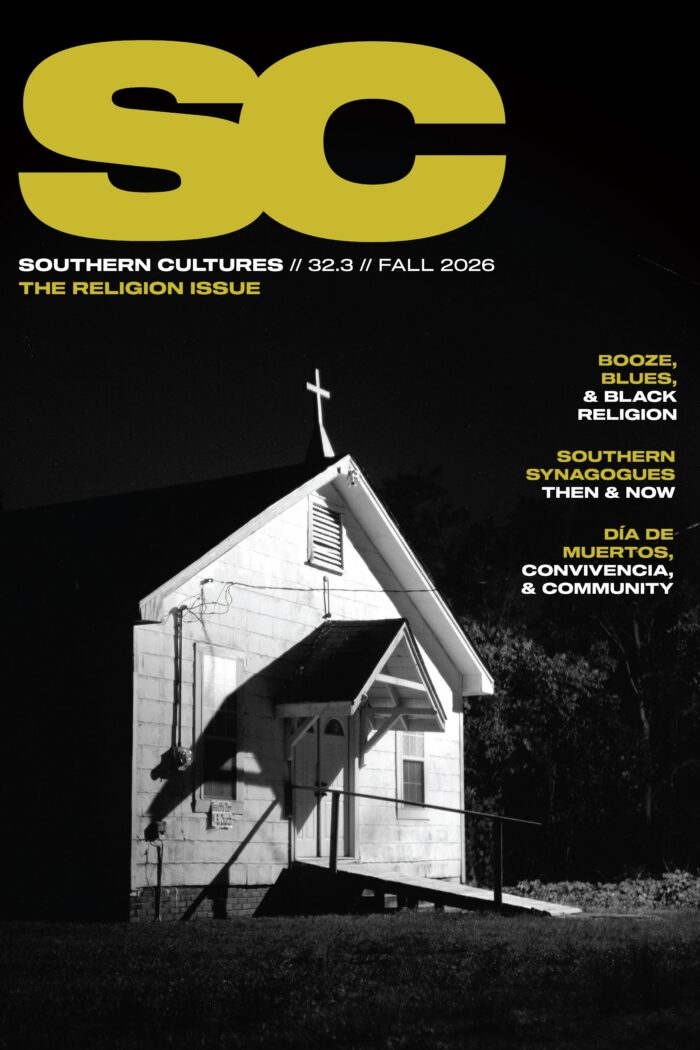
I predict Shari’s perceptive introduction will become an influential historical overview, including the prescient themes she identifies as shaping southern religion today—the sway of moral reasoning and its impact on southern politics and policy, the deep connection to “literal and symbolic ancestors,” religious diversity, and how appreciating the varied “texture” of southern religious life reinforces our mutual humanity. Read together, the essays in this issue make an argument I recognize: The South has never been religiously homogenous, however hard its self-image insists otherwise. Michaela Calahan’s essay traces Christians who join ICE alongside Christians who resist it, a single faith fractured over what faithfulness requires. Emily Williams’s photo essay explores the back roads of Texas, Louisiana, Mississippi, Alabama, and Georgia as she documents Jewish congregations, storefronts, and cemeteries at the “edges of the diaspora”—my own family’s worlds placed in another scholar’s insightful frame. In other essays, we look to New Orleans, where spiritual women work outside Catholicism; to Durham, North Carolina, where Día de Muertos redefines belonging in the Nuevo South; to juke joints, where alcohol and respectability blend together in Black religious life; and to FDR’s Georgia cottage, which has become a civil shrine. None of these experiences fit the mythology of a singular Protestant South. Instead, they reveal a region perpetually negotiating whose religious and spiritual identities are recognized.
This issue of Southern Cultures demonstrates that the region’s religious life is plural, contested, and unsettled—Christian and Jewish, Catholic and folk-Catholic, Black church and hoodoo and Rastafarian temple. The South is not where America’s argument over religion, race, and belonging gets resolved; it is where that argument most visibly takes place.
That negotiation calls out to our readers as immigration enforcement is debated from southern pulpits and antisemitism rises in plain sight. Consider the arson attack on the Beth Israel Congregation in Jackson, Mississippi, this past January—an echo of the 1967 Klan bombing of that same synagogue. The boundary between religious conviction and state power is redrawn in real time as the evangelicalism that once tried gently to convert me now organizes American political life.
My students view the Jewish South not as a niche but an opening—a way into questions of race, migration, and belonging. And my colleagues across southern religious studies and Jewish studies departments expand this view in their own fields. The Museum of the Southern Jewish Experience opened in New Orleans in 2021 and collects artifacts, archival materials, and oral histories from which they create exhibits such as the recent “Holocaust Survivors in a New Land.” The exhibit, which examines the local New Americans Social Club, a World War II–era organization, features the photographs, letters, and life stories of European Jews before, during, and after the war. One of my favorite artifacts at the museum is a gold-painted bagel “throw” tossed to Mardi Gras paradegoers by spirited members of the Krewe du Jieux, a satirical Jewish parading organization founded in 1996 by New Orleans attorney and photographer L. J. Goldstein.
University programs like the College of Charleston’s Yaschik/Arnold Jewish Studies Program and UNC’s Carolina Center for Jewish Studies foster scholarship, mentorship, teaching, and publication. In 2027, UNC will host the fifty-first annual conference of the Southern Jewish Historical Society, at which established scholars, graduate students, and museum curators share cutting-edge work on the Jewish South. Participants will also explore southern Jewish materials in Wilson Library’s world-class Southern Historical Collection, whose holdings range from Rachel Mordecai’s Civil War–era diary, in which she shared wartime conditions of Union-occupied Richmond, Virginia, to former UNC Chancellor Frank Porter Graham’s 1930s correspondence pushing back against antisemitic enrollment quotas at the university’s medical school.
I once believed my religious life, my Jewishness, was expressed solely in the classroom. But today, I viscerally need religion—specifically, spiritual guidance, ritual, and community—and I experience it in a multitude of ways. When a baby is named. When a young woman becomes an adult in front of a room that has known her since infancy. When a couple stands under the marriage chuppah. When a stand is taken on global harm and violence. When a rabbi provides comfort, bedside in the hospital. When a body is washed, wrapped, and buried by the Chevra Kadisha, the local, volunteer-led Jewish burial society. When Sabbath and holiday services are streamed live in response to the pandemic. When friends gather for a shiva meal. This is not nostalgia; it is my southern infrastructure.
—Marcie Cohen Ferris, Editor
Header image: Krewe du Jieux bagel throw, from the Krewe du Jieux parade organization, 2019. Museum of the Southern Jewish Experience, Permanent Collection, gift of L. J. Goldstein.