Taking advantage of low property values caused by white flight during the 1960s, many LGBTQ+ individuals made their way into the heart of Atlanta. They established bars, clubs, businesses, and bathhouses in Midtown and Cheshire Bridge, transforming these neighborhoods into hubs of queer nightlife and culture. At the same time, the city was becoming a hotbed of gay rights activism. After Atlanta police raided the Ansley Mall Cinema for screening Lonesome Cowboys—a satirical take on Hollywood Westerns that had sparked national controversy for its gay cowboy characters—Georgia State University students founded the Georgia Chapter of the Gay Liberation Front (GLF). Two years later, GLF organized the city’s first pride march through Midtown and Piedmont Park. As queer business owner Deana Collins recalled in a 2011 interview with GAVoice, she participated in the first pride march, where protestors demanded an end to police raids and employment and housing discrimination, and encouraged those still in the closet to come out, while some onlookers “threw shit at us.”1
As much as Atlanta’s first pride march signaled unity among the city’s LGBTQ+ population, the community was deeply divided. Lesbian women criticized male-dominated organizations like the GLF as uninterested in women’s issues, such as sexism, reproductive rights, or the Equal Rights Amendment. In response, some lesbians founded their own organizations, including the Atlanta Lesbian/Feminist Alliance (ALFA) in 1972. Collins also perceived her community as dividing along gender lines, but, for her, the problem did not lie in activist circles. In 1979, after a group of women were, as Collins described, “treated like shit” and kicked out of the gay disco bar Numbers, she wrote a letter to the editor of the local LGBTQ magazine Gaybriel: “Come on fellows, let’s all be fair and, when we get together treat each other decently. Gay women and men should think of each other as brothers and sisters.” Collins then added that bars should be spaces of LGBTQ unity, as she praised the employees at the women’s bar Sports Page, where she worked in 1979 and 1980, for “go[ing] out of their way to be nice to any Gay guys who come in.”2
Collins attempted to enact the change that she wanted to see. Two years after publishing this letter, she opened her own women’s bar, the Uptown, and later opened two others—The Rose, in 1985, and Deana’s One Mo’ Time, in 1987. Over the following decades, Atlanta’s queer community would confront a new array of challenges, including the HIV/AIDS crisis, rising property taxes and rents, and the dissolution of historically Black and LGBTQ neighborhoods. In the face of these challenges, Collins, and the community that emerged from her bars, turned to a seemingly unlikely resource: country dancing. Atlanta’s queer country dance community had reproduced, at times, the same harmful exclusions promoted by the mainstream country music industry—exclusions that Collins believed also divided the city’s LGBTQ community. Nonetheless, country dancing proved valuable for addressing the community’s needs, while increasingly connecting people across gender, racial, sexual, and class lines. This inclusivity has taken decades of work, as bar owners opened their space to the community, volunteers taught countless free lessons, and mentors prepared the next generation to take up the mantle. Atlanta’s queer country dance community reveals what it looks like to turn the dance floor into a space of reclamation, as marginalized peoples reimagine the boundaries imposed by LGBTQ communities and country music’s mythologies.
Collins’s decision to found women’s bars reflected her interest in building inclusive spaces for all queer Atlantans. Women’s bars were more open to male clientele, as compared to lesbian bars. Rachel, a self-described “would-be bar dyke,” opined in a 1985 op-ed in the Atlanta Gay Center’s newsletter how the city’s lesbian community struggled to support bars that catered exclusively to them: “Statistics show that the average woman is paid 59 [cents] for every dollar paid the average man. At these wages, a lesbian couple makes barely more than a single male.” In this economic environment, some female bar owners in Atlanta opted to create spaces branded as “women’s bars,” openly advertising that, although the bar primarily catered to women, men—and their disposable incomes—were also welcome. As advertisements for the opening of Sports Page read in 1979: “the place where sporting ladies meet . . . but everyone—men included—are welcome anytime.”3
While women’s bars offered a more sustainable business model, Collins seemingly tried to balance a gender-inclusive environment with providing a space for women. Advertisements for The Uptown included the tagline, “Our brothers are always welcome.” However, as a 1985 profile on Collins explained, “Deana’s basic philosophy is that womyn in Atlanta (and everywhere) deserve to be treated well and cared for as one would a sister. Examples of this attitude are everywhere [in her bars]—there are roses on all the tables and on the bar, the bathrooms are bright, clean and odor free . . . the decor of the bar is pleasant and the food and drinks are good.” Other hints of Collins’s efforts to carve out a space for women in Atlanta’s LGBTQ+ nightlife come through additional advertisements and news articles. She regularly hosted local female artists and helped start the “OMNI awards,” an annual awards benefit held in “recognition to women and their achievements.” Additionally, as if answering would-be bar dyke Rachel’s call to make a night out more affordable, Collins regularly offered free food.4
But even as Collins’s bars addressed some of the issues facing Atlanta’s LGBTQ+ community, it replicated some of its other problems. As queer people moved to Atlanta during the 1960s and 1970s, the city’s racial makeup shifted from 38 percent to 67 percent Black after white flight to the suburbs. Amid these demographic changes, some white LGBTQ Atlantans tried to restrict Black people’s access to their spaces. Greg Worthy, a Black gay man, recounted in a 1979 interview in Gaybriel that bouncers at white-owned gay bars Backstreet and Numbers kept Black patrons from entering by requiring them to produce “two pieces of identification” or a membership card without asking the same of white patrons. Worthy applied for a membership card at Numbers but never received it, unlike his white friends who “received their membership cards shortly after” applying.5
Some Black patrons faced this problem at Collins’s bar The Uptown. In 1981, an ALFA member witnessed the bar’s bouncer deny “two Black women” entry “with the explanation that there were too many membership cards sold that night,” only to then sell cards to “several White women.” A month later, another ALFA member, Lorraine Fontana, met with Collins to discuss the incident. As Fontana reported in ALFA’s August 1981 newsletter, Collins was dismayed to learn about the incident, claiming it broke with her philosophy of creating a “pleasant, safe and enjoyable place for women.” Collins denied that the bar was “racist in its admission policy” and agreed to post a nondiscrimination policy prominently by the bar’s entrance. However, when Fontana returned a week later with a proposed nondiscrimination sign, she again witnessed the bouncer deny Black patrons entry while admitting white ones. Fontana alerted Collins, who admitted the Black patrons but declined to post the nondiscrimination sign, instead offering vague promises to create her own. Fontana left frustrated, as Collins refused to clarify whether the final sign “would explicitly state that the bar did not discriminate on the basis of race.”6
In response to incidents like those at The Uptown, ALFA and Gay Atlanta Minorities Association members began documenting instances of racial discrimination in Atlanta’s LGBTQ bars. In 1982, they distributed surveys to bar patrons asking whether they had been a “victim of, or witness to, discrimination based on race in admission to, or running of, an Atlanta bar,” and, if yes, whether a bouncer had denied someone entry on the basis of identification requirements, claiming that the “bar was too full,” or by charging a higher cover. While the results of these surveys are unavailable, their findings persuaded the Atlanta City Council to pass three antidiscrimination ordinances in 1983. The ordinances prohibited businesses from requiring more than “one valid government-issued” identification for entry and mandated bars to post membership fees, cover charges, and a nondiscrimination policy visibly near the bar’s entrance.7
Even as activists successfully pushed for antidiscrimination ordinances, exclusion remained deeply embedded in Atlanta’s LGBTQ nightlife—and especially at events rooted in country culture. In 1979, Hot’Lanta—a circuit party organization—hosted the “Hot’Lanta Hoedown,” an outdoor Western-themed barbecue and dance to mark the ninth annual Atlanta pride. While advertised as “open to everyone,” the event drew criticism from local antiracist activist James Moore, who explained in Gaybriel that organizers had distributed advertisements for the event at only “one or two white male bars.” This limited marketing, Moore asserted, was no accident: It reflected the organizers’ views on women and people of color. One organizer, he noted, had published op-eds in the local LGBTQ periodical Cruise Weekly denying that white-owned bars had discriminatory carding practices for Black patrons, while another organizer had reportedly complained to a friend of Moore that “Blacks are taking over Atlanta.” When asked why Hot’Lanta had not advertised the event in lesbian bars, another organizer told Moore that “women just don’t know how to do outdoor activities like rafting and camping.” Photographs from the event reveal the effects of the organizers’ decisions, depicting a crowd composed entirely of white gay men dancing in cowboy hats and jeans. As Moore pointedly asked, “Look closely, do you see any black bodies in those pictures?”8
In the late 1970s and early 1980s, as country-themed gay bars, such as Texas Drilling Company, P’s, and The Stud, opened and existing bars, The Armory and The Cove, hosted weekly country dance nights, the gay country scene remained overwhelmingly white and male in Atlanta—as evidenced by photos from these bars and events. This emergence coincided with a nationwide boom of country-western bars during what music scholar Jocelyn Neal has called the “Urban Cowboy era,” when country music surged in mainstream popularity, catalyzed, in part, by the movie Urban Cowboy. The demographic makeup of Atlanta’s LGBTQ+ country scene mirrored some national patterns, particularly around race. By the 1980s, country music record labels had promoted white artists like Merle Haggard, whose lyrics valorized rural, working-class, heteropatriarchal American life to capitalize off white backlash to the Civil Rights, gay rights, and women’s liberation movements. At the same time, these labels whitewashed the genre, pushing Black artists—who had influenced country music from its beginnings—out of country music by refusing to sign them or offering them less creative control or compensation than offered to white artists. However, while Dolly Parton, Loretta Lynn, Reba McEntire, and Wyonna Judd topped the charts, women were almost entirely absent from Atlanta’s queer country nightlife in the early 1980s.9
Several reasons likely accounted for this racial and gender homogeneity. First, these bars may have had discriminatory racial policies. Frank Powell, the owner of P’s, had enforced racist carding policies at his previous bars, and according to GAMA’s reporting, The Armory and Academy had similar reputations. Additionally, in 1984, when members of ALFA visited several country-themed bars to check for compliance with the city’s antidiscrimination ordinance, only one—the Texas Drilling Company—had posted the required policy. On top of that, gay country groups operated within homogenous networks. Atlanta’s all-white male clogging troupe Buffalo Chips performed at venues that historically catered to white gay men, such as Bulldogs bar or the International Mr. Leather competition in Chicago. The community also centered hypermasculinity and whiteness. Ads for country-themed bars and events exclusively featured chiseled white men, wearing cowboy hats and jeans riding just below their hips. When Blackness and femininity appeared in the scene, they were caricatured—as evidenced by the 1983 “Miss Buffalo Chip Pageant.” One contestant under the stage name “Chocolate Chip” covered his limbs in black fabric, painted his face black, and exaggerated his lips with bright red lipstick while carrying a Kentucky Fried Chicken bucket as a purse. A trio of cloggers also performed at the pageant in blackface. At the end of the night, the judges celebrated these acts of minstrelsy by crowning Chocolate Chip as the pageant’s winner.10
The predominance of men in Atlanta’s gay country scene makes it more notable that Collins—who had catered her businesses to female clientele—opened Hoedown’s in 1991, making it the city’s first full-time, LGBTQ-friendly country dance bar. It marked a shift in her business model. Starting in 1987, Collins hosted fundraisers for HIV/AIDS nonprofits, including the National Association of People with AIDS (NAPWA), Project Open Hand, the Atlanta Gay Center, and AID Atlanta—one of the few HIV/AIDS resource centers in the South. One raffle in 1988 raised more than $700, with the winners receiving “a color television.” At the same time, country music reemerged after a lull in popularity in the mid-1980s. Between 1989 and 1995, country record sales more than quadrupled, and the number of gold and platinum country albums increased from 39 to 135. Recognizing the opportunity to cater to this crowd, Collins rebranded Deana’s One Mo’ Time into Hoedown’s. After the rebrand, Collins’s fundraisers grew dramatically. From 1991 to 1994, she cohosted “Round Up,” a weekend-long event organized by the Southeastern LGBTQ country dance group Southern Country, which brought dancers from across the South to venues including Hoedown’s, Backstreet, The Armory, and The Heretic. Attendance swelled—from sixteen hundred in 1992 to twenty-five hundred in 1993—and proceeds totaling more than $15,000 were donated to organizations like Project Open Hand and NAPWA’s housing fund. The success of Southern Country’s Round Up also extended beyond Atlanta, helping inspire the creation of the International Association of Gay/Lesbian Country Western Dance Clubs in 1993, an organization that now claims member clubs in the United States, Canada, and Germany. A year later, Southern Country hoped to raise $25,000 for a new healthcare organization in Atlanta dedicated to women’s health.11
As Collins’s fundraising efforts expanded, she saw a shift in her bar’s clientele. Toni Ralston recalled that in 1996 she was one of just nine women who danced at Hoedown’s regularly, the others white gay men. Photographs from Hoedown’s fundraisers reinforce Ralston’s memory, and such demographics mirrored those of the city’s major HIV/AIDS nonprofits. White gay men disproportionately occupied leadership and volunteer roles at organizations like AID Atlanta, and Southern Country Atlanta followed similar patterns. In 1993, its treasurer claimed that a third of its two hundred members were women but noted that women tended to dance at The Otherside, a lesbian bar, while men preferred Hoedown’s. A year later, the organization’s president described the membership as “overwhelmingly white” and added that he “wish[ed] there were more” women involved. As Collins reoriented her business around country culture and large-scale HIV/AIDS fundraising, her clientele came to reflect the demographics of her partner organizations and Atlanta’s gay country nightlife, perhaps inadvertently contributing to the gay community’s claiming of country culture as the property of white men.12
Atlanta’s queer country dance community experienced a turbulent decade in the 2000s. Collins sold Hoedown’s in 2004, and it passed through several owners until it ended up in the hands of self-proclaimed “gay entrepreneur” Ben Elliot. But the bar closed in 2007 after Elliot was arrested and pleaded guilty to conspiracy to commit wire fraud. Collins opened a new bar called 3-Legged Cowboy in 2008.13
Meanwhile, the community’s makeup was changing as more women came to Hoedown’s and 3-Legged Cowboy. This demographic change was partially the result of Collins’s efforts in hosting a Ladies’ Night every Thursday. Hoedown’s regulars, Ralston, Shirley Adams, and Leigh Broschat recalled the success of these nights, as women packed into the bar. But more women stayed in the community due to the efforts of women already in it. As Ralston explained, when she became the ninth woman to dance regularly at Hoedown’s, she was new to country dancing. But her eight predecessors took her in, teaching her how to two-step. “These women became my new friends,” she told me, and she continues to country dance to this day.14
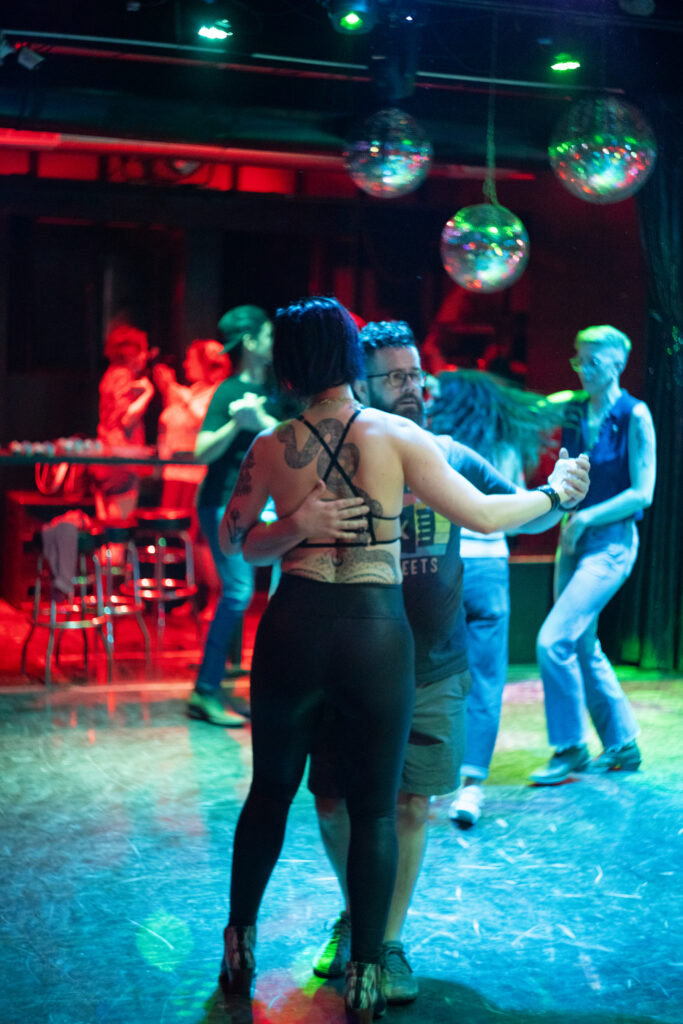
Regulars at Hoedown’s and 3-Legged Cowboy also found empowerment in the freedom to challenge traditional gender roles through country dancing. Like most forms of partner dancing, country dance can replicate traditional gender norms, where men typically lead and women follow. But Atlanta’s queer country dancers disregarded these norms, with women leading, men following, and same-sex partners dancing together. Recounting their first visit at 3-Legged Cowboy, Ryan Owens, a gender-nonconforming person who was assigned female at birth and has danced with the community since 2009, explained that seeing same-sex partners dance together “was eye opening and transformative,” as country dancing became an expression of same-sex desire. They also felt amazed that “[they could] lead a man, [and] that was fun seeing women lead and men follow.” Adams, who joined Hoedown’s in the late 1990s, explained that she eventually grew fond of country music, especially songs like Kathy Mattea’s “455 Rocket,” which she described as a “woman’s song . . . about a woman daring boys to race her” and winning. Mattea’s song reminded Adams that she too could take charge over men, claiming space and empowerment for herself and other women in a culture the she initially perceived as valorizing patriarchy. As she continued participating in the community, she got past the industry-crafted image of country music promoted by record label executives since the 1960s. Adams discovered that female country artists wrote songs challenging male authority, as they had since the genre’s origins.15
The freedom to break country dancing’s dominant gender norms at Hoedown’s and 3-Legged Cowboy became even more significant as the community’s members ventured into other venues. Sometime in the 2000s, Ralston attended Peach State, a local country dance convention. She was the only woman at the convention who knew how to lead, but the male attendees expected her to follow. When they refused to let her lead them, she was left to dance exclusively with women. “They said I led better than the men did,” she joked. Ralston added that more women started leading at Peach State over the following years, but Hoedown’s and 3-Legged Cowboy were initially the only venues where she could consistently dance however and with whomever she wished.16
Other queer country dancers were not as lucky to find a welcoming country dance environment outside Collins’s bar. Terence Ng, a leader of DanceOut ATL, recounted an incident in the early 2010s where he and his friends encountered a homophobic slur written on a car in the parking lot of Electric Cowboy—a “straight” country bar north of Atlanta. When they brought it to the bar owner’s attention, he assured them that as the parent of a gay child, he welcomed them and would not tolerate homophobic attitudes at his bar. Encouraged by the owner’s reassurance, Ng continued to dance at Electric Cowboy, but he and his friends learned to be careful. “Straight spaces do not have to be unwelcoming,” he told me. “But there are always concerns for queer people if that’s really going to be the case,” even in bars that claim to welcome LGBTQ people.17
As its members encountered homophobic attitudes at other venues, Hoedown’s and 3-Legged Cowboy offered them not only a safe place within the country dance community but also leadership roles. The bars held four free dance lessons a week—beginner and advanced two-step, line dancing, and rotating partner styles—led by community members, including Adams, Ralston, and Broschat. They had little to no formal training, but they learned how to dance from their friends. And when those volunteer teachers left, they took their place. When Hoedown’s shut down and 3-Legged Cowboy opened, Adams and Ralston continued teaching at Collins’s bar. They, along with countless other volunteers, were leaders in the community, and when they retired, their students took up the mantle; they continue to teach at The Heretic’s Country Night today.18
But Hoedown’s and 3-Legged Cowboy’s ethos of inclusion and empowerment had its limits. Many patrons attended in regular clothes—t-shirts, shorts, tennis shoes—but others wore what Hoedown’s regulars called “cowboy drag”: jeans, cowboy boots, flannel, pearl snaps, and cowboy hats. While cowboy drag gave gay men and lesbian women access to a culture that had become increasingly entangled with heteronormativity in recent decades, it restricted self-expression outside binary gender norms. Owens explained that the bar’s patrons often dismissed masculine-presenting women as “trying to be a man” and were more inviting to women who performed femininity in the way they dressed. If female attendees dressed country, Owens explained, they needed to look like a stereotypical cowgirl: skirt or tight jeans, a neat flannel, and a cowgirl hat. They also recounted that one regular even divided women in the bar into four categories based on their perceived femininity, descending from most feminine to masculine: “lipstick, chapstick, no stick, want a stick.” Owens added that this stigma kept them from wearing masculine clothes, and they did not come out as nonbinary until years after 3-Legged Cowboy closed.19
These rigid expectations applied to men as well. In a desperate attempt to bring more people to Hoedown’s, Ben Elliot held drag shows four nights a week. While most regulars were annoyed that they could no longer dance on six different nights, one took to David—a regional gay magazine—to complain: “Even though I’m gay, the last thing I want to see is men dressed like women—how stupid! You’re a GUY so act like it.” This resistance to drag performances reflected discomfort with men who challenged traditional masculinity at Hoedown’s, leaving little room for those who did not conform to gender binaries within the community.20
Hoedown’s and 3-Legged Cowboy also continued to struggle with attracting a nonwhite crowd into the late 1990s and 2000s. Many interviewees recalled that two Black men regularly danced at both bars, and another added that a Korean woman danced on Hoedown’s square dance team. However, these exceptions underscored the overwhelmingly white composition of these bars’ crowds. In 2007, just months after Hoedown’s closed and before 3-Legged Cowboy opened, the gay bar Jungle rebranded as The Wild Mustang, becoming Atlanta’s new full-time LGBTQ+ country bar to draw in Hoedown’s crowd. While it initially worked, many patrons returned to Collins’s 3-Legged Cowboy or danced at both venues. Pictures from this era reveal a sharp difference in crowds at these bars. A vast majority of attendees in photos of 3-Legged Cowboy were white, while The Wild Mustang’s crowds were mostly Black and Latino men. This difference seems to be due, in part, to The Wild Mustang’s Latin-themed nights. But it also reflected a pattern of segregation in Atlanta’s LGBTQ nightlife. Hoedown’s and 3-Legged Cowboy were “white bars,” and The Wild Mustang emerged as the “Black bar.”21
Even though the community returned to 3-Legged Cowboy, Collins could not financially sustain the bar after the 2008 recession. In April 2011, she stood in the middle of the dance floor and announced that 3-Legged Cowboy was closing. She reassured the hundreds of patrons crowding around the dance floor that their community would outlive the bar because “You can’t keep a good hoedown.” Collins’s words proved prophetic. In 2012, 3-Legged Cowboy attendees persuaded Alan Collins (no relation to Deana) to host a weekly country dance night at his bar, The Heretic, where they have danced ever since. In 2018, they formed DanceOut ATL to coordinate dance lessons and events and to keep the community together. As DanceOut ATL took shape, the community it served began to shift in response to the broader changes across Atlanta’s urban and cultural landscapes.22
Over the past decade, LGBTQ+ communities inside and outside Atlanta have faced a new array of challenges. Gentrification and urban development projects have driven up property taxes and values and led to the disintegration of historically LGBTQ and Black neighborhoods in cities across the nation. In Atlanta, the increased cost of living and rent has pushed some queer and Black residents out of Cheshire Bridge and Midtown, and has led some LGBTQ bars to close, including The Hideaway in 2023. To remain financially viable, many LGBTQ bars have had to cater to more affluent audiences—often middle- to upper-middle-class white gay men. On nights other than Country Night, The Heretic is generally packed with this crowd.23
The COVID-19 pandemic also threatened to disband queer country dance communities. Oil Can Harry’s, a gay honky-tonk in Los Angeles, California, a fixture of queer nightlife since 1968, closed in 2021 due to the financial pressures of the pandemic. Terence Ng recounted organizing Country Night in the Heretic’s parking lot—where they could dance six feet apart—but few people attended. Ng eventually turned to online instruction, recording and sharing videos for dancers to practice safely at home.24
When DanceOut ATL resumed gatherings at The Heretic as the pandemic waned and country music surged in popularity, its members witnessed their community transform. Over the past three years, the average crowd size for Country Night has doubled from about one hundred to about two hundred patrons, with the record attendance reaching three hundred eighty-seven during Atlanta’s Pride Week in 2025. With this new and predominantly younger crowd, Ng explained, more trans and gender-nonconforming people and people of color have entered the community. Based on observation and conversations with DanceOut ATL’s leadership, it seems the crowd remains predominantly white, with an estimated 20 percent of attendees people of color. Furthermore, the crowd’s class and age composition vary widely, with several regulars being recent college graduates, graduate students, white- and blue-collar professionals, and retirees. This shift mirrors trends in other queer country dance groups founded in the past decade, including Second City Country Dance Association in Chicago, Stud Country in Los Angeles and New York City, and Starlight Strut in Oakland, whose social media pages showcase similarly racially and gender-diverse crowds.25
To nurture this growth, DanceOut ATL’s organizers took an active role in welcoming newcomers: greeting them, helping them learn dances, and handing out cards with the group’s social media handles and a QR code linking to lesson schedules and dance tutorial videos. Regulars often offer to teach newcomers the steps to a line dance and partner dance patterns, suggesting the community’s demographic shift has been shaped through acts of hospitality.26
These efforts appear to be working. When asked why they attend Country Night, participants across racial, sexual, and gender identities regularly praised the welcoming atmosphere created by the organizers and other community members. Some mentioned that they use the group’s videos to practice dancing on their own. Many also shared that they first came to Country Night because a friend invited them. Gone are the days of the Hot’Lanta Hoedown, where information about country-themed events circulated within tight-knit networks of white gay men. In contrast, details are now spread through a more open and decentralized network: personal connections, word of mouth, and social media. While other queer country dance groups maintain a digital presence, DanceOut ATL offers one example of how hospitality and the integration of digital and in-person resources can make community spaces more accessible for groups that have been historically absent from them.27
Attendees also cited free admission and access to instruction for why they attend Country Night. As rent prices continue to rise in Atlanta, Country Night remains free to attend, in part because Alan Collins, who has admired Atlanta’s queer country community since starting his first bartending job at Hoedown’s, does not charge the group to use his venue. As DanceOut ATL has grown, organizers have begun hosting events at two other LGBTQ bars in Atlanta—The Eagle and Lore—and entry and lessons remain free. Other queer country dance groups follow different financial models. Adams, who now lives in Chicago, explained that, while SCCDA offers free lessons, the organization sometimes charges a cover to pay for rental space. Stud Country, on the other hand, has embraced a more overtly monetized model, charging around $20 per lesson or $185 for eleven beginner lessons. Some in the queer dance community swarmed Stud Country’s Instagram comment section when the organization announced this plan. “Sincerely envious of this business model,” one commenter wrote, “because I too would love to take a largely free activity elsewhere and monetize the shit out of it, gentrify the spaces, and whitewash the history. Genuinely not even trying to be a hater, I envy such a smart capitalization on [the] gay community.” When asked about Stud Country, DanceOut ATL’s leaders and community members expressed disappointment in the organizers’ effort to capitalize on queer country dancing, agreeing with the anonymous commenter.28
As these new groups come to Country Night, they renegotiate their connection to country culture. Many attendees shared that they grew up in rural communities and moved to Atlanta for work, school, or to find LGBTQ+ community. This “queer migration,” as scholar Rae Garringer calls it, presents problems for LGBTQ folks raised in rural areas: “Mainstream LGBTQIA media and movements have long assumed a shared desire to escape from the country to more liberal ‘gay meccas’ in urban and metropolitan areas,” where they can embrace their true identity, but “for many [LGBTQ+ people] raised in the country, following this normative queer migration narrative rips us from the landscapes, communities, and traditions that are as much a part of ourselves as our queerness.” At Country Night, those rural roots resurface. One white transmasculine attendee, who moved from rural Georgia to Atlanta, shared that Country Night helped him realize “I don’t have to leave country music behind. I can enjoy it now, too.” Country Night allows these queer migrants to reconnect with a part of themselves that they thought they had lost or left behind. In this urban space, they are able to inhabit their rurality and their queerness simultaneously.29
Just as Country Night participants are renegotiating their personal connections to rurality, other movements are reimagining who belongs in country music. Recent efforts, such as Rissi Palmer’s podcast, Color Me Country, have pushed back against the genre’s whitewashing and gatekeeping. Palmer, one of the few Black women to chart a country single in the 2000s, interviews Latinx, Indigenous, and Black country artists, introducing them to a diverse audience of country music fans. Similarly, the Black Opry has provided financial support and networking and performance opportunities for Black country artists, platforming musicians in an industry that, Holly G explains, “pushed them out.” These projects, like DanceOut ATL, do not simply call for more multiracial representation—they offer community-centered platforms that reclaim country music from the margins.30
DanceOut ATL’s playlist reflects this multiracial reclamation. Classic country songs like “My Maria” and “Strawberry Wine” still play but now appear alongside tracks from queer, queer-affirming, and Black artists, including Orville Peck, Kacey Musgraves, Shaboozey, and The Kentucky Gentlemen. The music’s diversity mirrors the dance floor’s changing demographics, yet some community members have noted that leadership at Country Night remains “a bit of a boys’ club” and “overwhelmingly white.” These critiques made it especially meaningful when two Black attendees recently taught lessons, offering a glimpse into a future where, like Black Opry’s touring stages and Color Me Country’s interviewees, Black participants take center stage, publicly claiming a culture they have always helped shape.31
These forms of inclusion extend beyond the dance floor and into the community’s visual culture. When The Heretic’s graphic designer proposed a promotional poster for Country Night, featuring a muscled white man and woman, Ng pushed back. The designer added a Black man in country attire and removed the abs. Ng creates most of the promotional material posted on DanceOut ATL’s Facebook and Instagram pages, favoring crowd shots from Country Night or silhouettes filled with nonrepresentational colors, such as red, yellow, and green. This visual language, unlike the hypermasculine, white-centered aesthetic that dominated advertisements for Atlanta’s country bars in the 1970s and 1980s, avoids prioritizing one body type or identity as belonging in the space.32
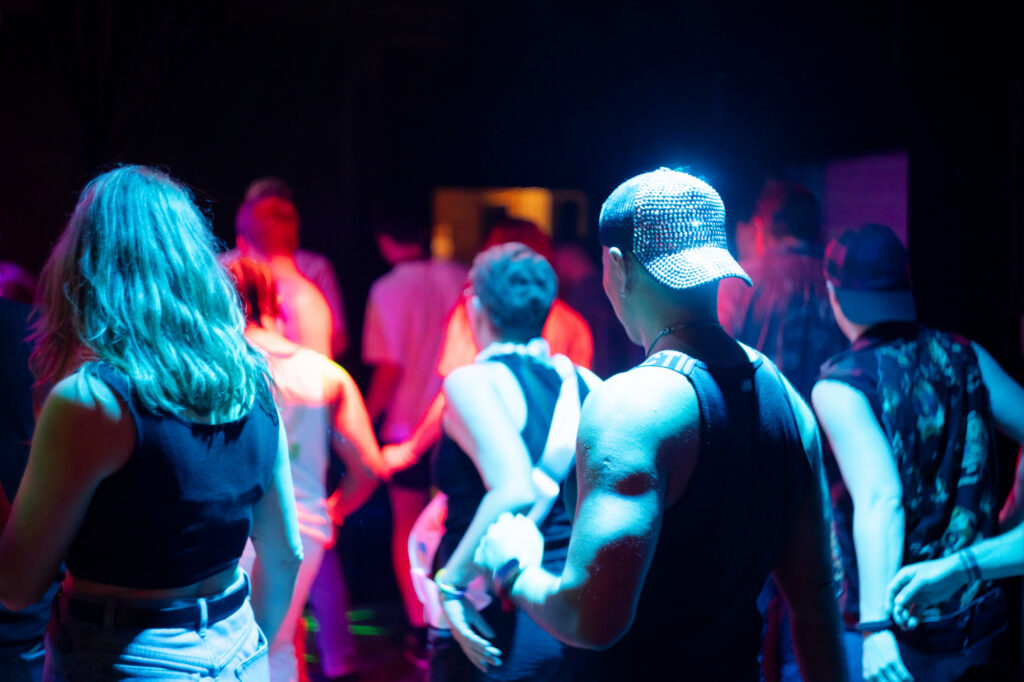
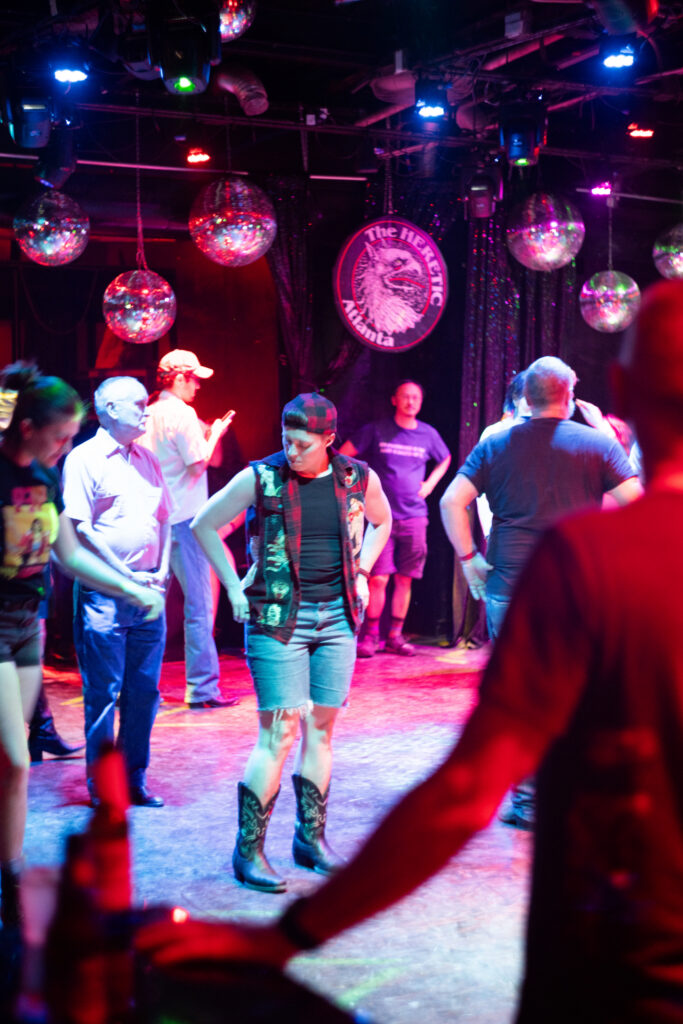
The reworking of this visual representation reflects a broader queer sensibility that engages country culture through playful exaggeration and critique. As Shana Goldin-Perschbacher has argued, country music is ripe for humorous reinterpretation because its “authentic” image of the white, working-class, cisgendered heterosexual is constructed through the music industry’s marketing and gatekeeping. Country culture’s built-in theatricality gives queer people space to expose the cracks in this purportedly authentic image and make room for themselves. DanceOut ATL and other queer country groups take this humorous approach. At The Heretic—and on Stud Country, Starlight Strut, and SCCDA’s social media pages—dancers appear in rhinestoned cowboy hats coupled with ostentatious belt buckles, sparkly vests paired with Levi jeans, and bolo ties draped on pearl snaps and leather harnesses. Now, Owens “butches it up,” regularly attending in a trucker hat, jeans, and scuffed boots. Other Atlanta dancers blend cowboy boots with t-shirts featuring quippy, queer-affirming slogans like “Y’all Means All” in rainbow-colored font or Collins’s catchphrase, “Can’t Keep a Good Hoedown.” These fashion choices mark a shift away from the Hoedown’s era of cowboy drag as mimicry of cisgendered norms. Instead, these performances exaggerate and rework country culture’s conventions, exposing their artifice and reimagining the genre as a canvas for queer expression.33
Now well established, Country Night also invites other aesthetics, providing a platform for multiple kinds of expression rooted in each dancer’s sense of style and taste and inviting participants to inhabit country culture (or not) on their own terms. On any given night, some attendees wear tennis shoes, shorts, or plain t-shirts. Others don expressive clothes that may not read as “country,” such as sparkly vests, knee-high rainbow socks, or capes. These stylistic choices exist alongside a musical repertoire that also expands beyond country into to pop songs, such as Ed Sheeran’s “Shivers,” Pitbull’s “Fireball,” and Chappell Roan’s “Good Luck Babe.” Such juxtapositions deepen its queer sensibility. The community no longer binds participation to sticking to a certain cultural and aesthetic script.34
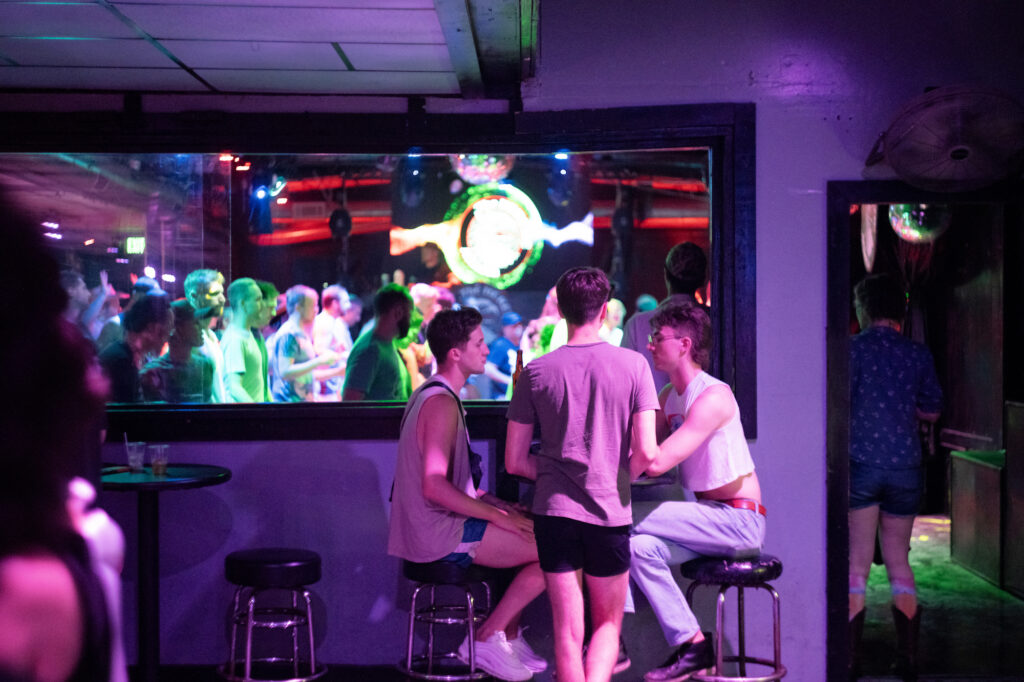
DanceOut ATL illustrates how queer people have navigated the tension between what country culture is said to be—white, heteronormative, and patriarchal—and what it can be, a resource for queer creativity. In its earliest iteration, Atlanta’s queer country dance community internalized and reproduced dominant cultural narratives. But over time, the increasing presence of women, people of color, trans, and gender nonconforming people has reshaped the community, demonstrating the ongoing negotiations over who country culture is for. For DanceOut ATL, the answer has become increasingly expansive.
This effort to redefine country culture has pushed the community toward new enterprises. During the summer, DanceOut ATL will host Hoedown South, its first LGBTQ-centered country western and line dance convention. The gathering will include workshops and competitions, alongside social gatherings for people of color, trans, nonbinary, and gender nonconforming people. DanceOut ATL also offers lower registration costs for attendees who volunteer. Framed as a cultural and skill-building event, the convention extends beyond recreation to build cross-community networks within queer country dance networks. Formalizing these connections through Hoedown South signals a shift toward a larger-scale, sustained institutional form of cultural production.35
At the same time, the event reflects how DanceOut ATL’s programming has expanded in response to the growing popularity and diversification of queer country dance communities in Atlanta and beyond. The inclusion of identity-based social gatherings and the volunteer work exchange program underscore the ongoing effort to address the uneven experiences of participation within country dance spaces, where race, gender identity, sexuality, and class can shape access and belonging. In this sense, the convention functions as another mechanism for producing queer engagement with a genre long associated with exclusion.
The meaning of country culture is not settled. To dance in this community is to participate in an unfinished project. Economic pressures, shifting nightlife cultures, and the commercialization of LGBTQ+ spaces and country aesthetics will shape what is possible for years to come. The tensions that have long defined the community—between openness and exclusion, tradition and reinvention—will likely continue to inform how the space evolves. Country culture will be made and remade on the dance floor, in moments of unlikely connection, and through collective effort, and DanceOut ATL’s success is a testament to what is possible when queer people reimagine country music’s mythologies.
Joshua Howard is a doctoral candidate in the Graduate Division of Religion at Emory University. His research examines the history of American evangelicalism and Christian nationalism from the 1970s to the present, focusing on how these movements have used media to promote visions of the family.
Header image: Two-stepping at Country Night, the Heretic, Atlanta, Georgia, June 5, 2025. Photo by Brandon Kilgore.
NOTES
- For a brief biography on Deana Collins, see Patrick Saunders, “Catching Up . . . with Deana Collins, Former Hoedowns and 3-Legged Cowboy Owner,” RoughDraft Atlanta, December 23, 2014, https://roughdraftatlanta.com/2014/12/23/catching-deana-collins-former-hoedowns-3-legged-cowboy-owner/; Petra L. Doan and Harrison Higgins, “The Demise of Queer Space? Resurgent Gentrification and the Assimilation of LGBT Neighborhoods,” Journal of Planning Education and Research 31, no. 1 (2011): 9; For an overview of the development of Midtown, Cheshire Bridge, and the rise of LGBTQ communities in Atlanta in the 1960s and 1970s, see Martin Padgett, A Night at the Sweet Gum Head: Drag, Drugs, Disco, and Atlanta’s Gay Revolution (W. W. Norton, 2021).
- For more information on the founding of the Atlanta Lesbian/Feminist Alliance, see La Shonda Mims, Drastic Dykes and Accidental Activists: Queer Women in the Urban South (University of North Carolina Press, 2022), 82–87; Deana Collins, “Wicked Whispers,” Gaybriel, August 17, 1979, box 33, folder 1, Atlanta Lesbian and Gay History Thing Papers and Publications (hereafter ALGHTPP), ahc.MSS773, Kenan Research Center at Atlanta History Center (hereafter Kenan Research Center), Atlanta, Georgia.
- “Dear Womyn’s Writes,” Atlanta Gay Center: The News,vol. 1, no. 21(October 17, 1985), 9; Sports Page Advertisement, Gaybriel, October 1979, box 33, folder 1, ALGHTPP, ahc.MSS773, Kenan Research Center, Atlanta, Georgia.
- The Uptown Advertisement, Cruise Weekly, April 1981, box 6, Lesbian, Gay, Bi-Sexual, and Transgender Serial Collection, ahc.MSS991, Kenan Research Center, Atlanta, Georgia; “Spotlight: Deana Collins and The Rose,” Atlanta Gay Center: The News 1, no. 20, October 3, 1985, 2; Advertisement for the Rose, ETC,1, no. 2, 1985, p. 16, box 1, Gender and Sexuality Collections, Special Collections and Archives, Q-Periodicals, Georgia State University, Atlanta, Georgia (hereafter GSU Gender and Sexuality Collections).
- Arnold Fleischmann and Jason Hardman, “Hitting Below the Bible Belt: The Development of the Gay Rights Movement in Atlanta,” Journal of Urban Affairs 26, no. 4 (2004): 411. For more on white flight in Atlanta, see Kevin Kruse, White Flight: Atlanta and the Making of Modern Conservatism (Princeton University Press, 2007); Robin Robert, “Gaybriel Interviews Greg Worthy of the Gay Atlanta Minorities Association,” Gaybriel, August 10, 1979, box 33, folder 1, ALGHTPP, ahc.MSS773, Kenan Research Center, Atlanta, Georgia.
- Atalanta: Newsletter of the Atlanta Lesbian Feminist Alliance 9, no. 8, August 1981, Atalanta newsletters, 1980–1981, folder 2, Atlanta Lesbian/Feminist Alliance (ALFA) Documents, ahc.MSS962f, Kenan Research Center, Atlanta, Georgia.
- “Survey,” box 1, folder 14, Lorraine Fontana papers, Gender and Sexuality Collections, Special Collections and Archives, Q-Periodicals, Georgia State University, Atlanta, Georgia; Copy of Ordinances Passed by the Atlanta City Council, box 1, folder 14, Lorraine Fontana papers, Gender and Sexuality Collections, Special Collections and Archives, Q-Periodicals, Georgia State University, Atlanta, Georgia.
- “Hotlanta Raft Race Coming Up Next Weekend,” Cruise Weekly. 4, no. 31, July 27–August 2, 1979, 16, GSU Gender and Sexuality Collections; James L. Moore, “Lavender Express,” Gaybriel, August 17, 1979, box 33, folder 1, ALGHTPP, ahc.MSS773, Kenan Research Center, Atlanta, Georgia; Photos from the Hot’Lanta Hoedown ’79, August 10, 1979, box 33, folder 1, ALGHTPP, ahc.MSS773, Kenan Research Center, Atlanta, Georgia.
- Billy Jones, “Bulldogs Celebrates Birthday Number One,” Cruise Weekly 4, no. 30, July 27–August 2, 1979, 11, GSU Gender and Sexuality Collections; “A Bulldog and Co. Exclusive,” Cruise Weekly 8, no. 19, 1983, GSU Gender and Sexuality Collections; Cover Photo at Texas Drilling Company, Cruise Weekly 8, no. 19, 1983, GSU Gender and Sexuality Collections; Photo of The Saddletramps (an all-gay male clogging troupe), Cruise Weekly 4, no. 27, July 6–12, 1979, GSU Gender and Sexuality Collections; Advertisement for “The Corral at the Academy Disco,” Cruise Weekly 4, no. 12, 1979, GSU Gender and Sexuality Collections; Advertisement for “The Cove Grotto,” Cruise Weekly 8, no. 10, 1983, GSU Gender and Sexuality Collections; Jocelyn Neal, Country Music: A Cultural and Stylistic History (Oxford University Press, 2013), 311–342; Jeremy Hill, Country Comes to Town: The Music Industry and the Transformation of Nashville (University of Massachusetts Press, 2015), 111–112; Charles Hughes, Country Soul: Making Music and Making Race in the American South (University of North Carolina Press, 2015), 128–151; for more on the influence of Black artists on country music, see Francesca Royster, Black Country Music: Listening for the Revolutions (University of Texas Press, 2022); Alice Randall, My Black Country: A Journey Through Country Music’s Black Past, Present, and Future (Black Privilege Publishing, 2024); and Karl Hagstrom Miller, Segregating Sound: Inventing Folk and Pop Music in the Age of Jim Crow (Duke University Press, 2010), 217–240; For a discussion of female country artists in the 1980s, see Neal, Country Music, 311–342.
- For a discussion of Frank Powell’s role in Atlanta’s LGBTQ nightlife and enforcing discriminatory carding policies, see Padgett, Night at the Sweet Gum Head, 49–50; Robert, “Gaybriel Interviews Greg Worthy”; Ordinance Compliance Report, box 1, folder 14, Lorraine Fontana papers, Gender and Sexuality Collections, Special Collections and Archives, Q-Periodicals, Georgia State University, Atlanta, Georgia; “A Bulldog and Co. Exclusive”; Photos from the International Mr. Leather Contest 1982, Scrapbook 2, Buffalo Chips Records, W116, Gender and Sexuality Collections, Special Collections and Archives, Georgia State University, Atlanta, Georgia; “Rope Your Stud” at Bulldogs and Co. advertisement, Cruise Weekly 8, no. 19, 1983, Q-Periodicals, Gender and Sexuality Collections, Special Collections and Archives, Georgia State University, Atlanta, Georgia; The Stud advertisement, Cruise Weekly 8, no. 38, 1983, 38, Q-Periodicals, Gender and Sexuality Collections, Special Collections and Archives, Georgia State University, Atlanta; Advertisement for The Academy Disco, Cruise Weekly 4, no. 18, May 4–10, 1979, Q-Periodicals, Gender and Sexuality Collections, Special Collections and Archives, Georgia State University, Atlanta, Georgia; “The Cove Grotto,” Cruise Weekly; Photos from the Miss Buffalo Chip Pageant 1983, John Blythe Scrapbook 4, Buffalo Chips Records, W116, Gender and Sexuality Collections, Special Collections and Archives, Georgia State University, Atlanta, Georgia; News clipping from Cruise Weekly, John BlytheScrapbook 4, Buffalo Chips Records, W116, Gender and Sexuality Collections, Special Collections and Archives, Georgia State University, Atlanta, Georgia.
- Dave Haywood, “$3000 Raised. Decatur’s Mayor Opens Benefit Basketball Game,” Southern Voice, dated between 1988 and 1999, Andrew P. Wood papers, Q121, Gender and Sexuality Collections, Special Collections and Archives, Georgia State University, Atlanta; “Deana Collins Does it for Atlanta—One Mo’ Time,” Southern Voice, February 2, 1989, 6; Picture of Deana with AID Atlanta Staff members and Volunteers advertising a People with AIDS Housing Fund, Southern Voice, December 3, 1988; “Thanks, Deana!,” Atlanta Gay Center: The News 4, no. 9, May 20, 1988, 21; For a discussion of the country music’s rise in popularity during the 1990s, see Neal, Country Music, 375–406; Hill, Country Comes to Town, 111–112; Georgia State University Library, “Out and About at Hoedowns, circa 2000,” YouTube, 31:30–36, accessed October 23, 2025, https://www.youtube.com/watch?v=ZuVisBcv_ZY&t=1897s; Candance Chellew, “Country Craze: Gays and Lesbians Dance to a Different Beat,” Southern Voice, February 18–24, 1993, 17; Candace Chellew, “Southern Country Atlanta,” Southern Voice, August 13, 1992, 15; Al Cotton, “Hot Two-Steppin’ in the August Sizzle of Atlanta,” Southern Voice, July 29, 1993, 21; Jerri Goldberg, “A History of the Formation of the Association,” The International Association of Gay/Lesbian Country Western Dance Clubs, accessed June 17, 2025, https://iaglcwdc.org/history.php.
- Toni Ralston, interview with author, November 16, 2024; Picture of Deana with AID Atlanta staff members and volunteers advertising a PWA Housing Fund, Southern Voice, December 3, 1988; photo of Deana Collins dated approximately 1990–2010, file VIS 415.392, box 2, Kenan Research Center, Atlanta, Georgia; For a discussion of racial disparities in access to HIV/AIDS care and the predominance of White gay men in AID Atlanta in the 1980s, see Dan Royles, “When My Brothers Fell: Black Gay Men and AIDS Activism,” The Baffler 56, no. 4 (2021):71; Chellew, “Southern Country Atlanta,” 31; Adam J. Sank, “Round Up ’94 Two-Steps into Atlanta,” Southern Voice, August 18, 1994, 31.
- Laura Douglas-Brown, “Hoedowns’ Elliot Faces Lawsuits, Investigation,” Southern Voice, July 27, 2007, 1; Laura Douglas-Brown, “Former Hoedowns Owners Pleads Guilty to Federal Charges,” Southern Voice, November 7, 2008, 15; Advertisement announcing the opening of 3-Legged Cowboy, David, April 23, 2008, 53.
- Joshua Howard, “Country Night Field Notes,” (The Heretic in Atlanta, Georgia, November 14, 2024); Toni Ralston, interview with author, November 16, 2024; Shirley Adams, interview with author, November 18, 2024.
- Kathryn Alexander, “Politely Different: Queer Presence in Country Dancing and Music,” Yearbook for Traditional Music 50, no. 1 (2018): 189; Ryan Owens, interview with author, November 25, 2024; Adams, interview with author, November 18, 2024; For more on the history of female country music artists challenging patriarchal norms, see Pamela Fox, Natural Acts: Gender, Race, and Rusticity in Country Music (University of Michigan Press, 2008), and Stephanie Vander Wel, “The Lavender Cowboy and ‘The She Buckaroo’: Gene Autry, Patsy Montana, and Depression-Era Gender Roles,” Musical Quarterly 95, nos. 2–3 (2012): 207–251.
- Ralston, interview with author, November 16, 2024.
- Terence Ng, interview with author, Atlanta, Georgia, November 10, 2024.
- Adams, interview with author, November 18, 2024; Ralston, interview with author, November 16, 2024.
- Georgia State University Library, “Out and About at Hoedowns,” 36:20; Owens, interview with author, November 25, 2024.
- “Hoedown’s Weekly Schedule and Drag Show Line-up,” David, April 25, 2007; “More Critics (and One Fan) of Hoedown’s Changes,” Southern Voice, April 13, 2007, 1.
- Shirley Adams, interview with author, November 18, 2024; Ralston, interview with author, November 16, 2024; John Packman, interview with author, Atlanta, Georgia, November 10, 2024; “Seen @ 3-Legged Cowboy,” David, May 7, 2008, 58; “Seen @ Wild Mustang’s Latin Night,” David, June 2008, 124; Rob Beck, “Tex Mex: The Wild Mustang Takes on Maxine Blue’s Latin-Flavored Friday Nights,” Southern Voice, January 25, 2008, 25.
- Project Q, “3 Legged Cowboy Closing Night,” YouTube, 1:36, May 3, 2011, https://www.youtube.com/watch?v=qlWVvyYqrfE&t=1s; Ng, interview with author, November 10, 2024; Ralston, interview with author, November 16, 2024.
- Greggor Mattson, “Style and the Value of Gay Nightlife: Homonormative Placemaking in San Francisco,” Urban Studies Journal 52, no. 16 (2015): 3146; Greene, Not In My Gayborhood!, 158–186; Petra L. Doan and Harrison Higgins, “The Demise of Queer Space? Resurgent Gentrification and the Assimilation of LGBT Neighborhoods,” Journal of Planning Education and Research 31, no. 1 (2011): 9; “The Hideaway Closing Piedmont Avenue Location,” WSB-TV, accessed December 10, 2024, https://www.wsbtv.com/video/local-video/hideaway-closing-piedmont-avenue-location/ebd80e65-2fdf-4a98-9e6a-1fc5a5218391/; Greggor Mattson, Who Needs Gay Bars?: Bar-Hopping through America’s Endangered LGBTQ+ Places (Redwood Press, 2023), 86.
- McAdory, “Line Dancing Toward Euphoria”; Ng, interview with author, November 10, 2024.
- For more on the resurgence of country music in the 2020s, see Alexander Gelfand, “Why Country Music is Topping Charts and Filling Arenas,” BerkleeNow, December 10, 2024, https://www.berklee.edu/berklee-now/news/why-is-country-music-popular, and Jon Caramanica, “The Year Country Went Everywhere, and Everyone Went Country,” New York Times, December 19, 2024, https://www.nytimes.com/2024/12/19/arts/music/jelly-roll-shaboozey-vavo-tanner-adell-country.html; DanceOut ATL (@danceoutatl), October 10, 2025, https://www.instagram.com/danceoutatl/p/DPpAjVIDkcZ/; Ng, interview with author, November 10, 2024; Josh Howard, “Country Night Field Notes,” (The Heretic in Atlanta Georgia, October 10, 2024); Second City Country Dance Association (@sscda), Instagram, accessed June 17, 2025, https://www.instagram.com/sccda/; Stud Country (@stud.country), Instagram, accessed June 17, 2025, https://www.instagram.com/stud.country/; Starlight Strut (@starlightstrut), Instagram, accessed June 17, 2025, https://www.instagram.com/starlightstrut/.
- Josh Howard, “Country Night Field Notes,” (The Heretic in Atlanta, Georgia, October 10, 2024).
- Ibid.
- Gay Barchives, “104 Bev Cook and Alan Collins Discuss the Long History of Atlanta’s Heretic Bar & Its Predecessors,” YouTube, 8:40–8:50, October 5, 2022, https://www.youtube.com/watch?v=hI-7LrHO4Qg&t=15s; Adams, interview with author, November 18, 2024; “Los Angeles,” Stud Country, accessed June 17, 2025, https://studcountry.us/LA; Stud Country (@stud.country), “Update: No Georgia Room Mixer Tonight . . . ,” August 27, 2024, https://www.instagram.com/p/C_L4cQmJeYt/?hl=en&img_index=1; Josh Howard, “Country Night Field Notes,” (The Heretic in Atlanta, Georgia, October 10, 2024; November 14, 2024); Ng, interview with author, November 10, 2024.
- Rae Garringer, “‘Well, We’re Fabulous and We Are Appalachians, So We’re Fabulachians,’” Southern Cultures 23, no. 1 (Spring 2017): 79–91. Garringer also discusses the effects of metronormativity on rural queers in Country Queers: A Love Letter (Haymarket Books, 2024), 3–14; Josh Howard, “Country Night Field Notes,” (The Heretic in Atlanta, Georgia, October 17, 2024).
- For more on Rissi Palmer’s career and podcast, see “Home,” Color Me Country, accessed June 17, 2025, https://colormecountry.com/color-me-country/; “Good Morning America, “Black Opry Revue Showcases Country Music Artists of Color,” YouTube, November 8, 2023, https://www.youtube.com/watch?v=_-z9EMU6f3M.
- Josh Howard, “Country Night Field Notes,” (The Heretic in Atlanta Georgia, October 10, 2024); Owens, interview with author, November 25, 2024.
- Ng, interview with author, November 10, 2024; For an example of Terence Ng’s use of nonrepresentational colors, see DanceOut ATL (@danceoutatl), “Grab Your Boots, take a sip . . . ,” May 27, 2025, https://www.instagram.com/danceoutatl/p/DKJOg47Oq2c/. For an example of crowd shots, see DanceOutATL (@danceoutatl), “Some fun videos . . . ,” June 15, 2025, https://www.instagram.com/danceoutatl/p/DK7J1VyOFsu/.
- Shana Goldin-Perschbacher, Queer Country (University of Illinois Press, 2022), 55–61; Josh Howard, “Country Night Field Notes,” (The Heretic in Atlanta, Georgia, October 31, 2024); McAdory, “Line Dancing Toward Euphoria”; Second City Country Dance Association (@sccda), “Thanks for coming out to dance . . . ,” Instagram, May 1, 2025, https://www.instagram.com/p/DJIlwrFR0pV/?img_index=4; Owens, interview with author, November 25, 2024.
- Josh Howard, “Country Night Field Notes” (The Heretic in Atlanta, Georgia, September 19, 2024).
- “Schedule,” Hoedown South, accessed April 16, 2026, https://www.hoedownsouth.com/schedule; “Volunteer Information,” Hoedown South, accessed April 16, 2026, https://www.hoedownsouth.com/volunteer-information.