If she is known for nothing else, Carson McCullers is known for being southern. The Georgia-born New York transplant set her fiction almost exclusively in small, stagnant towns in the Deep South. Despite her personal ambivalence toward the region, she needed to write about that South, she admitted, as it was her “own reality”: “People ask me why I don’t go back to the South more often,” she wrote in a 1959 essay. “But the South is a very emotional experience for me … a stirring up of love and antagonism. [Yet] the locale of my books might always be Southern, and the South always my homeland.” McCullers’s fictional South is a timeless, trapped-in-amber place, her settings so tinted with pathos that loneliness itself becomes a region.1
The static location for her fiction exists in an intriguing tension with McCullers’s own mobility as a writer, the wide geographic distribution of her readers, and her fiction’s utterly modern themes of psychic displacement and disconnection. McCullers was a migratory bird, with affiliations, attachments, and opportunities that pulled her north and south but also across oceans to England, France, Italy, and Ireland, and across the border to Quebec. Her travels often aligned with explosive growth in her work, and her return journeys south were often reluctant ones tied to her chronic ill health.
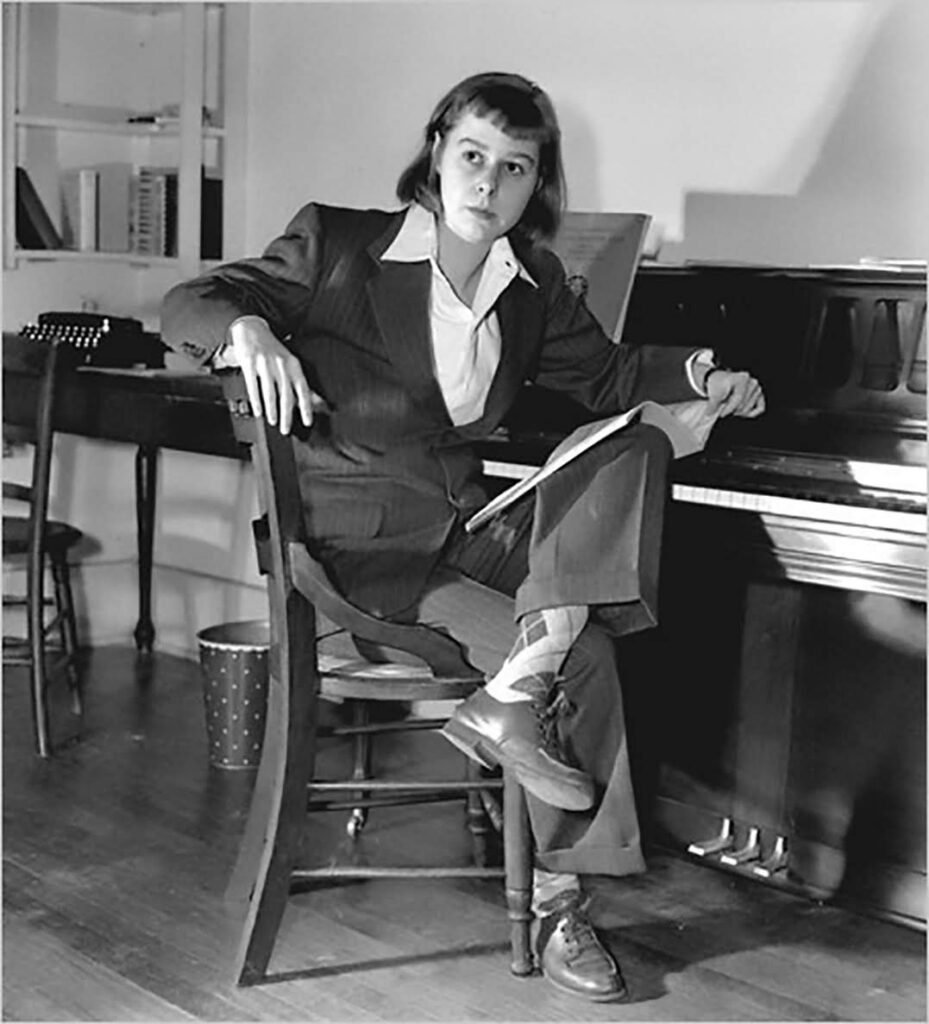
At age seventeen, Lula Carson Smith left Georgia, boarded a steamship to New York City, and, abandoning plans to study music, began taking creative writing classes at Columbia and New York University. At twenty, she married another aspiring writer named Reeves McCullers, but within two years, that doomed marriage was unraveling. At this early critical juncture, Carson McCullers found her footing while living among fellow artists in the largely gay and lesbian commune space of February House, a Brooklyn Heights brownstone she shared with W. H. Auden, Paul and Jane Bowles, Benjamin Britten, Gypsy Rose Lee, Richard Wright, and others. In this milieu, McCullers fell deeply into what was likely her first lesbian relationship at the same time as her identity as a writer was unfolding in New York. In an essay for Vogue about this time, she looks out the “windows of her rooms in Brooklyn” at the Manhattan skyline, the “grey East River, and the Brooklyn Bridge,” to contemplate her own homesickness, which she imagines echoed that experienced by Thomas Wolfe and Hart Crane, who had lived in the same “water-front neighborhood.” Situating herself among American authors past and present, McCullers’s sense of herself at the launch of her career, then, was not as a regional writer but as a national one, part of an American literary tradition, itself still a new idea in 1940. When her wildly celebrated first novel, The Heart Is a Lonely Hunter, appeared that same year, McCullers was only twenty-three.2
Two years after this astonishing literary debut, McCullers published a short story in the New Yorker titled “Correspondence.” Presented in epistolary form, the narrative unfolds through a sequence of letters sent over three months by thirteen-year-old Henrietta “Henky” Evans to a South American pen pal named Manoel García. The heartbreak of the story builds as Henky’s letters accumulate unanswered. The letters shrink in length as they shift from gestures of profound honesty and searching adolescence to confused fantasies of potential connection to the final clipped, wounded conclusion that these calls will never be answered: “Nearly every other person in the class got letters and some even friendship gifts, even though they were not especially crazy about foreign countries like I was,” Henky writes in her final letter. “I expected to hear every day and gave you the benefits of all the doubts. But now I realize what a grave mistake I made.” The protagonist’s signature changes across the story, from the intimate “Henky Evans” to the guarded “Henrietta Evans” to the final, cold, “Miss Henrietta Hill Evans,” a trio of renamings that foreshadow the transformations McCullers’s gender-bending protagonist Frankie (aka F. Jasmine and Frances Addams) will undergo in the novel The Member of the Wedding. While Manoel García never answers Henky’s letters, a deeper “correspondence” does, in fact, develop when they are received by the story’s readers. The kind of connection Henky Evans seeks, thwarted by the plot of the story, was manifested in the letters midcentury readers sent to its author.3
Carson McCullers received fan correspondence from the early 1940s until her death in 1967, and these letters constitute a fascinating archive. The fact that McCullers, unlike many midcentury writers, preserved such letters at all is evidence of a meaningful connection between this author and her readers. But the letters also express an extraordinary devotion, which seems to derive from the urgency of the fiction. Tracing the links between McCullers’s fiction and fan correspondence uncovers a powerful dynamic of call and response. Through this exchange, the author and her readers generated a kind of “queer counterpublic”: a space within which to resist the loneliness, silencing, and erasure that characterized queer existence at midcentury. Displaced, misplaced, misunderstood, Carson McCullers’s correspondents sometimes subtly “come out” as queer, but more often, through a kind of shared identification without category, her readers come in, finding a space to belong and even to exist between the covers of her books.4
Lonely Hunters
My frame of “queer correspondence” invokes the contemporary meaning of queer, meaning LGBT+ individuals, but also includes the other meaning of the word circulating at midcentury to signal the strange, unusual, outcast, or misfit. Taken together, these meanings incorporate the readers McCullers spoke to most powerfully, and the correspondence indicates that McCullers was creating community for all of them through both her work and her presence. McCullers’s correspondents regularly hinted or divulged to her that they were displaced, misplaced, alienated, sensitive, lonely, writers, ill or disabled, outsiders, and/or queer. The readers poured out these truths because they saw McCullers as a safe vessel for them. She began using the gender-neutral name “Carson” in high school. Later describing herself as an “invert,” she developed passionate attachments to people of all genders across her life and portrayed gender-bending, queer, disabled, and otherwise transgressive characters throughout her fiction with love and a certain autobiographical empathy. In every case, such characters are not symbolic but central. McCullers used her fiction to pull the dominant culture’s “fringes” toward the center, building a world that affirmed her outsider-readers. McCullers also conveyed her own sexual and gender nonconformity in ways that were strikingly public, given the times.
The fan letters McCullers received suggest broad circuits of reading that crossed and exceeded the North-South-Europe triangle the author inhabited in her short life. While the bulk of the correspondence came from the northeastern or southeastern United States, letters also arrived from California, Oklahoma, and the Midwest, and from Paris, Norway, Sweden, Japan, and the Philippines. Letters from friends and family pulse with the times, chronicling McCullers’s rise to international fame and the agonies of tempestuous marriages, alcoholism, suicides, familial losses, and the heartbreak of her debilitating illness and its impact on her career. These were the private storms at the center of the broader historic tumults, present in the archive through items such as World War II–era telegrams and requests for her signature in support of a nuclear test ban treaty or testimony to help free jailed civil rights workers. In its partial, flickering way, the archive of correspondence captures the personal and political despair from which McCullers’s art emerged at midcentury.5
McCullers herself claimed that the theme of her debut novel, The Heart Is a Lonely Hunter, was the “revolt against isolation,” the “search for expression and spiritual integration with something greater than” oneself. A commentary on love and loss as well as a parable of fascism, the novel centers a deaf-mute character named John Singer, who becomes the confidante of four of the town’s misfits. Lost in their own narratives, the characters orbiting Singer do not learn of his own suffering: his love for another deaf-mute man named Antonapoulos, exiled to an asylum. In a similar dynamic, McCullers became the “Singer” and her readers the “satellites” who make her the “repository for [their] most personal feelings and ideas.”6
The Heart Is a Lonely Hunter (1940) and The Ballad of the Sad Café (1951) are mentioned with great regularity in the fan correspondence. But McCullers’s readers invoke her 1946 novel The Member of the Wedding the most: a shorter work tightly focused on a triangle of found family—the adolescent Frankie, her young cousin John Henry, and their Black caretaker Berenice—and the misfit protagonist’s search for belonging. Popular stage and screen versions of Member in circulation throughout the 1950s likely increased its reach and impact. Reflections in a Golden Eye (1941), her most overtly queer-coded novel, and Clock Without Hands (1961), a powerfully political final novel about same-sex interracial desire in the context of desegregation, were mentioned less often, though one fan did come gallantly to McCullers’s defense to say that he was “completely disgusted” by a negative 1961 review of Clock Without Hands in “that narrow minded, snotty, Prep-schooled trained magazine,” Time. In the context of the virulent homophobia of the Lavender Scare, readers may have referred to Reflections and Clock less frequently because these novels engaged with sex and sexuality most pointedly.7
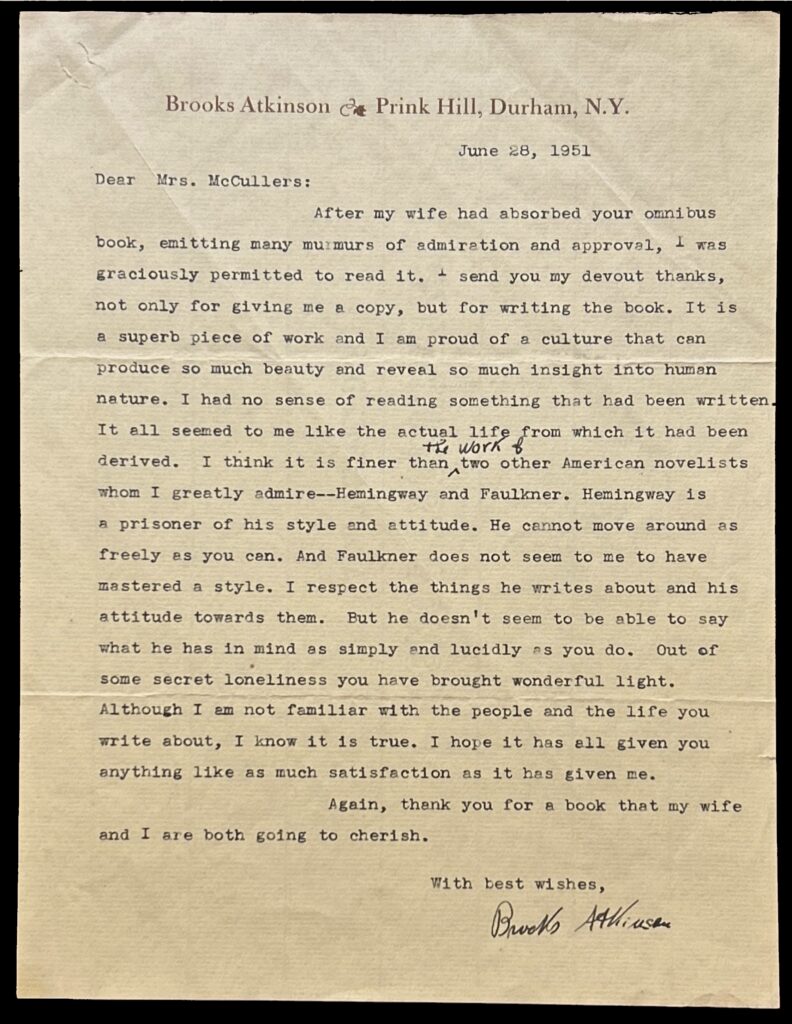
The correspondents regularly name a shared loneliness between themselves and McCullers’s writing. “Out of some secret loneliness you have brought wonderful light,” one reader marvels over The Ballad of the Sad Café in 1951. Of the story “Who Has Seen the Wind?” a female fan writes from New York City in 1956: “It is so seldom in this lonely world that we find a related understanding of things. It is just this quality of touching unseen chords of experience in people—of speaking directly and personally to everyone’s unseen self—that makes your writing timeless … How very nice to find one’s own fears and searches expressed so well by another.” The writer Andrée Chedid, reading McCullers’s work in translation, wrote to her from Paris in 1953: “Your wonderful books are an invisible and strong bond between yourself and those who love them.” Family, too, understood the significance of this central theme, as when her gay cousin Jordan Massee wrote in 1953, “Darling, when I share my loneliness with you I cut it in half.”8
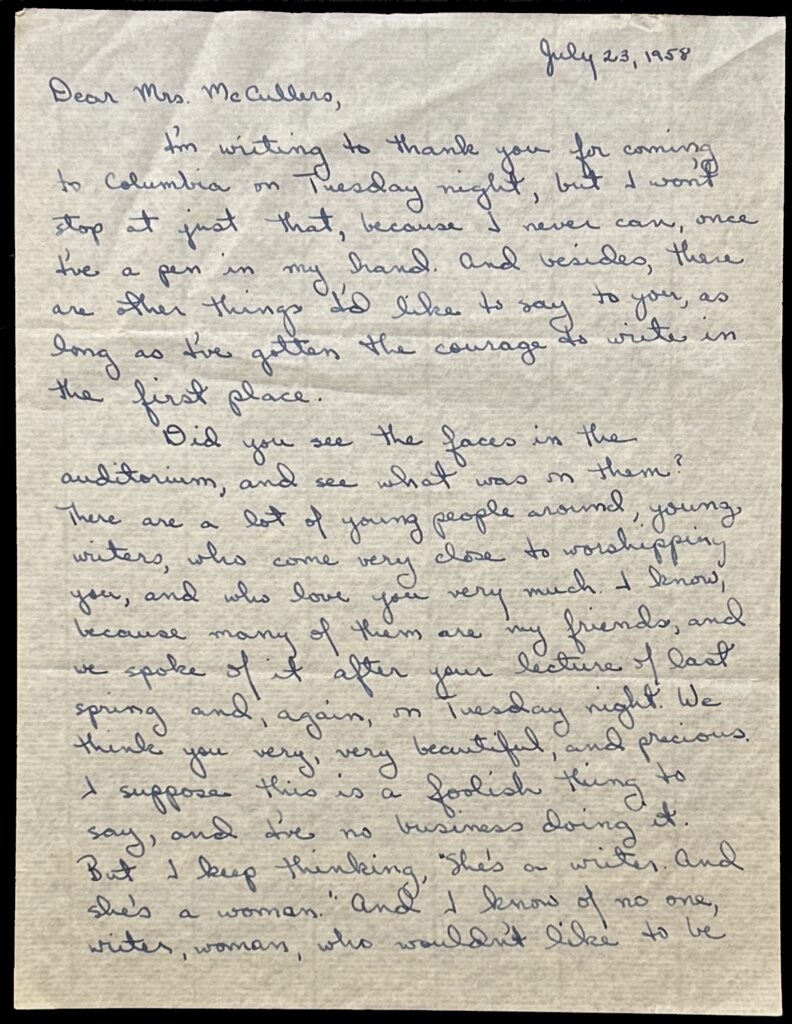
McCullers’s most devoted fans saw their written responses to her work as direct and necessary completions of a “correspondence” that she had begun. One female student makes this point when she writes in 1958 to thank McCullers for reading at Columbia University, but then decides to say more, “as long as [she has] gotten the courage to write in the first place”:
There are a lot of young people around, young writers, who come very close to worshipping you, and who love you very much … We think you very, very beautiful, and precious … You spoke to us of communication, of how difficult it is to communicate. I had to tell you, then, in case you didn’t know, that you have reached us, so many of us, not only through your work, but through your presence, too … And now, I guess, I’m just trying to give back something, whatever it may be worth, so that the communication can have been both ways [italics mine] … This isn’t a fan letter. I hate them and don’t write them. But it is a love letter, if you’ll have that.
As this striking testimony shows, there was a collective sense of an “us” that McCullers was reaching. To them, McCullers’s fiction was regularly entwined with her person, and together they were experienced, and returned, as “precious,” tender gestures of love.9
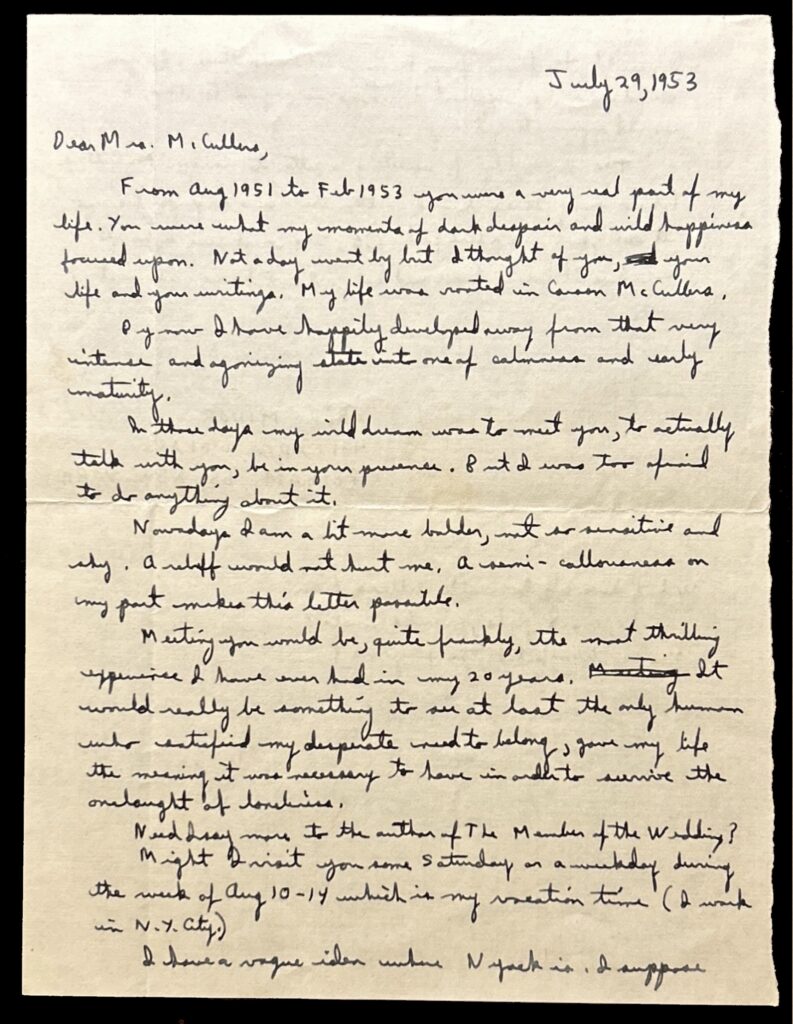
Loneliness is not merely theme or mood, it is stitched into the plots of McCullers’s fiction, which regularly features characters whose devotion is left suspended, unrequited, or scorned. In response, her readers rush to love them instead and, through them, love McCullers. One reader from Pelham, New York, names this dynamic, pouring forth his gratitude in tiny, cramped handwriting:
From Aug 1951 to Feb 1953 you were a very real part of my life. You were what my moments of dark despair and wild happiness focused upon. Not a day went by but I thought of you, your life and your writing. My life was rooted in Carson McCullers … the only human who satisfied my desperate need to belong, gave my life the meaning it was necessary to have in order to survive the onslaught of loneliness. Need I say more to the author of The Member of the Wedding? (F. M., July 29, 1953)
Echoing the ethical dilemma of Henky Evans’s unanswered letters, McCullers’s most devoted readers understand the necessary dynamics of a loyal “Correspondence.” Their reader responses offered the author and her characters the sense of belonging that was desperately missing from their world.
Archives of Feeling
“Thinking about feelings” is necessary work for queer theory and criticism, and McCullers’s fiction and fan mail overflow with feeling. One of the most moving moments in any of McCullers’s works happens when the dejected adolescent protagonist of The Member of the Wedding, Frankie, deigns to let her little cousin John Henry sleep in her bed, then sits and watches him sleep: “It felt like a little clock was ticking inside him,” McCullers writes. “He smelled like a sour little rose. Frankie leaned down and licked him behind the ear. Then she breathed deeply, settled herself with her chin on his sharp damp shoulder, and closed her eyes: for now, with somebody sleeping in the dark with her, she was not so much afraid.” As John Henry, who is also marked by McCullers as queer, finds sanctuary in her bed, the tomboy Frankie, so desperate for love, allows herself a taste of human connection. The sensual details bear a strangeness, a queerness—in Frankie’s impulse to “lick” this boy, his “sour” smell, the “damp” shoulder, and in their relatedness as cousins and fellow misfits. The scene indicates that the erotic aspects of the written longings, intimacies, and affections sent to McCullers are also worth considering.10
Love stories at their core, McCullers’s works hooked readers like romances. Even her titles forecast heartache. In Ballad of the Sad Café, for example, McCullers incorporates a philosophy of the paradoxes of love to frame the darkly comic tale of a doomed love triangle formed by an amazonian androgyne, a “hunchback dwarf,” and a violent ex-convict: “The curt truth is that, in a deep secret way, the state of being beloved is intolerable to many. The beloved fears and hates the lover, and with the best of reasons. For the lover is forever trying to strip bare his beloved. The lover craves any possible relation with the beloved, even if this experience can cause him only pain.” As a public figure, McCullers repeated or extended this discourse on love in her published essays and other writings for wider audiences: “Love is the bridge that leads from the I sense to the We,” she argued in a 1949 piece for the Herald-Tribune‘s This Week, titled “Loneliness … An American Malady.” Marguerite (Rita) Smith, McCullers’s sister, who edited a posthumous collection of Carson’s writings, shares a telling anecdote: One evening, at a university lecture, Carson had just finished reading “Stone Not Stone,” a brief poem to an unnamed “you” who has irrevocably “altered” the speaker’s world, leaving even the starlight “bent” above their “torn room.” After the reading of the poem, Smith reports, there was a silence, and then an audience member stood and simply said, “Mrs. McCullers, I love you.”11
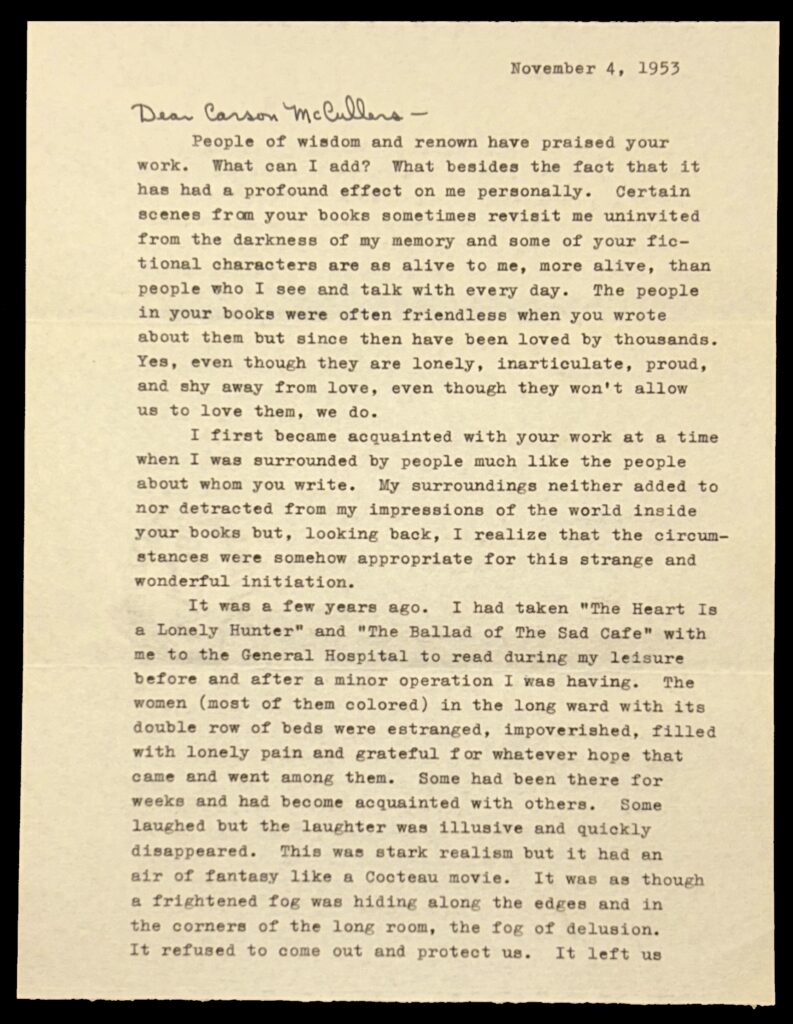
Love is transcendently part of the correspondence. Friends address her with deep affection, and strangers declare “I love you,” or “we love you,” or “you saved my life.” Such messages from readers echo themes in McCullers’s fiction, and they signal something specific and achingly significant about the function of her work at midcentury: It pulled the isolated and excluded together. Like the “I’m with you in Rockland” incantations of the more celebrated author Allen Ginsberg’s 1954 poem “Howl,” McCullers’s literature telegraphed a call to her readers, a keening for those sharing the oppressions of loneliness and marginalization. “Certain scenes from your books sometimes revisit me uninvited from the darkness of my memory,” wrote one female fan in 1953, “and some of your fictional characters are as alive to me, more alive, than people who I see and talk with every day. The people in your books were often friendless when you wrote about them but since then have been loved by thousands. Yes, even though they are lonely, inarticulate, proud, and shy away from love, even though they won’t allow us to love them, we do.” The “we” this reader describes incorporates the “thousands” that love the “fictional characters” in McCullers’s books, transforming them into a chorus of “people,” a community, a counterpublic.12
The many references to the lonely and lovelorn in both the fiction and the fan mail begin to accrue queer connotations, given the historical context of gender and sexual containment after World War II, in which marriage rates reached historic highs (78.8 percent of households in 1950) and age of marriage reached historic lows (median age 20 for women, 23 for men, by 1956). In the face of this fiercely heteronormative culture, McCullers inhabited queer cultural spaces and befriended figures who would have been, and often were, persecuted and cast as deviants in the sex panics that characterized midcentury America. She earned the admiration of Tennessee Williams, who promoted her writing and encouraged her adaptation of The Member of the Wedding into a play. She kept close correspondence with such figures as the persecuted gay literary critic and Smith College professor Newton Arvin, the red-baited Yaddo director Elizabeth Ames, and the trans (or intersex) author Dawn Langley Simmons. McCullers and her husband, Reeves, famously fell into a love triangle of sorts with composer David Diamond. Reeves was more tormented by his sexuality, but McCullers’s lesbian attachments were well-known among her friends, despite the erasure or diminishment of these relationships by critics and biographers, a problem powerfully corrected by Jenn Shapland’s innovative 2020 work, My Autobiography of Carson McCullers.
As in McCullers’s fiction and her life, thinly veiled queer accents and attachments are everywhere in her reader correspondence: delicate use of pronouns, careful omissions, loud silences, and countless references to “loneliness” and “belonging,” which themselves may telegraph the realities of queer existence at midcentury. Letters to McCullers from members of a more openly queer social circle of artists, writers, actors, and others also encourage queer readings of the general correspondence. Actor Sandy Campbell, for example, who penned reviews for the New Yorker, wrote to McCullers in 1946 to invite her into a distinctly queer canon: “I collect modern autographed books and I have books by: Thomas Mann, Andre Gide, Gertrude Stein, W. H. Auden, Isherwood, K. A. Porter, E. E. Cummings, etc. I should certainly like to have your book signed too. May I send it to you?” McCullers would remain friends with Campbell and his partner Donald Windham, an influential gay couple in New York literary circles. Sometimes McCullers’s social circle wrote to her explicitly about depression or suicide; many wrote notes of sympathy after her husband Reeves’s death by suicide; notes from mutual friends expressed shared concern for the queer-baited professor Newton Arvin’s life after his arrest and forced retirement from Smith College. McCullers’s first biographer, Oliver Evans, shared quiet, careful confidences in his letters to McCullers about having to choose between loneliness and the dire risks of cruising in the South. Such correspondence suggests the significance of the network of queer artists, writers, and intellectuals that McCullers had joined in the context of the Lavender Scare and signals the importance of these critics and writers in forging a new American literary canon of which McCullers was working to become a part.13
Other more subtle, sometimes comical, or even accidental queer elements dot the correspondence as well. A reader McCullers met on a train opens her letter with the offhand comment, “I hope you won’t think this letter terribly queer.” And for an author who identified privately as an “invert,” gender instability surfaces in surprising ways as well, as when an Italian publisher addresses McCullers with “Dear Sir,” or when a young couple in Lexington, Kentucky, writes to have McCullers solve their argument over her gender. A woman writing to McCullers from New England lets McCullers in on a “little secret”: “I am in love, too,” and then refers to her beloved as “this person”—carefully avoiding pronouns to preserve safety through anonymity.14
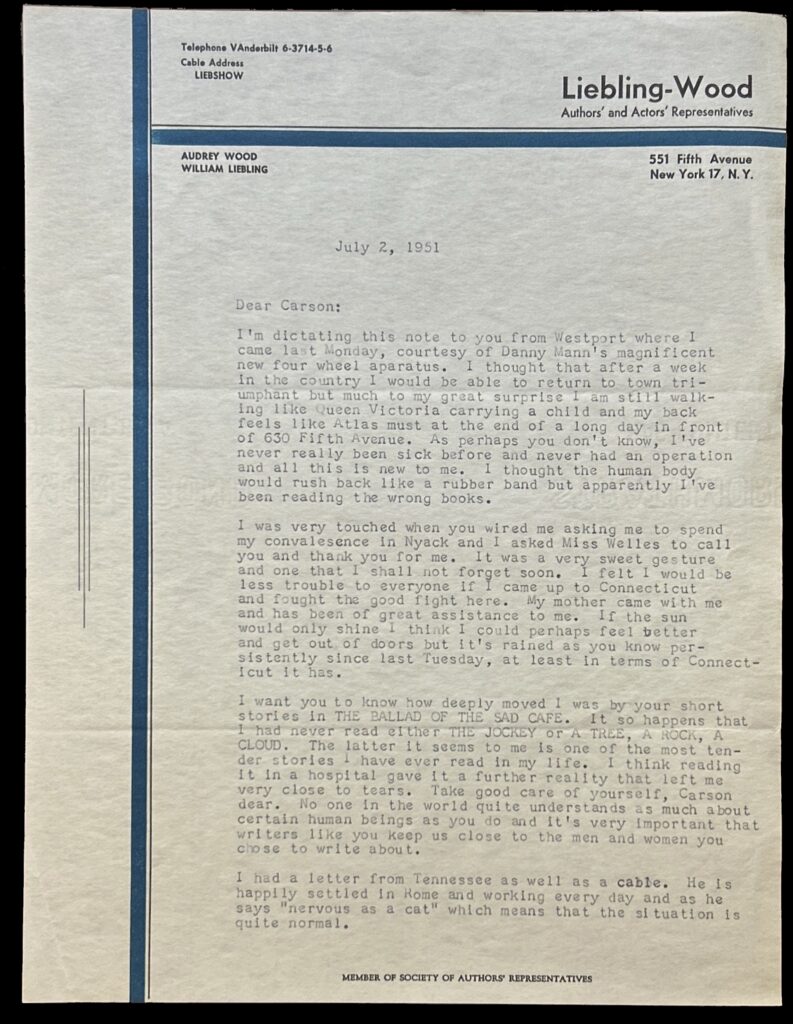
McCullers’s professional correspondents, too, in pausing to tell her how much they treasured her work, convey the importance of her books to “certain” people, as this agent does in 1951:
I want you to know how deeply moved I was by your short stories in Ballad of the Sad Café. It so happens that I had never read either “The Jockey” or “A Tree. A Rock. A Cloud.” The latter it seems to me is one of the most tender stories I have ever read in my life. I think reading it in a hospital gave it a further reality that left me very close to tears. Take good care of yourself, Carson dear. No one in the world quite understands as much about certain human beings as you do and it’s very important that writers like you keep us close to the men and women you chose to write about.
As this letter indicates, illness and disability, regular features of McCullers’s fiction and a profound reality in her life, were an intersecting node through which McCullers’s readers telegraphed their devotion. Understanding that McCullers struggled with chronic illness, readers regularly disclosed themselves as sick or even dying, or as having overcome major illness or debility, or as writing or reading while recovering in hospitals or sanitariums. Letters in the archive to McCullers from close friends and colleagues often bear an anguished tone, expressing a longing for more and better communication, as friends openly convey their love, concern, and admiration for a writer managing the intersection of queerness and disability in the shadowy space of her public/private life. Across all these communities, McCuller’s life and art constructed an appealingly complex middle ground, a kind of third space in which her characters—and readers—might manage to survive the world’s oppressive forces.15
“The We of Me”
In The Member of the Wedding, the adolescent protagonist Frankie Addams, seeking a sense of belonging, wishes to join with her brother and his bride-to-be and somehow be the third “member” of their loving relationship. “All other people had a we to claim,” Frankie realizes. “They are the we of me.” Echoing this mirroring theme, many of McCullers’s correspondents claimed to be like her or her characters in some way, whether that be through loneliness and isolation, through gender or sexuality, through writerly or regional identity, or through illness or disability. They credited McCullers with helping them understand themselves. In 1946, a US Army captain wrote poignantly from Mississippi after reading her third book, The Member of the Wedding: “To read something I wish I had written always breaks my heart a little, me being a fellow who wants to write … And you’ve contributed toward breaking my heart three times. You’re doing a beautiful job with words and sentences and thoughts that are strung together until they shine as the stars do.” Almost two decades later, a nineteen-year-old philosophy student wrote from Manila, Philippines, quoting McCullers’s work in her letter: “I read your works often … Sometimes I see me in them. Like in Frankie—F. Jasmine Addams. ‘Very early in the morning she would sometimes go out into the yard and stand for a long time looking at the sunrise sky. And it was as though a question came into her heart, and the sky did not answer … something inside her stiffened and waited’ … I hope I do not presume too much in saying that I feel I have known you for a long time, and think of you as a wise, warm friend. But since it is quite unlikely that I shall ever meet you in the flesh … I have settled for keeping a scrapbook.” This writer asks for a photo, and McCullers obliged, noting at the foot of the letter, “picture mailed.” Using the language of love, friendship, and connection, these readers see McCullers as their world-builder and reciprocate by inserting her into their worlds. Through her, they found a “we,” and through that we, they could better perceive their “me.”16
Correspondents invoke the language of call and response in their testimony, understanding that their responsibility is to do more than read; they labor, listen, and feel. One fan, in a 1951 letter, acknowledges the critical function of McCullers’s art in her life: “Recently I have been reading, over and over again, your novel The Member of the Wedding … It seems to me a perfect work of art … I loved it as one ordinarily loves a book that one loves, but also I felt that it had something to say to me, which, if I could only listen hard enough, I would hear.” Another female reader describes listening to the 1958 LP Carson McCullers Reads from The Member of the Wedding and Other of Her Works: “[I have] listened to your record many times and I weep with you when you read Frankie’s speech … I believe you reach the heart of this ‘aloneness’ more truthfully than any other author I’ve read. You must have a beautiful soul. I feel … much more of a person, somehow [italics mine], for having read you.” Whether identifying with the author or her characters, readers found reflections of themselves in McCullers’s eye.17
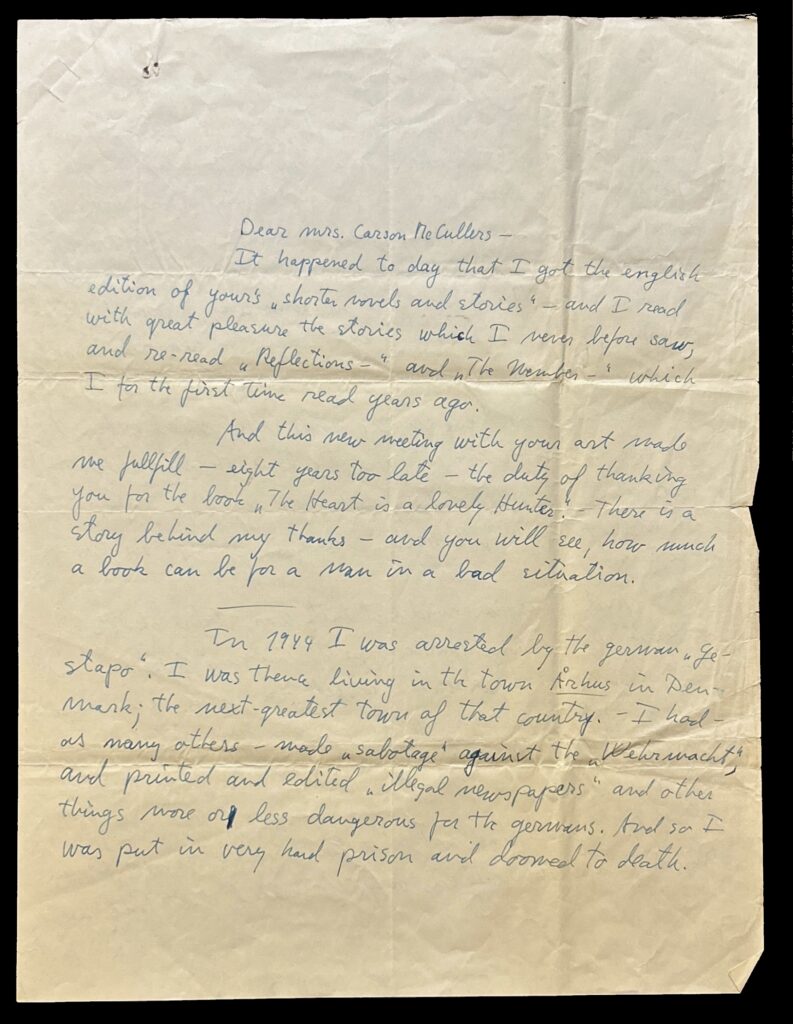
It is no exaggeration to say that Carson McCullers’s works were life-saving. The intensity of emotion in the correspondence suggests that McCullers was helping her readers to exist. Of all the fan letters in the archive, none was more arresting than the one sent from Ramstad, Norway, which moves from the ethical functions of fiction to the existential. While imprisoned by the Nazis during World War II, this reader miraculously acquired a copy of McCullers’s The Heart Is a Lonely Hunter:
And thus, in midst of bitter war, before death, in a lonely cell, without further hope of live [sic] and freedom; and under circumstances, which, – I can tell you – were very horrid – your book became a torrent of hope and joy (and tears) – a symbol of the lost freedom, – and my only consolation for those weeks.
After this struggle, the Ramstad reader was sent on to a German concentration camp, where, as he wrote to McCullers,
I promised myself, when I saw that I might escape death, that I should tell you about the place your book had in my fate. I can say you, that without “The Heart”—I should have killed myself in time before the germans would kill me. But in some way I thought after reading the book, that things could change, and that I should wait my time out … The inner strength to live through all the terrors I got from your book … So I now at last can say you, with my whole heart (and in a bad english!) thank you for this your first and best book, which had more strength and vigour to comfort than anything else in a period of my life where I most needed relief.
Such stunning reader testimony brings the metaphorical significance of McCullers’s “revolt against isolation” to a profoundly literal level: This book saved a reader’s life. How many more did her writing save?18
Books Save Lives
Fan letters to McCullers provide an opportunity to read about reading itself. Like many authors, McCullers reached readers not solely through her novels but also by publishing stories, essays, and poems in a range of venues. Her fans wrote letters after reading her work in glossies like Mademoiselle, Esquire, and Vogue; newspapers, such as the New York Herald Tribune; or magazines, including the New Yorker and the New Republic. Some read everything she wrote, others stumbled across her work unexpectedly. Some wrote to McCullers after seeing her work performed or on screen or after listening to her voice on LP records. Others decided to read her work only after having seen these media adaptations. Some encountered her work in the context of a classroom, since the paperback revolution made books more affordable. One high school teacher even assigned his entire class to write her letters when they finished reading The Heart Is a Lonely Hunter.19
This relationship with books was new, a culture of reading made possible by postwar transformations in the production and distribution of books, as well as shifts in higher education and leisure time. The McCullers correspondence suggests reading was a strategy for self-improvement and class mobility; some letters to her expressed shame for not having read a particular text, or not having read more in general. Many readers evaluated her writing in the context of her previous works, making comparisons and judgments as part of an imagined community of McCullers superfans. Some evaluated and situated her in a broader American canon. With such gestures, fans both measured McCullers and crafted their own identities as members of an emergent reading class.20
Carson McCullers’s readers also worked to place the author geographically. Certain scholars, publishers, and journalists, as well as family members and hometown friends, repeatedly pulled McCullers South. But others, writing from New York, Europe, and beyond, regularly inserted McCullers into a cosmopolitan, transatlantic canon that included Flaubert, Bowen, and Dinesen. One Louisiana reader wrote two fan letters to McCullers, one in 1956 and another in 1963. Full of devotion, these letters signal a shift in the writer’s reputation across the arc of her career, as the reader describes her at first as “a talented young Southern writer” and later as “the best contemporary American teller of tales, and by best I simply mean the truest and the most beautiful. [Your writing] will last; it is timeless and placeless, universal and permanent.” Such evaluations produced McCullers, the southern gothicist, but also McCullers, the cosmopolitan modernist, and McCullers, the American author, who could hold her own alongside Hemingway, Faulkner, or Wolfe.21
The work of determining Carson McCullers’s place in American letters continues, as scholars frame her variously as a regional, national, or international writer; debate her as modernist or middlebrow; contemplate her as a woman writer, a queer writer, or perhaps a trans writer before her time. The passion for McCullers also continues, from Oprah Winfrey’s selection of The Heart Is a Lonely Hunter for her 2008 Book Club, to Suzanne Vega’s one-woman show “Unjoined: An Evening with Carson McCullers,” to Sarah Gubbins’s 2012 play fml: how Carson McCullers saved my life for Chicago’s Steppenwolf Theatre, to Karen Allen’s short film version of “A Tree. A Rock. A Cloud,” to any number of new articles and auto/biographies. Such works are less a revival than a continuation of a call-and-response that McCullers’s work has long evoked. McCullers’s more contemporary “correspondents” still respond to her and her work from some of the same margins, and many still share the sense that McCullers has allowed them to know themselves. Jenn Shapland’s innovative hybrid biography/memoir, for example, is in many ways the apotheosis of the kind of correspondence between McCullers and the queer counterpublic that her life and fiction evoke. In a newer historical context, the expressions of queer connection become more open, or less circumspect. But now, as in the past, McCullers invites her most devoted readers to come in.22
For Carson McCullers, this archive of fan correspondence likely sustained her own ability to continue to write, despite the terrible obstacles of her own loneliness, illness, and loss. For the rest of us, attention to this one writer’s correspondence can inspire a reevaluation of the significance of letter-writing and of the impact of one author during a tumultuous time. As Rachel Adams has noted, McCullers’s fiction cultivates “alternative spaces” where new possibilities are “germinated, nurtured, and articulated.” But it is the space between her fiction and her readers where the shape of that world comes into focus. As the correspondence shows, it is a world where secrets can be shared, where loneliness becomes solidarity, where tenderness is treasured, and where love is not spurned but returned. Carson McCullers’s readers remind us that books build community, that books are communicative human acts, that books save lives. And the correspondence reframes McCullers not solely as a southern writer, nor solely as a queer writer, but as a midcentury modernist with complex literary geographies and lasting cultural significance.23
Anna Creadick is George E. Paulsen ’49 Professor of English and core faculty in American Studies at Hobart and William Smith Colleges. In addition to her book Perfectly Average: The Pursuit of Normality in Postwar America, she has published essays in Mosaic, Legacy, Appalachian Journal, and The Tacky South, and one on banjo shame for Southern Cultures.
NOTES
All reader correspondence discussed here comes from the Carson McCullers Collection, Series III Recipient [Letters], 1939–1967, Boxes 25–29, Harry Ransom Center, The University of Texas at Austin. Correspondents who were public figures are named, but everyday readers are cited henceforth by initials and date. I am grateful to Erica Abrams Locklear, Ani Mukherji, and Michael Bibler, among others, for early feedback on this essay, and to Kate Villinski and Strummer Dunn for research assistance. Special thanks to the anonymous reviewer who helped formulate the idea of “identification without category” and to the Southern Cultures reviewers and editors whose close, careful feedback helped me strengthen this final version. This essay is dedicated to Cadence Whittier and Grant Holly.
- Carson McCullers, “The Flowering Dream: Notes on Writing,” Esquire, December 1959, reprinted in The Mortgaged Heart: Selected Writings, ed. Margarita Smith, 1971 (Mariner, 2005), 274–282, 279.
- Unlike Carson, Reeves McCullers was, as Jenn Shapland puts it, “a writer who never wrote.” Like Carson, he had same-sex affairs outside their marriage, but Reeves was more fraught about his sexuality. He was a violent alcoholic, suicidal, and by some accounts even homicidal, having tried to involve Carson in a suicide pact. They married, divorced, and remarried, but Carson finally left him for good after he was found to have been cashing her checks. See Shapland’s My Autobiography of Carson McCullers: A Memoir (Tin House, 2020), 170–174, 190–194. Dwight Garner, “The ‘Sad, Happy Life’ of Carson McCullers,” review of Mary V. Dearborn, Carson McCullers: A Life (Knopf, 2024), in the New York Times, February 19, 2024; Sherill Tippens, February House: The Story of W. H. Auden, Carson McCullers, Jane and Paul Bowles, Benjamin Britten, and Gypsy Rose Lee, Under One Roof in Brooklyn (Mariner, 2006). The object of McCullers’s affection was Swiss writer and photographer Annemarie Schwarzenbach. Carson McCullers, “Look Homeward, Americans,” Vogue, December 1, 1940, reprinted in The Mortgaged Heart, 209–213; 209, 212–213.
- Carson McCullers, “Correspondence,” New Yorker, February 1942, reprinted in The Mortgaged Heart, 153–159, 159. Daniel Davis Wood first pointed me to “the emergent kinship between the girl and the reader who shares her purpose” in his essay “Howling into the Silence, Yearning for a Reply,” Infinite Patience, December 22, 2010, danieldaviswood.com/tag/carson-mccullers/.
- Of the more than one thousand letters in the general correspondence file for McCullers at the Ransom archive, I culled and worked closely with roughly one hundred pieces of fan correspondence from people I would describe as “everyday readers,” correspondents who appeared to be unknown to the author. William Faulkner, for example, reportedly burned his fan mail. See Anna Creadick, “Reading Faulkner’s Readers: Reputation and the Postwar Reading Revolution,” in Faulkner and History: Faulkner and Yoknapatawpha, 2014, ed. Jay Watson and James G. Thomas Jr. (University Press of Mississippi, 2017), 158–176. In “Publics and Counterpublics,” Michael Warner writes, “A counterpublic maintains at some level, conscious or not, an awareness of its subordinate status. The cultural horizon against which it marks itself off is not just a general or wider public, but a dominant one … The discourse that constitutes it is not merely a different or alternative idiom, but one that in other contexts would be regarded with hostility or with a sense of indecorousness … Within a gay or queer counterpublic, for example, no one is in the closet: the presumptive heterosexuality that constitutes the closet for individuals in ordinary speech is suspended.” Public Culture 14, no. 2 (Winter 2002): 49–90, 86. See also Lauren Berlant and Michael Warner, “Sex in Public,” Critical Inquiry 24, no. 2 (Winter 1998): 547–566.
- McCullers had a severe but misdiagnosed case of rheumatic fever, which resulted in a series of increasingly devastating strokes. Suffering also from alcoholism and severe depression, she eventually became partially blinded and paralyzed. She worked from a bed or wheelchair for the final decade of her life, generating her final 1961 novel Clock Without Hands under tremendous strain, then producing an unfinished autobiography via dictation. She died of a final stroke in 1967, at age 50.
- Carson McCullers, “Author’s Outline of ‘The Mute'” (The Heart Is a Lonely Hunter), in The Mortgaged Heart, 124–152; 124.
- Ballad of the Sad Café was originally published in Harper’s Bazaar in 1943, then republished in 1951 as the title story of a collection of her short works. S. M. B., September 25, 1961. McCullers’s short stories were also often mentioned by name in the correspondence, especially “A Tree. A Rock. A Cloud.” and “Who Has Seen the Wind?” As Claire Lenviel argues, “What McCullers ultimately explores in Reflections in a Golden Eye is that all desire is queer, and this queer desire transgresses both heteropatriarchal and homosexual definitions of sexuality.” See Lenviel’s “‘At the Expense of Normalcy’: A Queer Reading of Carson McCullers’ Middle Works” (master’s thesis, Radford University, 2012), 46, https://wagner.radford.edu/58/1/Lenviel_Thesis_Final.pdf.
- B. A., June 28, 1951; A. B., September 23, 1956; Andrée Chedid, March 4, 1953; Jordan Massee, March 1, 1953. Sarah Schulman, “If They Mated: Carson and Gypsy,” Letter to the Editor, The Gay and Lesbian Review, February 18, 2016, http://www.glreview.org/article/readers-thoughts-7/. Massee was also friends with Tennessee Williams, and his father may have inspired the character Big Daddy in Cat on a Hot Tin Roof. One of his nicknames for his cousin Carson was apparently “Sister Woman.” See Barbara Ewell, Carlos Dews, Virginia Spencer Carr, and Will Brantley, “Exotic Birds of a Feather: Carson McCullers and Tennessee Williams,” The Tennessee Williams Annual Review, 2000, http://www.tennesseewilliamsstudies.org/journal/work.php?ID=31.
- P. A., July 23, 1958.
- I am borrowing from Ann Cvetkovich, An Archive of Feelings: Trauma, Sexuality, and Lesbian Public Cultures (Duke University Press, 2003). Hearing Cvetkovich, Heather Love, and other theorists at a Queer Method conference at the University of Pennsylvania was foundational to framing this essay. I am also grateful to Caél Keegan, Jaime Harker, and Michael Bibler for helping me approach this archive through the productive lenses of affect theory, trans studies, and queer southern studies. Sarah Chinn, “Queer Feelings/Feeling Queer: A Conversation with Heather Love about Politics, Teaching, and the ‘Dark, Tender Thrills’ of Affect,” Transformations 22, no. 2 (Fall 2011/Winter 2012): 124–125. Carson McCullers, The Member of the Wedding (1946, Mariner, 2004), 15.
- Carson McCullers, Ballad of the Sad Cafe and Other Stories (1951, Mariner, 2005), 26; Carson McCullers, “Loneliness … An American Malady,” This Week, December 19, 1949, reprinted in The Mortgaged Heart, 259–261, 260; Marguerite Smith, quoted in The Mortgaged Heart, 285.
- Allen Ginsberg, “Howl,” in HOWL and Other Poems (City Lights, 1956), 19–20; P. C., November 4, 1953.
- Sandy Campbell, April 14, 1946. Campbell retired from acting to focus on writing and publishing largely in support of his life-partner Donald Windham, whom he met while an undergraduate at Princeton in 1943. They remained together until Campbell’s death in 1988. See also Terry, “Donald Windham and Sandy Campbell,” Gay Influence: Gay & Bisexual Men of Importance [blog], March 6, 2013, gayinfluence.blogspot.com/2013/03/donald-windham-and-sandy-campbell.html. Michele Cantarella, October 28, 1960. Caleb Crain, “Search and Destroy,” review of The Scarlet Professor: Newton Arvin – A Literary Life Shattered by Scandal (Doubleday, 2001), New York Times, August 5, 2001, www.nytimes.com/2001/08/05/books/search-and-destroy.html.
- V. D., September 13, 1944; E. C., March 1, 1950. With the Kentucky couple, a comical domestic scene unfolds: The young man reads McCullers’s story “Who Has Seen the Wind?” in a magazine while the young woman readies herself for their date. They disagree over whether a line like “His scrotum tightened and he tried desperately to look unconcerned” could have been written by a woman, and decide simply to write McCullers and ask if she is a man or a woman. E. G., September 15, 1956.
- Audrey Wood, July 1951.
- McCullers, Member of the Wedding, 42, emphasis in original; C. B. C., April 6, 1946; A. M. P., June 1963.
- J. C., February 3, 1951; J. S., July 27, 1959.
- M. R., November 28, 1952, emphasis in original.
- The teacher, from Hyde Park, Massachusetts, decided “because of [his] great affection for [her] book” The Heart Is a Lonely Hunter to assign it for outside reading for his seniors, then invited his students to write the author directly. “I thought you might be interested in reading the reactions which some of them expressed, after finishing the assignment,” he wrote to McCullers, adding, “I am convinced that they are all expressing their true feelings.” The students, in their tentative way, focused in on the “suffering,” the “sadness,” the “heartaches” of the characters, and shared these feelings, echoing the tenor of the other direct correspondence: “I was right in the story … Their heartaches were mine, and their happiness I could feel.” (B. E., December 22, 1966).
- This reading revolution was also gendered in powerful ways, as I discuss in “Gendered Terrain: Middlebrow Authorship at Midcentury,” Post-45, July 1, 2016, https://post45.org/2016/07/gendered-terrain-middlebrow-authorship-at-midcentury/; B. A., June 28, 1951.
- W. S .G., September 15, 1956; W. S. G., May 30, 1963.
- For example, Sarah Schulman, “White Writer,” New Yorker, October 21, 2016, www.newyorker.com/culture/cultural-comment/white-writer; Shapland, My Autobiography of Carson McCullers; Dearborn, Carson McCullers: A Life. An example of more contemporary response is this comment from an online reader in 2012 about Clock Without Hands: “In Jester I feel as though Carson McCullers is seeing through me. How can she put herself in a soul of a young gay teenager is beyond my comprehension.” Janko, December 26, 2012, Comment 2814, http://startnarrativehere.com/2010/02/clock-without-hands-by-carson-mccullers-1961/#comment-2814.
- Rachel Adams, “‘A Mixture of Delicious and Freak’: The Queer Fiction of Carson McCullers,” American Literature 71, no. 3 (1999): 551–583, 553.