1
One drizzly Tuesday night in Chapel Hill—April Fool’s Day, 1975—my girlfriend and I were studying in the student union at the University of North Carolina. We’d found a vacant room then shut the door, spreading out books and notes to prepare for upcoming exams.
After a few hours, we needed a break. Walking into the open common area, each of us noticed something we hadn’t seen when coming in: a large punchbowl filled with peanuts. Nobody was protecting it, nor did it seem to be a prank. And so—being college kids, and therefore poor, and always hungry—we walked straight to it and started eating nut after nut, enjoying this salty manna that the Lord had so generously provided.
But not for long. Behind us, double doors swung open from the Great Hall, and people burst forth, surrounding a slight man who was striding straight toward us and that bowl of plenty. He smiled, put out his hand, shook ours heartily, and said, in a soft southern accent, “Hello, I’m Jimmy Carter, and I’m running for president.”
I’d registered to vote in my hometown of Asheville four years earlier: Mom took me to the courthouse downtown, and I entered the rolls as a Democrat, as was the local custom. That fall, a freshman in college, I got an absentee ballot to return by mail, since I wasn’t planning to be in Buncombe County on the second Tuesday in November 1972. But a few weeks before Election Day, I found myself back home, sitting at the kitchen table with that ballot, thinking, I guess I might as well fill this out. My mother—an ardent Nixonite, for some reason—walked by, saw what I was preparing to do, leaned down, looked into my face, and said, “Son, if you mark that ballot for McGovern/Shriver, I’m gonna tear it right up.”
“Oh, Mom,” I said as she walked away, marking my ballot for McGovern/Shriver, “I’d never do that.”
I also voted for Nick Galifianakis, running for a US Senate seat against Republican newcomer Jesse Helms, the first of five fruitless times I’d say Yes to Senator No’s opponent. (And thus was born a yellow dog Democrat.)
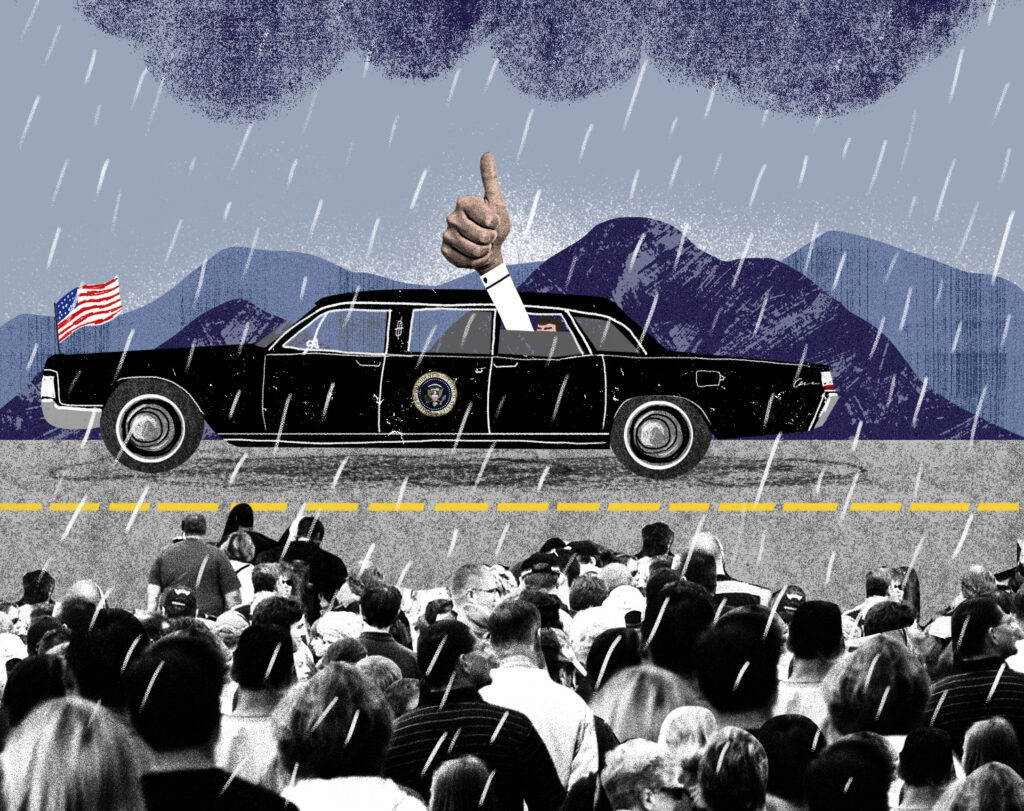
President Nixon had visited Asheville in October 1970, stumping for a local Republican congressional candidate. Though my mother very much wanted to see and hear him, she wasn’t willing to drive downtown to City-County Plaza and fight the crowds, so we stayed near home and waited on a cold rainy shoulder of then-new I-26 near the airport, south of the city. And waited. And waited. Eventually, traffic disappeared in the southbound lanes; soon, the black advance cars appeared; then there it was, the long presidential limousine, wet flags flapping as it sped toward Air Force One. And, finally, there he was, viewed through the lowered back window, the most powerful man in the world, waving at several dozen citizens lined up along a mountain interstate.
At least, I assumed it was Nixon, in that dim interior, swiftly passing by. I think I saw a hand moving, in a political-howdy manner, before the window slid back up to keep him dry. The next day I learned that at the rally, among many other things addressed—it was not a short speech, despite the rain—he said, “Young Americans are not going to be killed in Vietnam in the months ahead.” Mom may have believed him, but I didn’t. Three years later, when my draft number came up, a low one, making me vulnerable to conscription, I applied for CO status on religious grounds. When Dad—a World War II veteran, a GI who had trekked through Europe for four cruel years—found out, he burst into my bedroom and cried, “I hear you applied to be a communist! I mean, a conscientious objector! Well, it’s worse!”
Mine was a pyrrhic gesture. The draft had ended while my application to Local Board No. 11, Buncombe County, of the Selective Service System was being processed. No more soldiers would be conscripted. But I wanted that 1-H classification declaring me “not currently subject to processing for induction or alternative service” and that draft card I would never need to burn in protest.
The card was surely in my wallet in the summer of 1974, when I was part of UNC-Asheville’s study abroad in Oxford program. We lodged at St. Benet’s Hall, a four-story Benedictine building on St. Giles’, a pleasant boulevard in the north part of town. The brothers kept their TV in the basement, though we rarely watched it, preferring to play croquet together in the backyard or enjoy conversational sherry in the library. But there was big news on Friday, August 9, so everybody gathered down there to watch something that had aired the previous night back in the States: Richard Nixon resigning the presidency, chased from office by the Watergate scandal.
Father James was in his black cassock, as usual, and smoking cigarette after cigarette, as usual, but he was uncharacteristically puzzled. “Why is he resigning, exactly?” he asked us young Americans. “What did he do wrong?” We did our best to explain the political events of the past few years, but the harder we tried, the more puzzled he got. Could he not imagine a country’s leader doing such things as Tricky Dick had done? Or was he wondering why puritanical Yankees were driving from office a typical politician playing democracy’s dirty game? As I climbed the stairs, ready to enjoy one of my last days in Edenic Oxford, he was still smoking and frowning, the house’s tall Master bent toward the tiny black-and-white television.
2
As a first grader, I spent hours, at home and in the classroom, studying my blue plastic pencil box labeled presidents of the united states. It had two narrow cutouts in its lid, with the information displayed in each one controlled by dials at the bottom, the left wheel showing president no. and the right one showing yrs. in office. Inside the box was a card packed with more facts about presidents and vice presidents, including their dates and places of birth, and ages at inauguration and death.
I read all that data so many times that, without meaning to, I memorized it. Somehow, this private obsessive achievement became known to my teacher, the beloved Veatrice Ponder at Valley Springs School in south Buncombe County, a small campus serving grades 1 through 12. She was so impressed that she took me to visit each high school classroom to recite the list, from “George Washington, 1787 to 1797, born Virginia 1732, vice president John Adams,” to the new president, “John F. Kennedy, born Massachusetts 1917, vice president L. B. Johnson.” I rattled off the info fast as I could—it was embarrassing to be the teacher’s clever pet paraded before teenagers about to graduate, who were surely thinking, “Why do we have to listen to this weirdo egghead kid?”
Sometimes I can convince myself that I watched ancient Robert Frost try to deliver “For John F. Kennedy His Inauguration” at the inaugural ceremony in January 1961, before bright sun or bitter wind made reading it impossible. So he recited from memory “The Gift Outright,” a far superior poem. Sometimes I can imagine that watching him on TV that day planted the seed of my lifelong interest in poetry.
Well, maybe. One thing I am sure of: what happened that late November Friday when JFK was killed. After lunch, the principal at Valley Springs announced “The president has been shot” over the intercom, then left the microphone pressed to a radio until Kennedy was pronounced dead and we all went home for the weekend, stunned. That night, I traced his likeness in the center of a sheet of onionskin paper and filled the rest of the crinkly sheet with “John Fitzgerald Kennedy” in my new cursive, his penciled head and shoulders framed by “Born May 29, 1917,” “Inaugurated January 20, 1961,” and “Assassinated November 22, 1963.” My fourth-grade hand was shaky on the tricky capital “F” and “K,” and the lowercase “z,” and it almost stalled on those interminable five-syllable verbs; but I did it, a Baptist boy crafting a heartfelt icon.
And then (why?) I took my sister’s blue Bic ballpoint, to outline JFK’s hair, lips, nose, and eyes. The effect was ghoulish, so I tried to soften the damage with Venus colored pencils. Alas, his brown hair looked like a filthy sponge, and his oddly rectilinear lips were raw strips of bacon, and what I did to his nose so upset me that I colored his navy blue suit and necktie hard, hard, hard, until the paper almost tore. I made a few final background swipes with a deep green pencil; it’s as if the late president’s head is floating in the depths of an eternal oceanic forest, his slightly lifted brows echoing the bags under dark-rimmed pharaonic eyes.
Kennedy was the first president to feature a poet reading at his inauguration. Since then, three others have done so: Bill Clinton (fellow Arkansans Maya Angelou in 1993, reading “On the Pulse of Morning,” and Miller Williams in 1997, reading “Of History and Hope”), Barack Obama (Elizabeth Alexander in 2009, reading “Praise Song for the Day,” and Richard Blanco in 2013, reading “One Today”), and Joe Biden in 2021 (Amanda Gorman, reading “The Hill We Climb”). Carter invited someone from his home state to compose a poem for the occasion, if not the inauguration ceremony itself; James Dickey read “The Strength of Fields” at an inaugural gala the night before his fellow Georgian was sworn in as president.
Were any of these poems actually good? Not particularly, though Alexander’s holds up fairly well in retrospect. But at least an original occasional poem was on the program. Literature was read aloud by a living author. It was part of The Big Show.
No poet has ever read at a Republican’s inauguration. Or ever will, I’d bet.
3
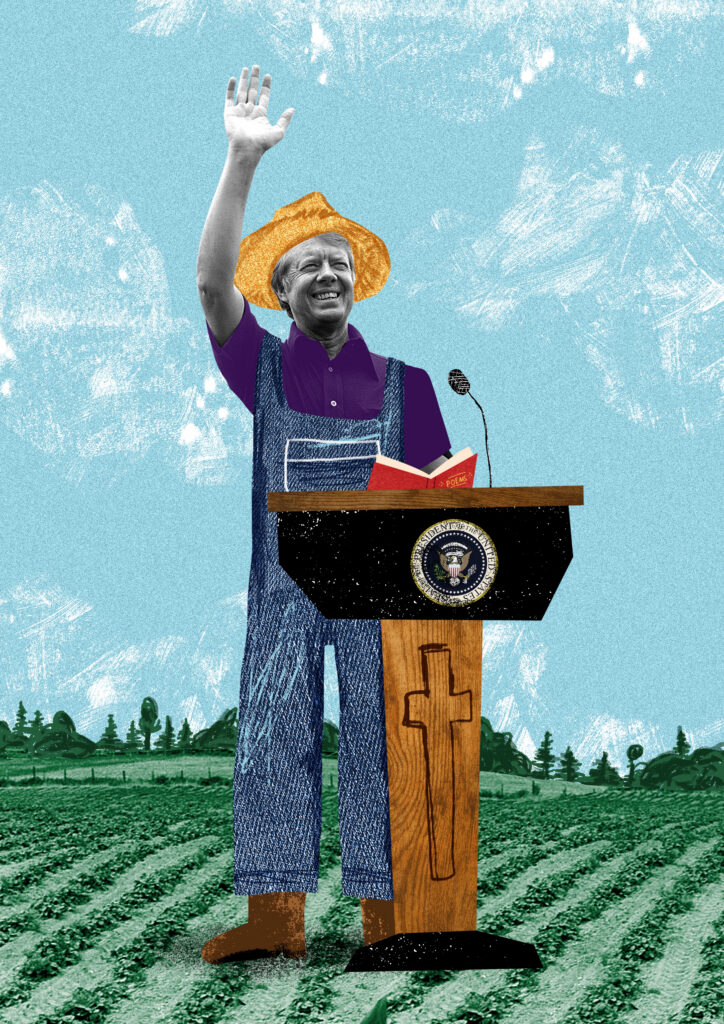
Nearly a year after the Chapel Hill Punchbowl Peanut Surprise, I was back in Asheville, visiting friends one last time before I became a college graduate. One buddy, a student at UNC-A, suggested that we go hear Jimmy Carter speak on that campus, campaigning two weeks before the North Carolina Democratic primary on March 23, 1976. Though his voice was raspy, Carter gave a strong stump speech that night—intelligent, specific, engaging—and waded into the crowd afterward. We were among the first to greet him on the floor of the auditorium. “Don’t get too close,” he warned us. “I’ve got a cold.” This smart farmer from Georgia, so different from other politicians, was winning me over.
jimmy carter for president said the pin-back button I picked up, those bold white caps set in a bright green circle framing a stylized image of smiling Jimmy in the center. I liked it better than his other buttons, including the wordier for america’s third century, why not our best? carter / mondale, with Walter mustering a grimly neutral expression over his grinning running mate’s shoulder. Carter’s superlative “Why Not the Best?” campaign slogan may not have been the most compelling question or logic, but it was more inviting than the incumbent Ford’s experience counts or the independent Eugene McCarthy’s mccarthy ’76.
I was surprised—as an English major and would-be poet at Carolina—to learn that Carter particularly loved Dylan Thomas, whose intense and gorgeously baffling Welsh lyricism was so unlike the plainspoken Georgian’s manner. I remember hearing him quote “The Force That Through the Green Fuse Drives the Flower” in some campaign speeches— and even during a 1977 trip to the United Kingdom, when he expressed dismay that Thomas was not recognized at Poets’ Corner in Westminster Abbey. (In 1982, a memorial stone was installed there, beside fellow bad boy Lord Byron: “Time held me green and dying / Though I sang in my chains like the sea.”)
Carter and his wife, Rosalynn—“my equal partner in everything,” as he said after her death in 2023, whether politics or business or their seventy-seven eventful years of married life—hosted a small “evening for poets” at the Folger Shakespeare Library a few days before his inauguration, and a more formal “Salute to Poetry and American Poets” at the White House a few days before he and his family moved out. Hundreds of invited poets attended, and twenty-one read work in seven rooms. I wish I could have been in the Red Room for the unlikely pairing of Louise Glück and James Dickey, or in the Green Room to see the raised eyebrows of North Carolina maverick Jonathan Williams when he saw that both his first name and his first poem’s title were misspelled in the program. As poet William Matthews later wrote about that congenial literary party, “It had been a long time since poets either felt welcome at the White House or wanted to go there. In some curious and even touching way, American poetry had been honored.”
I also wish I could’ve been there in 1978 when President Carter convened a White House Jazz Festival on the South Lawn: With questionable cadence and pitch, the short-sleeved leader of the free world earnestly delivered the minimal vocals of “Salt Peanuts,” to the great delight of Dizzy Gillespie on trumpet and Max Roach on hi-hat.
4
One reason I warmed to Carter: he was a southerner, born and raised in a state contiguous with mine. His may have been a different world down in Plains, and he spoke with a different version of the regional accent, but he was from the same part of the United States, and his way of speaking was familiar to my ear.
It was not familiar to most Americans. I remember articles and books “explaining” the South in general or this Democrat in particular, like Crackers: This Whole Many-Angled Thing of Jimmy, More Carters, Ominous Little Animals, Sad-Singing Women, My Daddy and Me, by Roy Blount Jr.—a lively and insightful treatment by another Georgia native. Others who were much less sympathetic freely indulged patronizing regional stereotypes. Nonsoutherners did not hesitate to mock Carter’s accent and speech, and editorial cartoonists did not resist adding comically huge peanuts to caricatures of his toothy grin.
Jimmy had a chip on his shoulder, in part because he was southern. That fact allowed people to assume things about him (racism, ignorance, general redneckery) that weren’t true. I was becoming familiar with such slights. The month before Carter’s inauguration, when visiting a friend in Massachusetts, I met her bred-in-Boston father. He knew I was from North Carolina, and, after brief handshaking pleasantries, the first thing he said to me was, “So, say something southern!” I wish I’d replied, “Well, fuck all y’all!” . . . but I was too shy or polite or, well, southern to do so. A few months later, a Harvard-educated professor at UNC would mock me for the Appalachian double modal verb “might could,” which I’d just used—“Where are we anyways,” he asked the class, “the set of The Beverly Hillbillies?”
Maybe they were just trying to be playful. But what they said stung, and that hurt lingered, like a bruise if not a scar. I’m sure Jimmy had many thousands of such experiences out in the much wider world. No wonder he involved unapologetically southern artists like James Dickey or the Allman Brothers or Willie Nelson in White House festivities, and wore jeans and a denim work shirt when he could, and never made excuses for his immediate family members, each one a colorful character—his quotable mother, Miss Lillian; his even more quotable brother, Billy; and his two sisters, Ruth the evangelist and Gloria the motorcyclist. These are my people, for better or for worse, he was saying. We’re all from the same place: The sounds they make are music to my ears. I will always love them, no matter what.
Another thing I had in common with Jimmy: we’d both been raised Southern Baptist.
Like southern accents, Southern Baptists vary widely. I grew up in First Baptist Church, a large congregation in downtown Asheville, whose Art Deco building was designed by Douglas Ellington, the elegant architect laureate of that mountain city. Jimmy grew up in a much smaller place and attended a much smaller church, teaching Sunday School at Maranatha Baptist into his nineties. Once I left my hometown, I left the Baptists behind; he never did. The church and his faith were always important to him, even if he could be a bit sanctimonious about it—plus, he happened to have the same initials as our lord and savior Jesus Christ.
(A denominational aside: Though one may claim to have “left the Baptists behind,” one never quite does. The Bible verses, and the hymns, and above all, the I-am-sinful-and-disappointing-God-no-matter-what-I-do sense of personal guilt persist. It’s hard to enjoy unclouded happiness, given the selfish things you’ve done, and are doing, and will continue to do. Even the ever-devout Carter titled his one book of poems Always a Reckoning: From childhood to death and afterwards, detailed accounts are being kept, and they will be settled one day.)
Carter read and quoted theologians like Paul Tillich. He took his religion seriously, and it would surface in unpredictable places, as during his infamous 1976 interview with Playboy, in which he said, “I’ve looked on a lot of women with lust. I’ve committed adultery in my heart many times. This is something that God recognizes I will do—and I have done it—and God forgives me for it.” When I read that, at the time, I thought, Amen, brother. But he was widely ridiculed for his comments and admitted they almost cost him the election.
Jimmy Carter was a paradox, my favorite kind of person. He was a human being being human, and owning it. He may have been a born-again Southern Baptist—his Secret Service code name was “Deacon”—yet he admired rowdy poets and artists who were no strangers to controlled substances or the brownest of the brown liquors. He loved their work, and he didn’t judge their behavior. “Don’t be condescending or proud” was one of his forgotten points in that Playboy interview: “Christ says, Don’t consider yourself better than someone else because one guy screws a whole bunch of women while the other guy is loyal to his wife.” That’s unexpectedly forthright, and definitely not the neutral diction typical of presidential candidates at the time. I bet such honesty won him a few votes.
5
In mid-July 1979, I was invited to dinner at a friend’s apartment in Durham. For some reason the TV was left on, and I found myself watching President Carter’s address about what he called “a crisis of confidence” in America, our national loss of unity and our doubt about the future, which threatened the social and political fabric of the country. It turned into a speech about energy and conservation, but his description of paralysis and stagnation, in Washington and across the United States, was pretty much spot-on, in my opinion and experience. I came away from it impressed by his frank comments. He avoided the usual patriotic U-S-A rah-rah-rah; it felt like an adult talking thoughtfully with other adults.
Though Carter never used the word in it, that televised talk came to be known as his “malaise” speech. Afterwards, he was chided by conservatives—I’d never heard of George Will before—for being self-righteously negative about the American people. And given the rise of sunny can-do Ronald Reagan, in addition to ongoing gas rationing and double-digit inflation, as well as Russia’s invasion of Afghanistan and the Iran hostage situation, its overcast vision of the country did not help him during his second run for the presidency, however accurate that speech may have sounded to me back then, and even if it seems like a prophecy come true here in 2026.
I’ll never forget Carter’s second election night, Tuesday, November 4, 1980. My wife and I—who’d met him over peanuts at UNC—were settling in to watch a John Wayne movie on local TV. I hadn’t paid much attention to the presidential campaign, and so it had never occurred to this Democrat that the Republican opponent might win. He was just a B-actor joke, right?
Remember Bedtime for Bonzo? Remember “Ronald Ray-Gun . . . Zap! ” at Woodstock?
We didn’t even get to finish our Western. NBC interrupted The Duke with breaking news before 10 p.m.: Our sitting president had lost in an electoral landslide. Carter was already conceding defeat, even before the polls on the West Coast had closed. He did so, apparently, to avoid any impression that he was sulking, but his quick surrender made a bad night feel even worse.
Jimmy Carter touched me. He was a different manner of political candidate, one I liked. He was a different sort of president for four years, one I could relate to. And—compared with those who preceded and have followed him—he was a different kind of ex-president, one I admired for his sincere sustained devotion to ordinary human beings. Carter became like a welcome member of the extended family: not blood kin, but one of those longtime close friends we’d give the honorary title of “uncle” or “cousin.” To me, that latter term of affection is the right one for friendly, sometimes over-earnest Jimmy, who carried a boyish quality even into his second century of life, before passing at the end of December 2024. My country kin might have called him Cud’n Jimmy; we suburban kids would probably have called him Cuz, in a teasing but respectful way.
I admit: Cousin Jimmy could be difficult to like. He stubbornly played the Washington outsider role, in ways that alienated lawmakers, whom he did not woo or charm. Too often (especially when religion came up) he appeared piously stiff, even holier-than-thou, in ways that alienated the voting public. But he was also a hard-on-himself idealist, which may be what attracted me to him in the first place. “I’ll never lie to you,” he promised while campaigning, and tried hard to tell the truth, however inconvenient. That cost him. His thirty-eight years of post-presidential service with Habitat for Humanity was no cameo celebrity appearance; his namesake Center, in Atlanta, has worked around the world to resolve conflicts, to protect democracy and human rights, and to improve the health of needy populations. As he concluded his 2002 Nobel Peace Prize lecture, “The bond of our common humanity is stronger than the divisiveness of our fears and prejudices. We can choose to alleviate suffering. We can choose to work together for peace. We can make these changes—and we must.” He may have been a naval officer, an agricultural businessman, a state senator, a governor, a president—all of which required him to be a practical-minded, detail-oriented, nose-to-the-grindstone man—but that quote shows Carter for what he truly was: a dreamer.
6
I’m not sure why presidents mattered so much to me, when I was growing up. Maybe when you live far from any center of power, as I did in Appalachia, you’re attracted to the powerful? (I’m still ashamed of rooting for the New York Yankees when I was a little leaguer.) Maybe I heard some adult say “You could grow up to be president,” and an optimistic fragment of fatalistic me believed that American myth? Maybe, when you’re young and God feels real, you also believe in the secular god residing in the White House, preserving order in the fallen world? Such faith in such hierarchies may fade with experience, but I’m grateful that it once filled me.
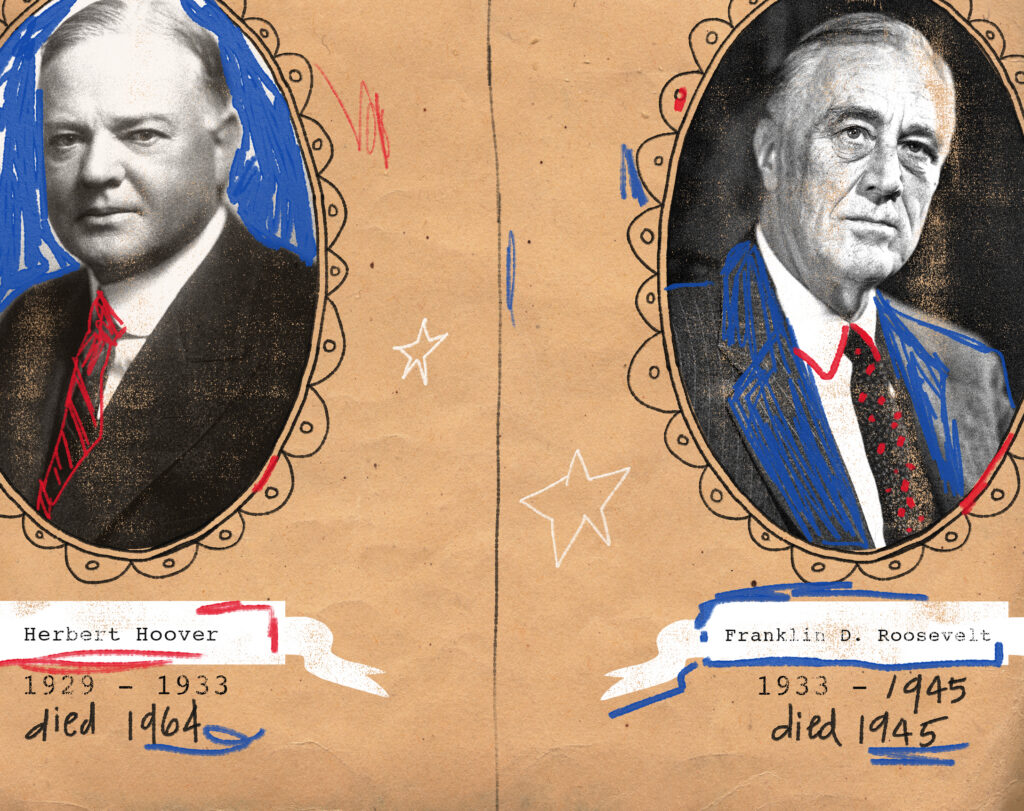
I still have a little book published in 1935, Presidents of Our United States, by L. A. Eisler. At the bottom of its cheap paperboard cover I penciled, in my pre-elementary-school hand, a phonetically spelled subtitle: My Tresure Book. The last president included is Franklin Delano Roosevelt, still very much alive at the time, though I helpfully filled in his death date and age, annotated the index with an X beside each assassinated chief of state, and added two names to the list: “John Fitzgerald Kennedy, 35th President, Assassinated Nov. 22, 1963, by Lee Harvey Oswald. Vice President Lyndon Baines Johnson took his place.” Its thirty-two full-page black-and-white headshots are a gallery of sober grandfathers, many of them gazing into the distance, jaws set, keeping watch over our American flock by night and by day.
Michael McFee is professor emeritus of English and comparative literature at the University of North Carolina at Chapel Hill, where he taught in the creative writing program for thirty-five years. The author of A Long Time to Be Gone: Poems and Appointed Rounds: Essays, McFee received the North Carolina Award for Literature from Governor Roy Cooper in 2018.