Introduction: Grounding
shah noor:
Like seeds braided in cornrows,
grains of rice hidden into tendrils,
maps stitched in quilts, and
braid patterns weaving histories
Ayana:
There is always tea,
something with garcinia
and mint,
and a little maté
—for a kick.
These are glimpses of how we craft Black ecologies. In the polyvocal piece that follows, we reflect on Black craft as both a practice and a site of analysis. As artist-scholars, we create from the American South and its geographic kin: the Atlantic, the Gulf Coast, the African Continent (specifically Sudan), and México. Our written collaboration emerges from panels at the Association of American Geographers Meetings in 2021 and 2022 and semimonthly virtual meetings over two years. We initially gathered around questions: How has crafting been a site of Black ecological knowledge(s)? How do climate and environmental injustice impact the land, plants, and other life that constitute the materiality of Black craft? What are possibilities, given the intimate relationship between Black material culture and more-than-human life? What are possibilities, given Black ecologies that approach nature as kin, ancestors, or spirit/Spirit? The panel calls drew deeply on Black Ecologies as a field, and in the spirit of critical craft studies, approached craft as socially and politically situated. In the early days of the COVID-19 pandemic, amid unseasonable wildfires and more public violence against Black lives, these questions intensified. The call for panelists in 2021 was a call to community.1
Black Ecologies are our mutual ground. In 1970, sociologist Nathan Hare gave a disciplinary name to the lived reality of Black eco-social life, calling it a Black Ecology. While our inspirations are many, our collaborative thinking, feeling, and crafting draws deeply on Black Ecologies. We mark Hare’s scholarly intervention as a moment rather than an origin, as Black people have always made life in material environments and have always held ecological relationships. But, oft undertold in theorizations around Hare’s conception of ecology, which he derives from the German word akios, meaning “house,” is his attention to how the home is “an extension of one’s self,” and that private space, child rearing, homemaking, housekeeping, and, we would argue, craftare all tied to the ecologies in which we exist. Hare further notes Black people disproportionately face worse economic opportunities, limited access to safe resting places, and more noxious environments than their white counterparts, arguing that there is “both an inadequate distribution of land and people and, more significantly, of people and resources.” Sitting with this tension, we conceive Black ecological craftwork as both a practice of making and making do—that is, a tactile and social construction of Black life and material cultures built out of remnants, fragments, and shared knowledges produced through and in spite of eco-racial suppression.2
In recent years, interdisciplinary scholars have taken up Hare’s concept to expand Black Ecologies into a growing subfield that addresses the material and social outcomes of relationships Black people have with, and build within, environments. For us, Black Ecologies, capitalized, refers to the subfield, while Black ecologies, uncapitalized, refers to the embodied Black experience of existing and making life within ecological spheres. The plurality of these Black ecologies signifies the multiplicity of Black life and Black ecological experience, a capaciousness that encompasses multispecies and more-than-human relationalities, land tenure and stewardship, worldmaking and marronage, reimagining environmental pedagogies, and justice-oriented environmental frameworks, among many other ecological kinships. Against fatalistic narratives that situate Black people as objects, victims, or subalterns in the background of white life and white supremacy, the study of Black Ecologies affords space for both ontological and epistemological expansiveness, connectivity, and repair.3
To craft Black Ecologies, as we practice here, is to attend to the material realities of Black ecological life, focusing on how Black people make worlds with their bodies, their spirits, and their intergenerational and multispecies kin. We assume craft is situated and political, consistently rearticulated in the midst of capitalism and white supremacy. Black geographies continue to be sites of environmental and climate (in)justice, from hillside collapse to intensifying storms. Plantation legacies and capitalism undergird climate change and its effects, with particular implications for communities where predominantly Black and other historically marginalized populations live. These times hold social and ecological implications for everyday lives, including craft. In our collective writing, we hold this acknowledgement close while honoring “Black livingness.”
Weaving: A Note on Method
Black Studies scholar and writer Katherine McKittrick teaches us that we can never fully know Black life; this includes Black ecologies. There are infinite ways to gain familiarity with Black ecologies, particularly ways that allow us to know them “differently,” as more than data of an “othered” people to be contrasted against a normative white background. Scholars draw on a variety of disciplines and methods for Black Ecologies research and writing. Black Ecologies texts engage with ethnography, archival collections, essays of Black intellectuals, novels, music, poetry, and various forms of Black cultural expression. Rarely are just one of these approaches incorporated into these Black ecological analyses, and Black ecologies often exceed the capacities of any one discipline. The swamps and forests are riddled with memories of marronage. The waters “splash on” about extraction, recreation, and healing. The trees remember stories of brutality, survival, and joy: As anthropologist Ashanté Reese writes, “Black storytelling would lead me places that I had not planned to go.” The ecological knowledge, caretaking practices, and experiences of Black/Afro-descendent peoples have long lived on through oral traditions and histories, place-based intergenerational teachings, and much more. It is difficult to practice intimacy with these ecologies and not be called beyond one’s own discipline(s).4
We creatively disrupt disciplinary boundaries by collaging and crafting, discussing and pausing together. In our polyvocal reflection, we collectively explore the possibilities of craft and artistic practice as we render Black Ecologies. We offer a woven tapestry of our words decoupled from linear storytelling and transparent narratives. As they did during our virtual gatherings, our words dance with one another, dipping in and out of our individual voices to present a shared vision, sites of engagement, mediums of craft, and praxes of Black ecological making. Our way of writing reflects experimental work in Black geographies, where artists/thinkers/activists come into dialogue. Our praxis pays homage to Black feminist ways of gathering and crafting that honor emergence, (un)learning, and unfolding. The “shape” of our piece reflects our gatherings and our curiosity. We are writing to bear deeper witness to what we have crafted—and to what we might craft moving forward. This piece is a glimpse of our collaborative process, which continues to unfold.5
This piece is also a map of relations. Our writing also represents Blackness as diasporic and global. Our work emerges out of the United States South, Latin America, the Caribbean, and the African continent with Sudan in particular. However, our collaborative writing and crafting does not address each location as a discrete and disparate site. Rather, much of what we trace with our work are the connections in ecological knowledges, practices, lives, histories, and futures of our homes, research sites, and communities across the Black diaspora. Our coming together foregrounds and underscores the spaces of shared histories, knowledges, and relations that have survived various paths of displacement, disaster, and racial and environmental violence. Our work carries the reader through various locations across the diaspora with brief glimpses of Black ecological stories and relations touched at each site, providing details of situated ecological experiences of Blackness. Yet, the collection and integration of our reflections expresses interconnected, interrelated, and interwoven experiences of Black craft and Black ecologies across time and space.6
Crafting: A Polyvocal Reflection
shah noor:
How do we craft Black ecologies?
What landscapes are our sites
/ sights
of engagement?
Where, in these geographies, do I locate my Self?
Perhaps, it is in the Atlantic
My field site is the diaspora, particularly Sudan and its past and ongoing diasporas. My site of engagement is the Atlantic and the Nile. My site of engagement is the archive of sight and memory, of nostalgia and grief, of love and justice. My site of engagement is music, dance, performance, and (social) media. My sight of engagement is my family, my cousins, and my people.
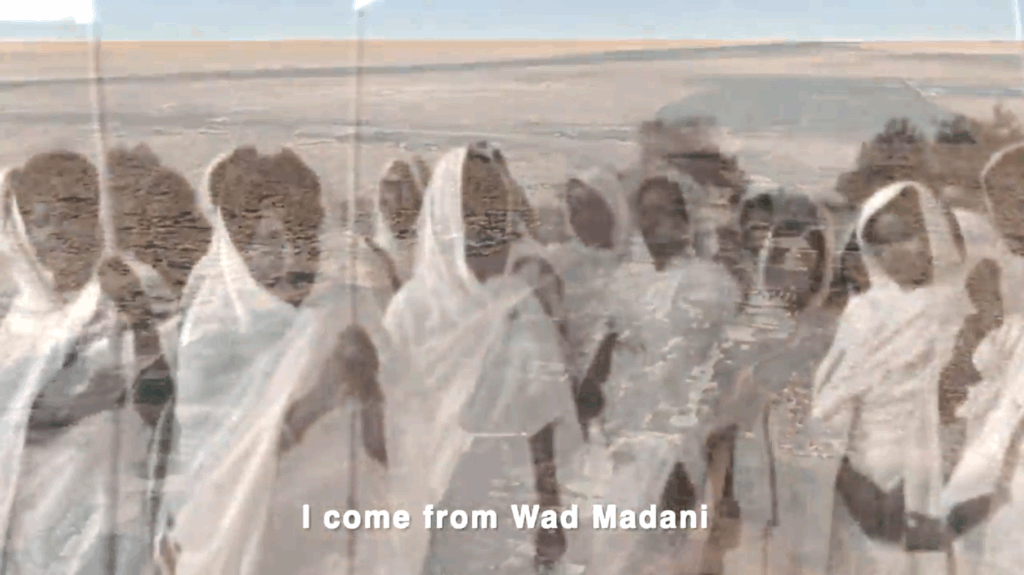
Morgan: My work plunges into the subaquatic worlds that engulfed Black towns in the twentieth century. The materiality of the communities and of the adjacent swampland ecologies no longer exists. The houses were leveled, removed, and/or submerged in 1941, at a moment of “modernization.” Dams, levees, and reservoirs—infrastructures of exclusion—take the place of once vibrant Black eco-social life.
Tianna: I craft from the Gulf. The Gulf Coast [of Mexico] that is, but also gulf in various meanings of the word. A gulf is “a part of the ocean or sea that extends into the land.” This calls to my ancestor brought to lands in the Americas across the ocean from a home. A home with earthed connections. Tiffany Lethabo King explains that Black peoples and relations are often over-theorized within oceanic tropes. This gulf is a literal space of the merging and coming together of land and sea that King may refer to as a “Black shoal.”7
Jennifer: My theoretical framework is rooted in womanism, Black Studies, and Diaspora Studies. My work is also informed by Urban Planning, specifically asset-based development, and participatory action research. What I gather from the archives becomes a raw material that influences my creative practice.
shah noor:
Perhaps,
In the soil I ask my dad to sneak in handfuls
Shoveling them quietly into empty water bottles
Stashing them in checked luggage
Hoping the border doesn’t stop us from bringing
Home
home with us
Again
Hoping
Like seeds braided in cornrows,
grains of rice hidden into tendrils,
maps stitched in quilts, and
braid patterns weaving histories
I’m just hoping,
Hoping
I get to take home Home with me
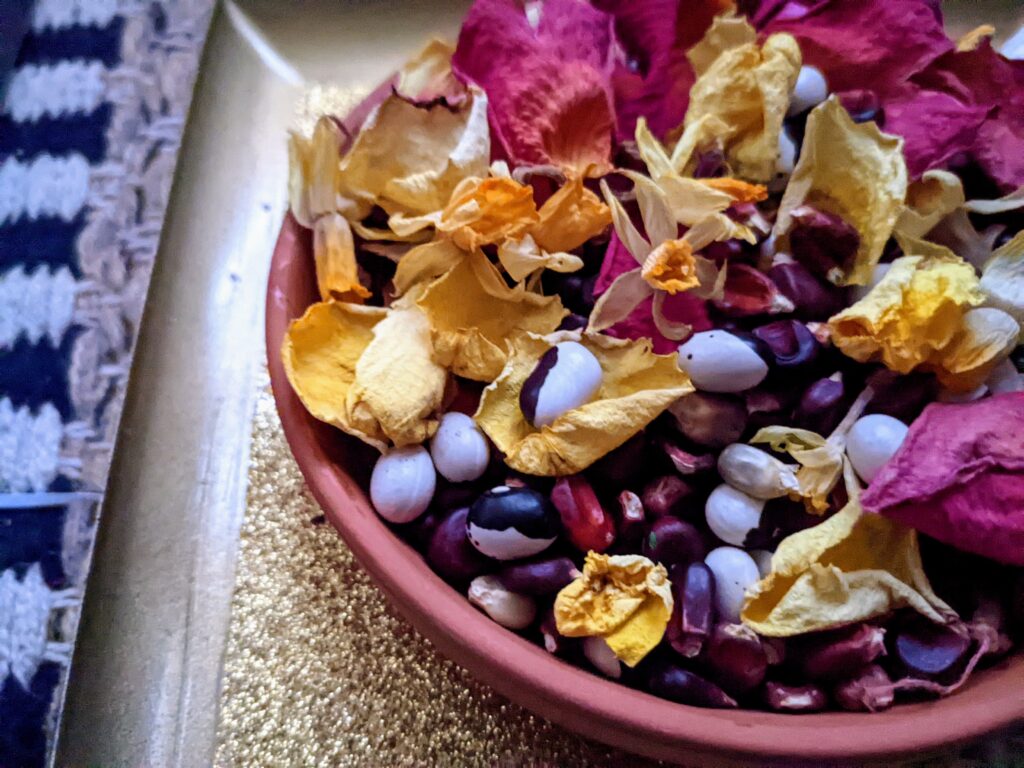
Naya: I craft with botanical kin: deep red corn kernels and purple cornmeal, two-toned black-eyed peas and pungent romero (rosemary). By crafting altars with ancestral plants, I literally come to my senses, from touch to sound. I remember embodied and intuitive ways of knowing. Through altarcraft I recall Black botanical journeys and archive Black ecologies in their expansiveness, including ritual spiritual expression.
shah: I consider creative and artistic crafting as avenues toward freedom, or what Green-Barteet calls “loopholes of retreat,” within the colonial, imperialist, capitalist systems that perpetuate suffering and oppression against Black and African people. My art practice and research produces crafts in the form of “written and unwritten expressive acts,” embodied, performed, and remixed across social landscapes.8
Tianna: Interventions on space, place, and relationally from Black geographies inform my theoretical and artistic groundings. The ways the field centers Black communities and peoples as geographic actors. My craftwork is led by the blurred boundary between Black life and what we call ecology, the familiarity with between life and death for Black life and ecology. Those before making space and possibility for the growth of the present and future.
shah noor:
How do we render Black ecologies?
How do I render Black ecologies?
In moments
riding out in the waters
my cousins squealing beside me
The sunset imminent and all of us gleeful
The possibility of the deep below
And our singing and laughter above
Floating up
Ayana: Typically some jazz playing by Nubya Garcia, Kamasi Washington, or Shabaka and the Ancestors, a tune that gets my mind away from the academic work I always have on my plate and into a frame of mind that allows me to be a bit more expansive in my body and mind.
Danicia: Can you come outside and play? A precious invitation unknowingly pregnant with possibilities of carving out relationships, melding with the external environment, and enacting imagination. Through the lens of play is where my investigation of Black Traditional Ecological Knowledge (TEK) peers to unearth acts of aesthetic expression etched into the built environment.
Tianna: Craft leaves me able to play with these boundaries, draw out the intimacies, call us in to take a second, more detailed, look to notice the ways life has been ever present in what’s been deemed “uninhabitable sacrifice zones.”9
Jennifer: My archival research unearths the artistic practices that Black people have used to imagine and gather Black communities through building, weaving, sewing, medicine making, gardening, and cooking. My artwork explores these techniques to understand how Black people have adapted to new landscapes and have created home through the innovative use of materials. I find techniques for surviving the current climate and political crises in these historic practices.
shah noor:
How do I render Black ecologies
in the disco ball between us?
The vast space of Blackness
Reflected back through sankofa mirrors
And muddled memories
And mama’s songs
And baba’s poems
Where, in these geographies, do I locate my self?10
Jennifer: The other question is asking self and others: “What recently inspired a sense of awe?” Both of these questions are exercises to tune my eyes, ears, and sensibilities to what otherwise might be rendered to the wayside—those being the design schemes devalued as useful by the traditional design archives.
Naya: I follow botanical lineages—personal, collective, intellectual, and creative lineages. Sometimes plants honor specific lineages, inspired by ancestors as a Black and Blaxicana (Black/Mexican/Xicana) artist-scholar and geographer, partner, and auntie. Maíz, or corn, honors Indigenous and Mexican ancestors, while black-eyed peas evoke ancestors from East Texas and the Deep South, the Atlantic, and unknown parts of the African continent. Botanical kin evoke landscapes with their textures: plains, oaks, clay, salt.
Morgan: I trace family histories back generations, from destroyed homes to the swamplands to the plantation.
Tianna:
Gulf: the space between life / livingness
and death
Naya: I take root in relations. With maíz or corn, relations involve longstanding intimacy with humans; the use of corn as a foodstuff during enslavement; the colonial transport of corn from Mexico to the African continent during the transatlantic slave trade; the adoption of corn for crops, cuisine, and (ritual) craft throughout Africa; movements to preserve corn’s genetic diversity; and more. These relations stretch from the past into the future, crafted before and beyond colonization, amid resistance and thriving.11
Morgan: My work wades through, skims atop, dives into, and emerges from the swampland of the Lowcountry South. Oft-studied as a space of resistance to white supremacist containment—social, material, bodily, and environmental, among others—in the antebellum era through practices of maroonage, the swamp is rendered a space of liminality and flight. But I push the timescale forward to study post-bellum swamp, where Black life is rooted in soft terrains, fugitivity is no longer an ever-present state, and the swampland is a commons. It is here where Black life, like cypress trees, takes root.
Ayana: As a terrestrial and maritime archaeologist, I focus on the African Diaspora, unearthing histories that lay at the foundation of our modern society, which are often understudied, ignored, and missing from history textbooks.
Jennifer: I find myself in the spaces that Black people crafted for themselves. I am grounded in gardens, the rivers made sacred by baptisms, the fertile low country that gave us woven sweetgrass and cast nets, the volcanic soils of Grenada overflowing with sweet water and smelling like spices. I stir dye pots full of herbs, looking for the colors that Black people made for themselves: “Den de women would go in de woods and take de bark frum de trees and pursley frum de groun’ and mix dem wid copperas and put it all in a big iron pot and boil it. Den dey would strain de water off and dye de cloth. De color was brown and, O Lawd, all de slaves wore de same color clothes.”12
Naya: I find plant kin, and they find me, through organic shops, random stops, walks in our neighborhood, and visits with friends. I source or harvest with care. I want to know what land and labor and stewardship make their presence possible.
shah noor:
Perhaps these Black ecologies live in haboba’s garden
where she plants bright hibiscus blooms that survive desert winds
I plant these in my California backyard,
they get bogged down in rainy season, they don’t make it to summer
I hope again for home and habobas healing hand and—
Naya: Sometimes, as with maíz, Black ecologies are Indigenous and Latinx and otherwise ecologies. I revel where plant geographies refuse rigid boundaries between environments or histories or communities. Their geographies remind me to think relationally, to craft relationally. Relations are not only between people and plants, but between ecologies of the oppressed who craft survival—and thriving—everyday.
shah noor:
In the Nile’s flowing waters
Moving northwards and together
Tianna: In this sense, I craft from the Gulf between past and present as we make way for a future never meant to be.
We remember from the Gulf.
Ayana: These are the tools that allow me to release into creation, that allow me to say yes to whatever wants to come through me that day.
shah noor:
Through call and response
the ancient ways we say our names
and listen back
in my commitment to listen and archive
My praxis is very citational, whether this means directly referencing inspirations, including epitaphs and quotes from authors and coconspirators, or receiving feedback from peers, community, and interlocutors. My praxis hinges on justice: seeking justice, knowing justice, dreaming justice, enacting justice.
Ayana: Crafting for me is a coming home, a coming into my body. In my home office I have a bench where I do all my jewelry and metal work, and I have my desk where I do all my writing and editing of film I’ve taken while diving.
Naya: Personal earth stories, earth testimonios, are my creative ground. Work on Black aliveness helps me articulate the significance (and sacredness) of personal accounts in the context of Blackness. I think of literary scholar Kevin Quashie’s work. He writes of “oneness” in Black women’s writing, or “the name for the praxis of beholding one’s self, of engaging one’s being as the basis for existing in and existing with one’s questions of being.” This oneness is not about Western individualism, which Quashie argues is impossible for Black folks in an anti-Black world. Instead, I hear an invitation to craft from Black being in ways that honor Black aliveness and multidimensionality. As I gather earth testimonios as part of altarcraft, including my own, I bear witness.13
Ayana: I love to make jewelry. I have been crafting adornments from base metals and gemstones since I was a young child. Jewelry making is a passion that my mother gifted to me. I have distinct memories of making necklaces, earrings, and bracelets with my mother on the weekends while Star Trek played in the background. Because of these memories, crafting has always been a connective thread between my mother and me.
shah noor:
In hands full of soil
and prayer beads tossed onto the bank
Tianna: I feel, love, mourn, and cherish from the Gulf. Black Studies scholar Christina Sharpe reminds us that Black life is often lived in close proximity to death, as abolition scholar-activist Ruth Wilson Gilmore teaches that the racism we experience often leaves us exposed to premature death. The landscape of racial and environmental injustice in the Gulf leaves us with many tears and much pain as we care and love in close proximity to death, in the wake of death, in the arms of the dead as the memories of ancestors bring us warmth even in our mourning. But, like our ecologies that surround and uphold us, we are yet alive. Our existence and relationships continue. There is still dance, laughter, singing, nourishing. There is still joy. I craft from the Gulf and intimacies of life and death in this space.14
Ayana: Christina Sharpe’s work In The Wake has been central to my understanding of the afterlife of slavery and how it scaffolds my work and my interpretive process. Alexis Pauline Gumbs’s Undrowned has come to shape how I understand the relationship I have not only to the ocean but to my breath when I’m scuba diving. My mother and grandmother have also deeply shaped my understanding of water, and I can always close my eyes and return to the early 1990s at Crandon Park in Miami, Florida, a historically Blacks Only Beach, where we always had community cookouts.15
Naya: I am moved by how sociologists Blackmer-Reyes and Currey-Rodríguez trace histories of testimonio, the public telling of personal stories as a form of protest and consciousness-raising, throughout Latin America and diasporic Latinx/Latiné communities. They place testimonio in conversation with “testimony” from Black feminism. They remind me that this work is Black feminist craft and Blaxicana testimonio.16
Tianna:
Gulf: the space between life / livingness
and death.
My crafting practice builds on the memory of the ecologies surrounding Black communities facing environmental precarity, or ecological memory. I aim to conjure up the memories of surviving, hurting, thriving, and flourishing shared between the community and the ecologies as entities mutually experiencing the harms of racial and environmental injustice.
shah noor: How do we anthologize Black ecologies?
How do I anthologize Black ecologies?
In my questions posed curiously and in earnest
and the way they tease in their answers
Morgan: I wade through ancient swamps, boat atop reservoirs, and locate remnants of disappeared spaces using depth finders to illuminate submerged, foregone words.
Danicia: A merger of three concepts: radical indigenism, coined by Eva Marie Garoutte from the Cherokee nation; rasquache, developed by Chicano scholar Tomás Ybarra-Frausto; and diasporic literacy, coined by VéVé A. Clark, have broadened my spatial imaginary, encouraging a renewed witnessing of the Black Quotidian. Of late my process starts with enlisting questions. One inspired by the words of my grandfather whose sweet provocation of “Whet ya kno gud?” was a gentle reminder and invitation to center gratitude.17
shah noor: My method for craftings considers each work of art as a “beautiful experiment” that can emerge in shared spaces of solidarity and asserts that Black art is “living art,” that is to say: made out of daily life.18
Naya: Altars are archives. I remember a precious conversation between Black feminist writer and social critic bell hooks and Chicana art critic and altar maker Amalia Mesa-Bains. Mesa-Bains describes Chicanx home altars and yard shrines as sites of memory that honor “the celestial in the everyday”; hooks recalls shrines of photographs in Black southern homes. They approach altars as sacred and subversive, especially for women in their lives. At altars, mothers, tias, and kinfolk offer prayers, silently and aloud. They speak and dance and sing desires. In these desires I find my own and witness collective ones.19
Jennifer: Quilting, working with plant color and medicine, widens my exploration of the Black craft ecologies beyond archival research. My site of engagement is the Black diaspora, inspired by my ancestors as a Black Californian and descendant of the Great Migration. I follow threads of textile traditions, botanical colors and medicines, seeds and gardens to find the places where we all fit together.
Tianna: I have written on the ways Black livingness has been overlooked in environmental justice scholarship and the ways a dendrochronological approach leaves me only with the memories of pollution and death-dealing conditions. How do I call out life from these limitations? This is an ongoing process, with the knowledge that we can never fully know Black ecologies, and I can never fully render Black life even in proximity to death in words.20
Danicia: Black TEK is shepherding design literacy and advancing social wellbeing across the Black diaspora. I recently observed TEK in San Basilio de Palenque in Cartagena, Colombia, a maroon or palenque community and the first free Black town of the Americas. Residents in this community are spiritually connected to their environments in such a way that it inspires play and social wealth.
Jennifer: I am an artist-scholar who explores Black craft as a placemaking practice. Craft creates, recreates, and memorializes Black communities. It is a means of endurance and resistance.
Naya: Any altar I craft, solita/alone or with community, nourishes research. Is research. I continue to find language, seek language, for how altar craft is “the work.” This means revisiting altarcraft as an ecospiritual and intellectual practice, one that express not only practices for everyday aliveness but relational ways of knowing the world, for now and for our planetary future.
shah noor:
In self-portraits across lands
In song lyrics
and placenames dropped in metaphor
My practice begins with tuning in—to my emotional landscape, my dreamscapes, and my immediate environment (both digital and physical). My praxis includes intuiting and trusting those impulses—to write or cry, craft or curate, dance or rest. My process includes reading, turning to my teachers or peers for support—either in their written and published crafts or in conversation. My process includes reflection. My practice includes writing and creating often and in small bursts, keeping the portal open. My process includes deep listening, experimentation, and revising.
Jennifer: My creative practice is a ballast in my research process; it counters archival violence and silence. I render craft ecologies through practice-led research that links the past with the future. I want to understand how Black people have created home for themselves over and over again in novel environments with traditional techniques applied to new materials.
shah noor: I come to this practice and commitment to crafting Black ecologies as a queer Black Sudanese diasporan living in a forced exile from my homelands. I come to crafting Black ecologies through Black geographies and diaspora studies. I come to crafting through the legacy of queer Black feminist theorists, poets, artists, and activists.
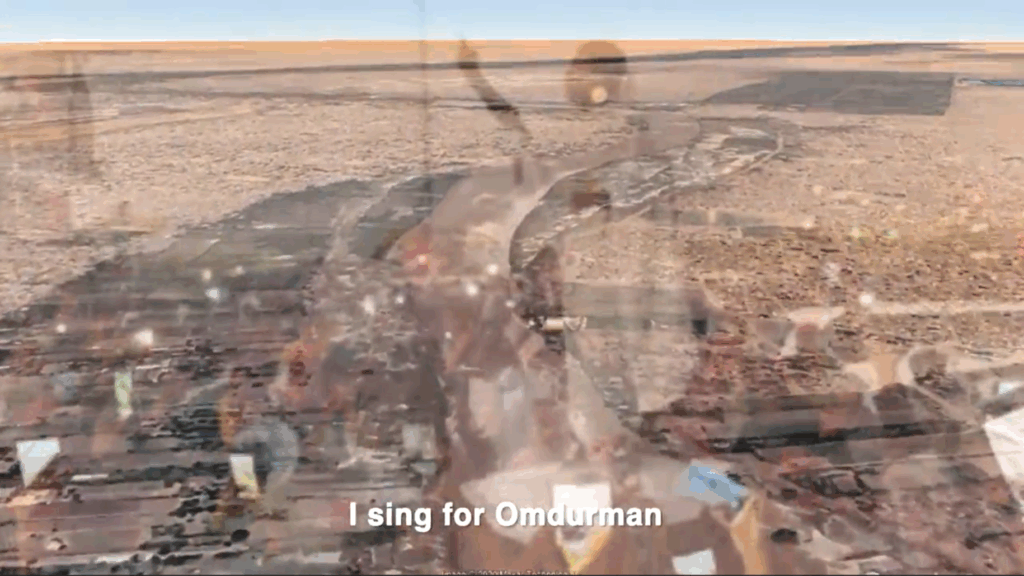
Morgan: The greatest tool I have here, beyond the limited archival record, is my capacity to imagine life in these spaces. As a (Black) geographer, my daily craft looks like freewriting and journaling. From time to time, I reflect using cartographic and visual representations, imagining what it was like to move through or swim through submerged spaces.
Tianna: As a social, and at times ecological, scientist, I feel limited in the ways of knowing Black ecologies. I learn from the Gulf. I write, care, cry, find joy, and know from the Gulf.
I also may not be able to do so with craft.
shah noor:
How do we craft Black ecologies?
How do I craft Black ecologies?
Through experiments in re-mixing
In my crossings
– Intentional and always –
Daily and not small
Immense and momentaneous
In separation and return
Tianna: Gulf: the space between past, present, and future. I want to call out the ways the past has shaped the present socially and ecologically.
Ayana: My site of engagement is in the wake of the transatlantic slave trade. My scholarship, both on land and underwater, centers on the physical remnants of Black life, in all its complexity, during and post slavery. I really work to make history tangible in my scholarship and craft practice. When Black people are at the center of unearthing, creating, and sharing our history, we are able to envision thriving futures for ourselves.
Tianna: Racial logics have been entrenched into the earth.
Ayana: My work on land centers on the sartorial practices of Black women as they navigated racial landscapes in the US post-emancipation.
Danicia: Recognizing that in the United States 70 percent of majority-Black zip codes are distressed, I catalog the manner in which we the descendants of these legacies access this TEK to facilitate architectural languages that are emblematic of community health and wealth within these divested Black neighborhoods.21
Naya: For me altarcraft involves—requires!—creating with dreams and ancestors and intuition. Every ritual, every altar, honors othered ways of knowing that are well known to the Black ecologies I study through testimonios and ethnobotanical methods, creative writing and ceremony. In another collaboration, shah noor, Morgan, and I reflect on Black dreaming in the shape of imagination and intuition. Dreaming is method too.22
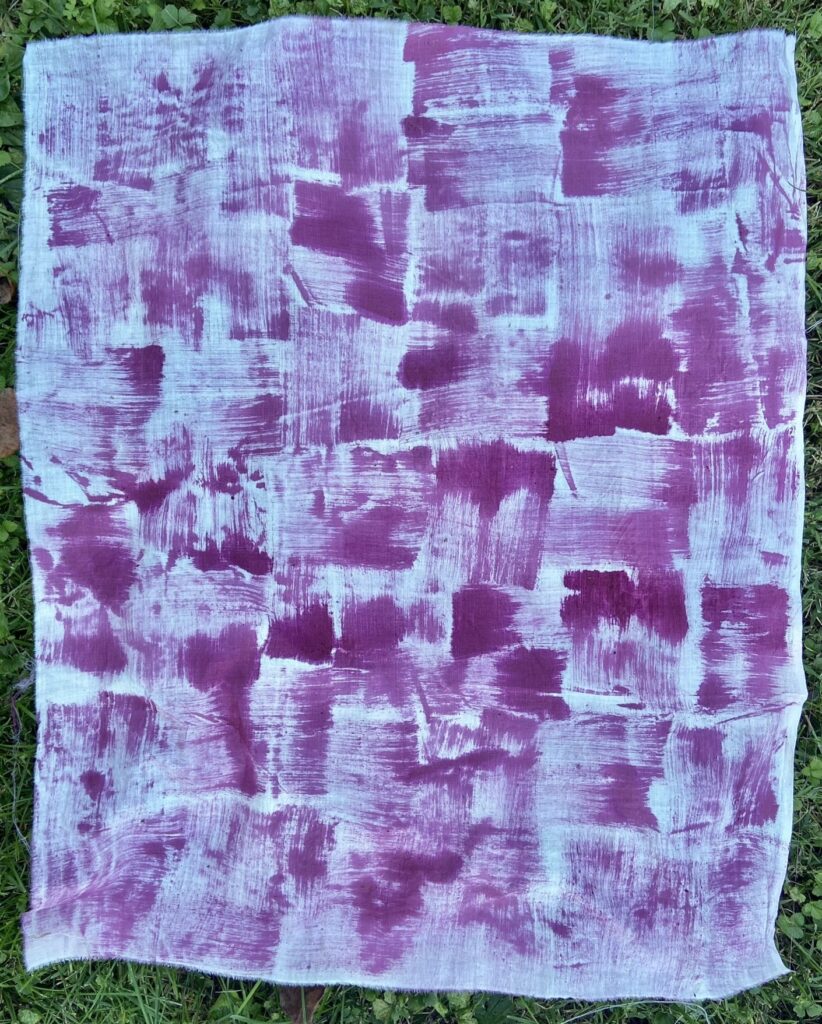
Jennifer: Cloth, handmade botanical dyes, inks, and prints are the mediums that I use to imagine into archival silence.
shah noor:
In the gesture of a film
Tracing the river’s path.
Closing
In our collaborative crafting and writing, we invoke play and wonder, spirit and creativity; we invoke a Black ecological craft that honors our divergent and varied ways of knowing and being, through and beyond the American South. In our reflection, we find common ground within and beyond Black Ecologies. We witness what constitutes this ground. Relationality is a pervasive theme for all of us, along with attunement to survival and (more than) “making do.” We stretch relationality to encompass relations between people and nature, as well as ancestors. We share attention to absences and erasures in the archives as well as landscapes, coupled with multiple ways of knowing Black ecologies. These ways of knowing involve working across disciplines with a wide range of tools and methods, among them archival research and textile crafts, filmmaking and scuba diving, ritual and textile arts. For each of us, crafting deepens our analysis and is a site of analysis. We are committed to craft as creative, intellectual, and ancestral work.
And, we sense a creative tension. We chose to include our names and our specific lineages, ancestral and intellectual. Are we inspired to write in a way that releases our names as well, as a more collective statement? (Like our Black feminist ancestors have.) How can we revel in this tension together? We also remember that our gatherings—virtual and in-person—have been vital for our collaborative craft. Alongside our panels on “crafting Black ecologies” we have been part of related collaborations together and with other communities with whom we build (and be). We close with this reminder for ourselves (and for all of us): gatherings themselves are craft, by creating space with ourselves and each other for work that invites us to remember our own Black livingness. Even without this piece, this writing, our gathering was (and is) enough.
We are carrying still other questions forward, and we wonder how these resonate with practicing Black Ecologies. What does our gathering and writing look like and feel like, moving forward? We first started collaborating in the early days of the COVID-19 pandemic. Where do we write from now, in the midst of intensifying climate catastrophe in the American South and worldwide, sustained anti-Blackness, and (more) forced displacement and deportation? Where do we want to write from, and what possibilities are we holding close in this moment?
Header image: Pink flowers blooming at Khartoum University in Sudan, 2017, by shah noor hussein.
Naya Jones (she/her/ella) is an award-winning cultural worker and geographer who (co)creates where Black ecologies, Black feminism, healing justice, and the arts meet. Her current research and ritual craft archive how Black ecospiritual traditions continue to be reimagined amid climate catastrophe. She holds a PhD in Geography and the Environment and is a research affiliate with the University of Texas at Austin. A scholar-practitioner, Jones is also a social justice chaplain-in-training at the Starr King School for the Ministry, where she is deepening her grounding in critical religious studies and counteroppressive crisis care. nayajones.com
Tianna Bruno (she/her) is an assistant professor in the Department of Geography at the University of California, Berkeley. Her research focuses on the intersection of Black geographies, critical environmental justice, political ecology, and critical physical geography, particularly along the US Gulf Coast. Her work foregrounds Black life, sense of place, and relationships to the environment within spaces of present-day environmental injustice. She highlights the mutual experiences of degradation and survival between subaltern communities and their surrounding ecologies. Bruno’s work has been published in Progress in Environmental Geography, Professional Geographer, and the Annals of the American Association of Geographers, among other journals.
Morgan P. Vickers (they/them) is an assistant professor of Race/Racialization in the Department of Law, Societies & Justice at the University of Washington. Dr. Vickers received their PhD in Geography from the University of California, Berkeley. Their research illuminates racialized ecologies, twentieth-century infrastructure projects, the social construction of race, and eco-social repair.
shah noor hussein (they/them) is a writer, visual artist, and public scholar crafting narratives at the nexus of Black feminist thought, Queer diaspora studies, and liberatory pedagogies. shah is doctoral candidate, Presidents Dissertation Fellow (2025–2026), and Cota-Robles Fellow (2019–2023) at UC Santa Cruz in the Departments of Anthropology and Critical Race & Ethnic Studies, researching music and dance in the Sudanese diaspora. shah’s poetry, art, and film work has been shown and performed at galleries, museums, and art venues across North and Central America. shahnoorhussein.com
Danicia Monét Malone (she/they) is a cultural strategist, urban planner, and critical geographer focused on the intersection of policy, public space, and aesthetic research. She leads Rokh Research & Design Studio, advancing community-rooted projects in urban planning, public art, and civic design. A PhD candidate exploring spatial aesthetics and racialized experiences of place, Malone centers cultural literacy and liberation. Her work has been featured in Forbes, The Washington Post, and Fast Company, and she’s held fellowships with Yale, Americans for the Arts, and others.
Ayana Omilade Flewellen (they/she) is a Black Feminist, an archaeologist, an artist scholar and a storyteller. As a scholar of anthropology and African and African Diaspora Studies, Flewellen’s intellectual genealogy is shaped by critical theory rooted in Black feminist epistemology and pedagogy. Flewellen is the cofounder and current board chair of the Society of Black Archaeologists and sits on the Board of Diving With A Purpose. They are an Assistant Professor in the Department of Anthropology at Stanford University. ayanaflewellen.com
Jennifer Steverson (she/her/hers) is an artist-scholar who explores Black craft as a placemaking practice. Her archival research unearths the artistic practices that gather Black communities through building, weaving, sewing, medicine making, and gardening. Her artwork uses these techniques to understand how Black people have adapted to new landscapes through the innovative use of materials. Her theoretical framework is rooted in womanism, Black Studies and Diaspora Studies. Her work is informed by community-led urban planning and participatory action research.
NOTES
Authors’ note: The second part of the title is inspired by Tianna Bruno’s notes on “crafting from the Gulf,” later in this piece. The authors thank the peer reviewers for their thoughtful suggestions.
- Priscilla McCutcheon, “Growing Black Food on Sacred Land: Using Black Liberation Theology to Imagine an Alternative Black Agrarian Future,” Environment and Planning D: Society and Space 39, no. 5 (2021): 887–905; Andrea Roberts, “Haunting as Agency: A Critical Cultural Landscape Approach to Making Black Labor Visible in Sugar Land, Texas,” ACME: An International Journal for Critical Geographers 19, no. 11 (2020): 210–244; Clare W. Wilkonson-Weber and Alicia Ory DeNicola, Critical Craft: Technology, Globalization, and Capitalism (Routledge, 2016).
- Nathaniel Hare, “Black Ecology,” The Black Scholar: Issue on Black Cities – Colonies or City States?, 1, no. 6 (1970): 2–8, 5, 7.
- Black Ecologies is a vibrant subfield; we capture some of the works that have deeply influenced us here. For further works and reflections on Black Ecologies, see Alex Moulton and Inge Salo, “Black Geographies and Black Ecologies as Insurgent Ecocriticism,” Environment and Society 13 (2022): 156–174, https://doi.org/10.3167/ares.2022.130110; Michael Warren Murphy, George Weddington, and AJ Rio-Glick, “Black Ecology and Environmental Justice,” Environmental Justice 14, no. 6 (2021), https://doi.org/10.1089/env.2021.0024; C. M. Frazier, “Troubling Ecology: Wangechi Mutu, Octavia Butler, and Black Feminist Interventions in Environmentalism,” Critical Ethnic Studies 2, no. 1 (2016): 40–72, https://doi.org/10.5749/jcritethnstud.2.1.0040; Morgan P. Vickers, “On Swampification: Black Ecologies, Moral Geographies, and Racialized Swampland Destruction,” Annals of the American Association of Geographers 113, no. 7 (2022): 1674–1681, https://doi.org/10.1080/24694452.2022.2137455; J. T. Roane, “Black Ecologies, Subaquatic Life, and the Jim Crow Enclosure of the Tidewater,” Journal of Rural Studies 94 (2022): 227–238, https://doi.org/10.1016/j.jrurstud.2022.06.006; and Leah Penniman, Farming While Black: Soul Fire Farm’s Practical Guide to Liberation on the Land (Chelsea Green Publishing, 2018). See Carrie Freshour and Brian Williams, “Toward ‘Total Freedom’: Black Ecologies of Land, Labor, and Livelihoods in the Mississippi Delta,” Annals of the American Association of Geographers 113, no. 7 (2022): 1563–1572, https://doi.org/10.1080/24694452.2022.2103501; Nik Heynen and Megan Ybarra, “On Abolition Ecologies and Making ‘Freedom as a Place,’” Antipode 53, no. 1 (2021): 22–35, https://doi.org/10.1111/anti.12666; J. T. Roane and Justin Hosbey, “Mapping Black Ecologies,” Current Research in Digital History 2 (2019), https://doi.org/10.31835/crdh.2019.05; J. T. Roane, Megan Femi-Cole, Preeti Nayak, and Eve Tuck, “‘The Seeds of a Different World Are Already Alive in the Everyday Practices of Ordinary Black and Indigenous People’: An Interview with J. T. Roane,” Curriculum Inquiry 52, no. 2 (2022): 29–138, https://doi.org/10.1080/03626784.2022.2052638; Fikile Nxumalo, Preeti Nayak, and Eve Tuck, “Education and Ecological Precarity: Pedagogical, Curricular, and Conceptual Provocations,” Curriculum Inquiry 52, no. 2 (2022): 97–107, https://doi.org/10.1080/03626784.2022.2052634; Naya Jones, “Reimagining Freire: Beyond Human Relations,” Cultural Studies of Science Education 18, no. 1 (2023): 205–216; Tianna Bruno, “Ecological Memory in the Biophysical Afterlife of Slavery,” Annals of the American Association of Geographers 113, no. 7 (2022): 1543–1553; and Tianna Bruno, “More Than Just Dying: Black Life and Futurity in the Face of State-Sanctioned Environmental Racism,” Society and Space 42, no. 2 (2023): 73–90. See Willie Jamaal Wright, “As Above, So Below: Anti-Black Violence as Environmental Racism,” Antipode 53, no. 3 (2018): 791–809; Laura Pulido and Juan De Lara, “Reimagining ‘Justice’ in Environmental Justice: Radical Ecologies, Decolonial Thought, and the Black Radical Tradition,” Environment and Planning E: Nature and Space 1 (2018): 1–2; and Jovan Scott Lewis, “Black Life Beyond Injury: Relational Repair and the Reparative Conjuncture,” Political Geography 108, no. 1 (2023): 1–8, https://doi.org/10.1016/j.polgeo.2023.102963.
- Katherine McKittrick, Dear Science and Other Stories (Duke University Press, 2021); Katherine McKittrick, “Mathematics Black Life,” Black Scholar 44, no. 2 (2014): 16–28, https://doi.org/10.1080/00064246.2014.11413684; Ashanté M. Reese, Black Food Geographies: Race, Self-Reliance, and Food Access in Washington, DC (University of North Carolina Press, 2019); Monica Patrice Barra, “Restoration Otherwise: Towards Alternative Coastal Ecologies,” Environment and Planning D: Society and Space42, no. 1 (2023): 147–165, https://doi.org/10.1177/02637758221146179; Danielle Purifoy, “Black Towns and (Legal) Marronage,” Annals of the American Association of Geographers 113, no. 7 (2022): 1599–1614, https://doi.org/10.1080/24694452.2022.2158062; Willie Jamaal Wright, “As Above, So Below: Anti-Black Violence as Environmental Racism,” Antipode 53, no. 3 (2018): 791–809; Clyde Woods, Development Arrested: The Blues and Plantation Power in the Mississippi Delta (Verso, 2008); Clyde Woods, Development Drowned and Reborn: The Blues and Bourbon Restorations in Post-Katrina New Orleans (University of Georgia Press, 2017); C. Hyman, “GIS and the Mapping of Enslaved Movement: The Matrix of Risk,” Environmental History Now, August 19, 2021, https://envhistnow.com/2021/08/19/gis-and-the-mapping-of-enslaved-movement-the-matrix-of-risk/; Roane, “Black Ecologies, Subaquatic Life, and the Jim Crow Enclosure of the Tidewater”; Michelle Lanier and A. J. Hamilton, “Rooted: Black Women, Southern Memory, and Womanist Cartographies,” Southern Cultures 26, no. 2 (2020): 12–31, https://doi.org/10.1353/SCU.2020.0026; Tianna Bruno, “Ecological Memory in the Biophysical Afterlife of Slavery,” Annals of the American Association of Geographers 113, no. 7 (2022): 1543–1553; Reese, Black Food Geographies, 3.
- See, for example, Camilla Hawthorne and Brittany Meche, “Making Room for Black Feminist Praxis in Geography: A Dialogue Between Camilla Hawthorne and Brittany Meche,” Society + Space (September 2016); and Roane et al., “‘The Seeds of a Different World.’” Thank you to a reviewer for raising The Combahee River Collective Statement as part of a Black feminist, collaborative writing lineage. Although our piece is not a statement in the same sense of the word, we draw inspiration from this collaborative writing; Zillah Eisenstein, Combahee River Collective, “The Combahee River Collective Statement,” 1978, https://americanstudies.yale.edu/sites/default/files/files/Keyword%20Coalition_Readings.pdf.
- For more on global Black Ecologies, see Justin Hosbey, Hilda Lloréns, and J. T. Roane, “Introduction: Global Black Ecologies,” Environment and Society 13, no. 1 (2022): 1–10, https://doi.org/10.3167/ares.2022.130101.
- Merriam-Webster Dictionary, “gulf,” accessed July 25, 2025, https://www.merriam-webster.com/dictionary/gulf; Tiffany Lethabo King, The Black Shoals: Offshore Formations of Black and Native Studies (Duke University Press, 2019).
- Miranda A. Barteet-Green, “‘The Loophole of Retreat’: Interstitial Spaces in Harriet Jacobs’s Incidents in the Life of a Slave Girl,” South Central Review 30, no. 2 (2013): 53–72.
- Steve Lerner, Sacrifice Zones: The Front Lines of Toxic Chemical Exposure in the United States (MIT Press, 2012).
- Jafari S. Allen, There’s a Disco Ball Between Us: A Theory of Black Gay Life (Duke University Press, 2022).
- Judith Carney, In the Shadow of Slavery: Africa’s Botanical Legacy in the New World (University of California Press, 2011); James C. McCann, Maize and Grace: Africa’s Encounter with a New World Crop, 1500–2000 (Harvard University Press, 2007).
- Diane D. Glave and Mark Stoll, eds., To Love the Wind and the Rain: African Americans and Environmental History(University of Pittsburgh Press, 2006); Dale Rosengarten, Theodore Rosengarten, and Enid Schildkrout, Grassroots: African Origins of an American Art (National Museum for African Art, 2008); Ellen Polk, quoted in Federal Writers’ Project: Slave Narrative Project (1936), 16, Texas, Pt. 3, Lewis-Ryles, manuscript/mixed material, Library of Congress, Washington, DC, https://www.loc.gov/item/mesn163/.
- Kevin Quashie, Black Aliveness, Or On A Poetics of Being (Duke University Press, 2021), 31.
- Christina Sharpe, In the Wake: On Blackness and Being (Duke University Press, 2017); Ruth Wilson Gilmore, Golden Gulag: Prisons, Surplus, Crisis, and Opposition in Globalizing California (University of California Press, 2007).
- Sharpe, In the Wake; Alexis Pauline Gumbs, Undrowned: Black Feminist Lessons from Marine Mammals (AK Press, 2020).
- Kathryn Blackmer Reyes and Julia E. Curry Rodríguez, “Testimonio: Origins, Terms, and Resources,” Equity & Excellence in Education 45, no. 3 (2012): 525–538, https://doi.org/10.1080/10665684.2012.698571.
- Eva Marie Garoutte, Real Indians: Identity and the Survival of Native America (University of California Press, 2003); Tomás Ybarra-Frausto, “Rasquachismo: A Chicano Sensibility,” in Chicano Art: Resistance and Affirmation (UCLA Wright Art Gallery, 1991); VéVé A. Clark, “Developing Diaspora Literacy and Marasa Consciousness,” Theatre Survey 50, no. 1 (April 2009): 9–18.
- Saidiya Hartman, Wayward Lives, Beautiful Experiments: Intimate Histories of Riotous Black Girls, Troublesome Women and Queer Radicals (Serpent’s Tail Limited, 2021), 7.
- bell hooks and Amalia Mesa-Bains, “Altars,” in Homegrown: Engaged Cultural Criticism (Routledge, 2006; repr. 2017), 115–116.
- Tianna Bruno, “Ecological Memory in the Biophysical Afterlife of Slavery,” Annals of the American Association of Geographers 113, no. 7 (2022): 1543–1553; McKittrick, Dear Science and Other Stories.
- Andy Olin, “There Are Only 19 Prosperous Majority Black Zip Codes. The Houston Area Is Home to Two,” Urban Edge from Rice University, January 13, 2021, https://kinder.rice.edu/urbanedge/there-are-only-19-prosperous-majority-black-zip-codes-us-houston-area-home-two.
- Naya Jones, “We Were Dreamt: Reflections on Black Dreaming as a Liberatory Practice,” The Arrow 10, no. 2 (2023), https://arrow-journal.org/guest-editors-introduction-we-were-dreamt-reflections-on-black-dreaming-as-a-liberatory-practice/; shah noor hussein, “An Antidote and A Map: Narrative Cartographies for Black Dreamers,” The Arrow 10, no. 2 (2023), https://arrow-journal.org/journal-editors-introduction-an-antidote-and-a-map-narrative-cartographies-for-black-dreamers/; Morgan P. Vickers, “Dreaming Through Submergence,” The Arrow 10, no. 2 (2023): 36–44.