
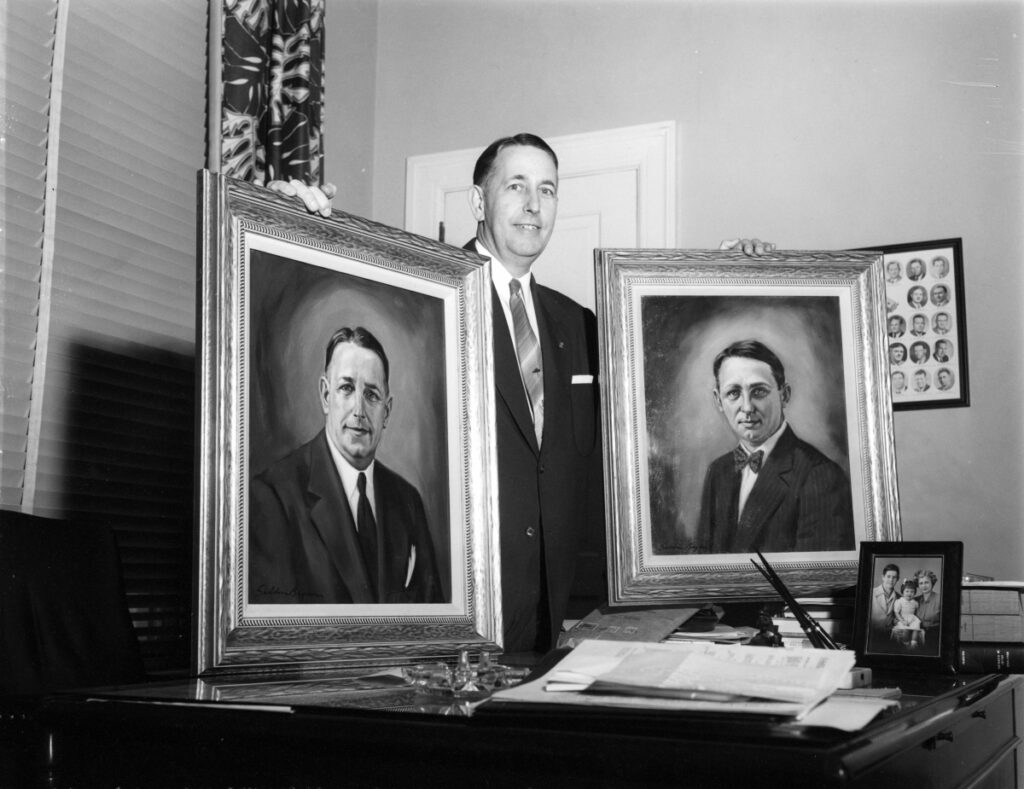
From 1956 to 1965, the residents of the boom state of Florida were held hostage to a McCarthy-esque investigation with the power to declare anyone who opposed segregation—including Black integrationists and closeted queer teachers—to be Communists, perverts, and “enemies of the people.” Officially called the Florida Legislative Investigation Committee, this group of white lawmakers was led by a strident legislator named Charley Johns, whose notorious campaign wrought such damage that it cast a chill over the entire state. Floridians colloquially referred to their work as the “Johns Committee.” Neighbor suspected neighbor as white nationalists terrified and planted bombs in the name of anti-Communism, though not a single Soviet agent was found. This little-known crusade planted the seeds of Tallahassee fear politics so deeply that it’s still impacting Florida—and America—today.
The following edited excerpt has been adapted from American Scare: Florida’s Hidden Cold War on Black and Queer Lives (Penguin Random House, 2025).
February 25, 1957
Terror preceded the opening gavel of the Florida Legislative Investigation Committee (FLIC) hearings in Miami, the so-called Magic City. “The top guns of the segregation forces are converging on Florida in a stepped-up drive,” touted the Miami Herald. Integration opponent John Kasper, considered a prophet of the white cause and a bomb inciter, sent his protégé Fred Hockett to Florida to recruit followers, foment disorder, and incite violence. Hockett was not a herald of the rural KKK but of a nouveau white urban movement—a “businessman’s Klan”—called the White Citizens’ Councils (WCC). “A little fire and some dynamite will show these n—–s we mean business,” Hockett preached at a backyard rally in Northwest Miami before marching the angry crowd to the home of an unsuspecting Black family, the LeGrees. Just before midnight that Saturday, Hockett crossed the boundary line onto the LeGree property and raised a kerosene-soaked cross.1
According to Miami NAACP attorney Grattan Graves, who had a mole in Hockett’s crew, Hockett’s plan was to “shoot the place up” as the cross burned. Fortunately for the besieged LeGree family, police received the NAACP tip-off and arrested Hockett and associates. In retaliation for infiltrating and scuttling their house-burning mission, the WCC sent death threats to three NAACP leaders under subpoena to testify in a few short hours before the Florida Legislative Investigation Committee, a McCarthy-era inquest led by state legislators determined to find scapegoats. The three targeted witnesses included former Miami NAACP president Father Theodore Gibson, Miami NAACP attorney Grattan Graves, and Miami NAACP secretary Ruth Perry. Problematically for these frontline activists, their home and/or work addresses had already been announced to the would-be assassins via news outlets.2
At 10:00 AM sharp that Monday morning, agents of the Florida Legislative Investigation Committee called for order in the East Circuit courtroom on the fourth floor of the Dade County courthouse. The courtroom setting, with state legislators of the committee arrayed behind a judicial bench, lent the proceedings an inquisitorial air. This choice of location was deliberate, as FLIC wanted to make NAACP members feel as if they were charged with crimes. Witnesses waited with a bailiff in an anteroom of the court while members of the Miami White Citizens’ Council, who’d menaced the city hours before, filed into seats in the gallery’s front rows.3
The FLIC called Father Gibson to the stand at 1:45 PM. A civil rights leader, Christian preacher, and public litigant suing “As Next Friend” for his son in the case Gibson v. Board of Public Instruction of Dade County, Father Gibson served as the spearhead of Miami’s school desegregation movement. FLIC members like Senator Charley Johns and attorney Mark Hawes privately hoped they could make a public example of him. Father Gibson raised his right hand and swore an oath to God, knowing that Senator Johns sat poised to attack him with just one question: “Have you ever been or do you now belong to the Communist Party?”4
Born in Miami in 1915, the same year that early voice for Black freedom Booker T. Washington died, Theodore Roosevelt Gibson was raised by his maternal grandparents in the Bahamas while his mother worked in Miami as a maid. Island life cultivated in him an early awareness of racial inequities; white Bahamians ran an apartheid system, though Black Bahamians outnumbered whites seven to one. “Racism was there,” Gibson intoned. At age nine, he returned to Miami to matriculate in Florida’s dual-school system. He attended the segregated Booker T. Washington High School, where he gained the nickname “The Instigator” for his resistance to school policies.5
Attending college in North Carolina and divinity school in Virginia, Gibson further bolstered his reputation for righteous agitation. Friends called the self-disciplined young man “God’s angry child.” Gibson received ordination in the Episcopal priesthood on March 3, 1944. He later affirmed that he entered the faith specifically to minister on racial matters and break down the “Berlin Wall” of neighborhood segregation. Since 1945, Gibson had served as pastor of the Christ Episcopal Church in Coconut Grove, a then-developing neighborhood in South Miami, where he preached a practical theology of literacy, education, and hard-won class advancement to some eight hundred Black congregants.6
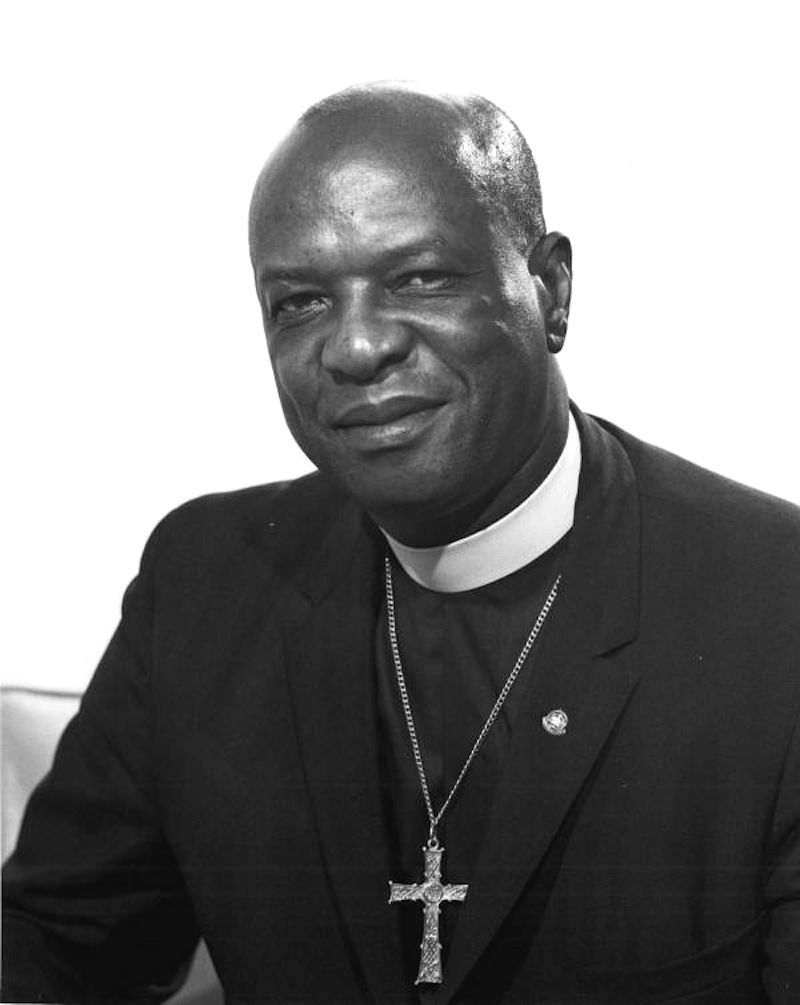
“His face is clean-cut and somber,” the Miami Herald reported, commenting on Gibson’s appearance with remarkable nonchalance. “And his dark skin contrasts vividly against the stark white circle of his cleric’s collar.” This was Gibson’s near-permanent look: pressed white collar on a dark shirt with a lapel pin on his blazer and a silver cross dangling from a simple chain. A founding member of the Miami NAACP and a litigant on behalf of his son, Theodore Jr., Father Gibson was as iconic a “racial radical” as Miami could claim. Now on the witness stand of a Miami courtroom in front of white terrorists who’d promised him harm, the forty-one-year-old minister received no assurances of protection from FLIC chief attorney Mark Hawes, a “barrel-chested, gravel-voiced ex-Marine” who proudly described himself as a six-one Aryan bruiser.7
“How long have you been a member of the NAACP, Reverend?” Hawes asked.8
“As long as I could recall that I was classified as or grouped as a second-class citizen,” answered Gibson sharply, “and that has been many years.”9
Sensing a formidable opponent, Hawes utilized several courtroom tactics designed to unsettle a witness. To break Gibson’s rhythm and shake his confidence, Hawes frequently asked the court reporter to read and reread questions back from the hearing transcript (“Now read the question, please.” “Read the question.”). Hawes mirrored and mocked Father Gibson’s answers while trying to trap the minister in inconsistencies.10
Gibson: I do not recall that sir.
Hawes: You don’t recall that?
Gibson: I do not recall.
Such exchanges between lawyer and minister provoked Senator Johns to jump into the fray with his own observations.
Johns: Mr. Chairman, this witness has been one of the most evasive witnesses that we have had come before this Committee. I want to insist that he either answer the question yes or no, or refuse to answer.
Hawes: May I proceed, Senator?
Johns: You may proceed.11
Father Gibson tried to explain to Senator Johns that he wanted to be “perfectly honest and frank” but also sought to understand “exactly what [he was] answering” when questions led or meandered. When finally asked by the committee why he’d filed suit against the state to take his son out of segregated schooling, Father Gibson opened his heart to the proceedings: “I say, with all the power of emphasis at my command, my boy will never, never get the necessary education that he ought to have as long as he is segregated as he is; there is something that happens to his personality, because at the very outset it stamps him as being inferior.” Having sat through Father Gibson’s oration, Senator Johns cut in.
Johns: Reverend—
Gibson: Yes, sir.
Johns: Did you ever belong to the Communist Party?
Gibson: No, sir. Sir, no negro in the South, especially coming from Miami, would you ever find in the Communist Party.
Johns: Do you know whether any of the members of your Chapter belong to the Communist Party?
Gibson: Sir . . . we have passed a law now that no member of the White Citizens’ Council, no member of the Ku Klux Klan, no member of the Communist Party can be a member of the NAACP, and I was at the National Convention when such a law was passed. I helped pass it.12
Maintaining his clerical poise, Gibson endured a quizzical and often sarcastic interrogation from Mark Hawes, with occasional snipes from Senator Johns, for the better part of an hour and a half. At the culmination of his testimony, Gibson identified NAACP Secretary Ruth Perry as the keeper of the branch records for the Miami NAACP, and the FLIC called recess.
Ruth Perry was a white Miami Beach librarian and a pro-integration personality on local radio. She joined the NAACP shortly before the 1951 assassination by dynamite of Florida NAACP Executive Secretary Harry T. Moore. Subject to frequent bomb threats herself in the years that followed, Ruth Perry nevertheless assumed a growing profile. In 1956, she began writing the column “Along Freedom’s Road” for the Miami Times, the city’s major Black newspaper, and used her various platforms to blast FLIC—calling its probe of the NAACP a “foregone conclusion.” Local members of the White Citizens’ Council branded her as a race traitor.13
Perry presented herself before FLIC conspicuously empty-handed. Although FLIC already possessed some of the Florida NAACP membership rolls through an alliance with the Texas Attorney General, Perry’s subpoena had carried with it an additional order to bring all meeting minutes and membership lists for the Miami NAACP. This command posed a dilemma. As secretary of the organization, Perry had kept such records until just around the July 1956 special legislative session in Tallahassee that had created the Florida Legislative Investigation Committee. Then, at an August 11 meeting of the Florida NAACP, chief counsel of the NAACP Legal Defense Fund Thurgood Marshall telephoned in and ordered the state’s chapters to mail their records directly to his offices in New York.14
Thurgood Marshall himself was a virulent anti-Communist, and he understood that white supremacists eagerly used any perceived Communist support of the NAACP as proof that the NAACP itself was a front for the Soviet Union. But he also knew that so-called anti-Communist panels like FLIC were not to be trusted or believed for their freedom-fighting rhetoric. By the time Florida governor LeRoy Collins allowed the FLIC bill to become law without his signature, all of Ruth Perry’s NAACP records had been passed beyond state lines, safely out of the reach of FLIC meddling.15
Perry knew that she was about to provoke Mark Hawes by walking into her testimony sans documents. Settling in, she looked past the state attorney into the eyes of her would-be assassins from the WCC. What if one of them stood up with a gun or lit a stick of TNT? Would Charley Johns protect her? Mark Hawes, sensing a visibly anxious person in the witness box, toyed with Perry the librarian. Hawes tried to get her to admit that it was national NAACP leadership who’d dragooned Father Gibson into filing the lawsuit and then rebuked her for disagreeing. Committee member Cliff Herrell cut in on one occasion and asked Perry to project her voice, a tactic known to fluster witnesses unaccustomed to public speaking.16
Hawes then lied on the record (an informally accepted deceptive interrogation tactic used by law enforcement) and told Perry that Father Gibson just testified under oath how the national NAACP had recommended the Dade County lawsuit to him before he filed his case. Perry, illegally held in a separate chamber during Father Gibson’s testimony, couldn’t have known that Gibson testified to the opposite. But Perry stood fast.
Hawes: Did you know that he testified that the Miami Branch approved of the recommendation?
Perry: No, I didn’t.
Hawes: You think he is mistaken in that testimony?
Perry: I think he will have to speak for himself.17
Turning to the same tension-ratcheting maneuver that had rattled Gibson, Hawes repeatedly asked Perry the same question by theatrically demanding for a court reporter to read and reread it back from the transcript: “Did the Miami Branch ever take any official action in regard to the Dade County federal lawsuit?” Perry, often cut off by Hawes and/or the court reporter mid-answer, attempted to respond six times: “I don’t know. I don’t understand what you are . . .”; “I thought the lawsuit was brought by individuals”; “I believe they agreed to pay the attorney . . .”; “I know that we—the Miami Branch—wanted an end to school segregation”; “I know we voted to give a certain proportion, a certain amount of our funds to pay the attorney . . .”; and, finally, “I think I answered that by my last statement.”18
Under pressure, Perry revealed under oath that she’d given up possession of her records nearly six months prior to the FLIC subpoena. When she did so, Hawes, in a move out of order for a state proceeding, turned his head and began to interrogate Perry and her NAACP attorney Grattan Graves in the courtroom simultaneously. With melodramatic flair, Hawes prompted Perry to engage in an awkward public pantomime with her attorney, who was seated in the chamber but not called to testify. Thus did the hearing devolve into full kangaroo status, with the Chief Attorney for the Florida Legislative Investigation Committee redefining the rules of decorum as he went.19
Hawes: Will you ask him to return those records to you?
Perry: You mean right this minute?
Hawes: Yes.
Perry: Mr. Graves, will you return the records to me?
Graves: Do you want me to answer the question? Or is she still on the stand?
Hawes: Answer it.
Graves: I don’t have the records, sir.
Hawes: To save time, are they in Dade County, Counsellor?
Graves: All the records have been shipped out of state.
At various points in Perry’s testimony, it became unclear if Hawes was grilling Graves in his seat or the witness on the stand. Facing the brunt of state ire, Perry and Graves became sacrificial lambs fated to explain how badly FLIC had been outmaneuvered by Thurgood Marshall. Finally, Hawes invited committee members to air additional questions, and Senator Johns seized on his refrain.20
“Mrs. Perry,” Johns asked, “do you know or have you ever belonged to the Communist Party?” “No, sir,” Perry answered. “That is all,” Senator Johns declared. As Perry stepped down, Hawes called on the NAACP lawyer to testify formally. Grattan Graves, under oath, revealed how Thurgood Marshall had demanded the records of all NAACP branches “from Palm Beach to Key West.” Given that Perry had just publicly asked Graves to retrieve her records, Graves assured the committee that he would promptly wire the request to Marshall.21
Hawes: Do you have any idea whether or not he will honor your request to release those records and ship them back to Florida?
Graves: In view of the commitments that I am making here, I hope so, but I have no control over him. I can only make a request. He made a demand.
Hawes: Do you have any strong personal feeling as to whether or not you will be able to get them back—just as a matter of personal information?
Graves: You know as well as I do, Counsellor. I don’t know.22
With Thurgood Marshall residing in New York and with FLIC unable to hold Graves or Perry in contempt outside of a full vote of the Florida Legislature during session, it became clear that FLIC’s efforts to publicly unmask NAACP miscreants had been anticipated and thwarted. At 9:36 PM that evening, as promised to FLIC, Graves wired Marshall a telegram:
THURGOOD MARSHALL FEBRUARY 25, 1957
NEED ALL MIAMI NAACP RECORDS MAILED TO YOU IMMEDIATELY FOR FLORIDA INVESTIGATION COMMITTEE. REPLY BY RETURN WIRE.23
To protect the Miami NAACP’s interests, Marshall did not respond himself. Deliberating internally the next day, the NAACP drafted a statement it decided to never release, instead leaving its position toward FLIC a mystery. With power and procedure moving against them, the committee realized its deadlocked position. What could they hope to accomplish in Miami if the NAACP wouldn’t cooperate? Witnesses were excused and the hearing recessed until 9:30 AM the next day.24
Then a front-page headline from the morning’s Miami Herald set off a public panic: “Will Dynamite Set Off Racial War in Miami?” The Herald quoted a White Citizens’ Council insider claiming that cross-burner Fred Hockett and his henchmen had a hundred boxes of dynamite cached somewhere outside city limits. After spending 48 hours in lockup for the LeGree incident, Hockett was fresh on the streets and initiating a masterplan. According to the article, Hockett promised that his mentor, “fiery” John Kasper, would be “sneaked” into Miami to help decide “the right place and the right time to let go with the big blast.”25
Robert W. Fieseler, a Tulane PhD history candidate and Mellon Fellow, was named a National Lesbian and Gay Journalists Association’s Journalist of the Year. His book, Tinderbox: The Untold Story of the Up Stairs Lounge Fire and the Rise of Gay Liberation, won the Edgar Award and the Louisiana Literary Award and was shortlisted for the Saroyan International Prize for Writing.
Header image: Bird’s eye view looking east from the Dade County Courthouse in Miami, The American News Co., 1958. Courtesy of Florida Memory.
NOTES
- Bert Collier, “Segregationist Big Guns Sounding Off in Florida,” Miami Herald, February 24, 1957, 26; Alec Marsh, John Kasper, and Ezra Pound, Saving the Republic (Bloomsbury Academic, 2015); John Howard, Men Like That: A Southern Queer History (University of Chicago Press, 1999), 39; “Will Dynamite Set Off Racial War in Miami?,” Miami Herald, February 26, 1957, 1, 5; James Buchanan, “Negro Householder Receives Bomb Threat,” Miami Herald, February 26, 1957, 2; “Probe Planed of White Group Klan in State,” Pensacola News Journal, February 27, 1957, 8.
- Grattan Graves, testimony to FLIC, February 28, 1957, 1555, Florida Bar Association Papers, State Archives of Florida; Poucher, State of Defiance: Challenging the Johns Committee’s Assault on Civil Liberties (University Press of Florida, 2014), 49–50; “Daring Plot Against Miami Negroes,” Jet, March 28, 1957, 12–14.
- Transcript of Testimony, February 27, 1957, Florida Bar Association Papers, State Archives of Florida; Mark Hawes, Confidential Memo to Dade County Circuit Court, February 13, 1957, Box 3, FLIC Papers, State Archives of Florida; Transcript of Testimony, February 26, 1957, Florida Bar Association Papers, State Archives of Florida; Miami White Citizens’ Council: Judith Poucher, State of Defiance, 41.
- Transcript of Testimony, February 25, 1957, 1096, Florida Bar Association Papers, State Archives of Florida.
- Carita Swanson Vonk, Theodore R. Gibson: Priest, Prophet, and Politician (Little River Press, 1997), 15; Vonk, Theodore R. Gibson, 16.
- Congressional Record: Proceedings and Debates of the 89th Congress, First Session, July 8, 1965; Jack Robert, “Coconut’s ‘Berlin Wall,’” Miami News, December 29, 1969, 5; Vonk, Theodore R. Gibson, 29.
- “Negro Pastor Sees Hope in King’s Death,” Miami Herald, April 9, 1968, 50; Ronald Hutchinson, “Three Dominate Trial,” Tampa Bay Times, March 1, 1970, 16.
- Theodore Gibson, Transcript of Testimony, February 25, 1957.
- Theodore Gibson, Transcript of Testimony.
- Theodore Gibson, Transcript of Testimony.
- Theodore Gibson, Transcript of Testimony.
- Theodore Gibson, Transcript of Testimony.
- Bella Kelly, “Witnesses ‘Surprised’ by Call to Red Quiz,” Miami News, February 8, 1958, 1; Poucher, State of Defiance, 43–44; Ruth Perry, “Along Freedom’s Road,” Miami Times, August 24, 1957, 5; Ruth Perry, “Along Freedom’s Road,” Miami Times, February 23, 1957, 6.
- Stacy Braukman, Communists and Perverts Under the Palms: The Johns Committee in Florida, 1956–1965 (University Press of Florida, 2012), 49–50; Ruth Perry, Transcript of Testimony, February 25, 1957; Francisco A. Rodriguez, letter to Constance Motley, August 6, 1956, NAACP Papers, Library of Congress.
- Ruth Perry, Transcript of Testimony, February 25, 1957.
- Ruth Perry, Transcript of Testimony.
- Ruth Perry, Transcript of Testimony.
- Ruth Perry, Transcript of Testimony.
- Ruth Perry, Transcript of Testimony.
- Ruth Perry, Transcript of Testimony; Poucher, State of Defiance, 52.
- Ruth Perry, Transcript of Testimony; “Miami Citizens Council Is Facing State Inquiry,” Tallahassee Democrat, February 26, 1957, 9.
- Gratten Graves, Transcript of Testimony, February 25, 1957.
- Gratten Graves, Telegram to Thurgood Marshall, February 26, 1957, NAACP Papers, Library of Congress.
- NAACP Revised Draft Statement on Graves, February 26, 1957, NAACP Papers, Library of Congress; Transcript of Testimony, February 25, 1957.
- “Will Dynamite Set Off a Race War in Miami?” Miami Herald, February 26, 1957; Ruth Perry, Transcript of Testimony.