“When people talked about ‘Katrina,'” a New Orleanian told a New Orleans Gambit reporter in 2008, “they are not just talking about the storm anymore. It’s the insurance crisis, the mental health crisis, the crime, the homeless under the bridge—the whole ball of wax.” What is Katrina now? A storm, a flood, or an engineering failure? A problem of race, class, or environment? A personal experience or a collective one? An open wound or a healed scar? An acute catastrophe receding into New Orleans’s past or an enduring trauma resounding into America’s future? In Katrina: A History, 1915–2015, Andy Horowitz writes that Katrina has come to “seem like one of the great Rorschach tests in modern American history, less a window than a mirror. But these [are] not competing interpretations of the same picture so much as they [are] different experiences of the same country.”
On the eve of Katrina’s twentieth anniversary, Southern Cultures asked people, “What does Katrina mean to you now?” Here is what they said.
Earlier this year, I moved out of the Central City apartment where I had lived the past twenty-five years. The building is a hundred-year-old converted corner grocery that hasn’t been especially well maintained. There is a cat’s claw vine growing on the overhang. The siding is badly worn, and the paint is peeling. There are other less cosmetic problems but suffice to say it is a charming specimen of New Orleans authenticity. Saying goodbye was not easy. Packing up a quarter-century’s worth of memories is some heavy emotional labor. Particularly when the century we’re talking about happens to be this one. On our very last day walking through the place, I stopped to take one last picture of the outside wall just next to the entrance. There, still just barely perceptible to the eye that knows to look for it, is the remnant of an “X” spray-painted by search and rescue teams after the Katrina flood of 2005. The once-bright orange mark has dulled. And it has been mostly obscured by a cheap patch-over paint job. But it’s not gone. Katrina and the flood have formed a similarly indelible mark on the life of our city. It is the palimpsest upon which every story about our city today is written. Twenty years later, it is impossible to understand anything happening in New Orleans without talking about how that thing is, in one way or another, a legacy of Katrina and its aftermath.
Of course, there are those who would presume to write over that mark with an aim toward obscuring its meaning. No doubt we will hear much from them as the anniversary approaches. But regardless of whatever revisionist boosterism may claim, the story of Katrina hews tightly to that of the disastrous twenty-first century it heralded. It is a story about abandonment of people seen as disposable, about the tightening grip of oligarchic power over the body politic, and about the advent of an increasingly cruel and chaotic scam economy. Perhaps a brief recap of the post-Katrina highlights will be illustrative here.
First came the mission statements. A week after the hurricane, while the floodwaters were still receding in New Orleans, columnist David Brooks wrote in the New York Times that Katrina had a “silver lining” in that it had left the city a “blank slate.” Republican congressman Richard Baker enthused that Katrina had “finally cleaned up public housing in New Orleans.” In Houston, some of the victims of that cleansing were regrouping at a makeshift shelter in the Astrodome when former First Lady Barbara Bush opined that they were “better off” now. That same week, a Wall Street Journal reporter interviewed members of the city’s business and social elite as they planned to meet with the mayor to discuss the future. “Those who want to see this city rebuilt want to see it done in a completely different way: demographically, geographically and politically,” one of them actually said out loud. The years that followed would find policymakers at the local, state, and federal level, and of both major political parties, turning the work of recovery toward implementing their vision of a smaller, whiter, tamer New Orleans that could function less as the bustling city it sometimes had been and more like the backwater resort its ownership class aspired toward.
A crisis like Katrina could have been an opportunity for societal soul-searching and a commitment to rebuilding a community that works for everyone. Instead, it proved an opening for the already advantaged to make off with a greater share for themselves. Our school board took the opportunity to fire some seven thousand unionized schoolteachers and embark upon a “first-in-the-nation experiment” with a wholly charterized school system. Our city council voted to demolish all four of New Orleans’s New Deal and Great Society–era public housing developments and turned our public resources, instead, toward permitting and subsidizing so-called “mixed income” and “market rate” housing. It’s a market that prices out struggling New Orleanians in favor of speculative investment in pieds-à-terre and short-term vacation rentals. Once vibrant neighborhoods have been drained of their character. Some have been so consumed with tourist-facing development that it often feels as if no one actually lives there at all. Even my run-down apartment building in Central City has been given over to Airbnb hosting periodically. One night a “guest” even carried his bags through the open door of our home mistakenly thinking it was his rental.
Political and business leaders throw around the word “resilience” to promote small ball patronage projects and to emphasize individual responsibility. But lawmakers do not act to protect residents from skyrocketing insurance rates. Perhaps most critically, they have been unable or unwilling to take on the task of protecting what remains of Louisiana’s fading coastline. They have certainly not begun to hold accountable the fossil fuel industry whose activities are primarily responsible for the ongoing environmental disaster in the first place. Without significant action on these points, the whole of South Louisiana is living on borrowed time. Another catastrophic event is all but inevitable.
New Orleanians who experienced the post-Katrina period may be nostalgic for the brief moment of heightened civic engagement spurred by the crisis. But today, those efforts mostly feel like a failure. More than anything this feels like a city resigned to a dismal fate. In 2024, the New Orleans Metropolitan Area was rated by the US Census Bureau as the fastest shrinking major metro in the country. Repeated claims by leaders that their schemes were sparking a boom have proven hollow over time. Estimated at 484,674 just prior to Katrina, the 2024 population of Orleans Parish is pegged at 362,700.
Earlier this year, the City of New Orleans hosted its eleventh Superbowl. Much as they had done with several other showcase events the city has hosted since Katrina (including a previous Superbowl), city leaders treated the game as an overriding priority. The mayor declared the months of preparation in 2024 the “Summer of Superbowl.” No expense would be spared in their efforts to make the right impression. The governor sent in the Louisiana State Police to round up the city’s unhoused population and store them in a hastily appointed and poorly heated warehouse for the week. Michael Hecht, the influential head of a local business formation, was given $40 million in public funds to spend on expedited infrastructure repairs in areas likely to host visitors. Streets were repaved in the French Quarter and around the Superdome. Streetlights and traffic signals were repaired. Not everything was so easily fixed, though.
Just a few blocks away from the Superdome stands the Plaza Tower. The outmoded mid-century office building hasn’t been especially well maintained. It is so decrepit, in fact, that a netting has had to be installed just to keep pieces of its rooftop from falling forty-five stories onto the street below. Suffice to say, it is another charming specimen of New Orleans authenticity. But it’s also not exactly the sort of thing you want to highlight during a high-profile event. Hecht’s solution was to patch over the blight with wrap-around advertisements. Maybe that worked well enough. But those of us who knew to look could still see the marks on the tower. To us, they were as bright as a big orange “X.”
—JEFF BOSTICK
It feels a bit too easy, too facile, to describe Hurricane Katrina as a watermark, but that’s what it remains for me: a metaphorical line in my personal history that reminds me how high the grief rose. And like those that striped so many houses and buildings in New Orleans, that figurative watermark has been a stubborn, if not permanent, line that resists erasure or forgetting. The sight of people struggling to stay afloat, the stench of a whole city in decay, the papery flimsiness of a bedroom door that gave way when I tried to push it open. These are the memories that divide my life into a before and an after. As the twentieth anniversary of the storm approaches, there will be many people describing the moment their lives irrevocably changed by using the phrases pre-Katrina and post-Katrina. I’ll be among them. But I find myself becoming increasingly mindful of the people who didn’t make it because Katrina’s watermark was over their heads.
—JARVIS DEBERRY
Katrina is part of the DNA that created me. There is no ignoring or changing it. It just is. It formed my future, one that was uncertain at the time, as I was undergoing cancer treatment. My daughter said I had intertwined the recovery of New Orleans with my own recovery, maybe that is true. We both recovered, the city and I, both changed and scarred but alive.
It changed the direction of my life. I, along with Ariella Cohen, started a news outlet, where I work till this day.
It’s been twenty years, it’s been a second.
—KAREN GADBOIS
Twenty years later, I know better what climate change means.
I can barely remember the ease with which I used the words “climate change” in the aftermath of Hurricane Katrina. I know that I used the term then because it’s in my earliest writings and diary entries from that time. But even though I used those words, I still thought that what happened to New Orleans and the Gulf Coast amid Katrina was exceptional. As I watched New York City move from Hurricane Sandy in 2012 to devastating rainstorms in 2019, I also read the predictions about the East Coast’s vulnerability—that one day, everything east of I-95 will be underwater. From Vermont and upstate New York in 2011 to Asheville in 2024, I now know that hurricanes can destroy mountainous regions as well as low-lying coastal areas. I previously thought that New Orleans was uniquely vulnerable, but now I know it won’t go under alone.
If I used to ask, what does it mean for a nation to lose a city, I now ask, how will the United States survive the loss of land masses that contain histories within them, the raw materials and experiential places and creations through which we define ourselves—archives, artifacts, architecture, cemeteries, monuments, and more? Of course, we have witnessed human attempts at such destruction, most recently in Israel’s destruction of Gaza and the West Bank and Russia’s attacks on Ukraine. We imagine we can recover from these manmade disasters. But can we? What does it mean for a nation to lose its history?
—LESLIE HARRIS

There’s an abstraction to disasters when they happen far away from home. While there’s empathy, of course, the clock does start to wind down on how long the empathy can be sustained. Especially when the next breaking news to distract you is around the corner. What we don’t get to see after the initial donations have poured in and the social media attention trickles to nothing is the aftermath of a community left alone to pick up the pieces and rebuild. Hurricane Helene brought home the sense of helplessness that I could only imagine the survivors of Katrina had to deal with. I realized that while there’s money and empathy flowing in, what’s missing is a sense of direction. Where does one start? Do you rebuild the same thing or something new? What does the community or city look like after it’s rebuilt? Does home continue to feel like home? As with anything traumatic, there’s always healing, but I’ve come to realize that the scars are always visible. Going through Helene helped me recognize that the next time I visit New Orleans I need to pay attention to the scars, be tender with them, and commune with the people that bear them. For the folks that come to visit Asheville, I would ask for the same in return.
—MEHERWAN IRANI
Katrina was a disaster waiting to happen. And it will not be the last one to threaten New Orleans.
The resilience efforts by both the state and the city are noble efforts. In the end, they just delay the inevitable. It would be wise to plan, in all seriousness, a well-thought out retreat from this rapidly sinking, sediment-starved delta.
Katrina helped other US coastal cities, including New York, to think more seriously about their future exposure to sea-level rise and coastal storms. Katrina also taught me that outsider advice, as expert as it may be, is not the wisest nor the most effective approach to bring resilience to a city that is at a severe existential threat if it doesn’t work directly with local communities.
—KLAUS JACOB
Katrina was a life-altering, defining moment for New Orleans. Many people have it seared in their hearts and minds. It imposed on us the responsibility to rebuild a beautiful city that in so many ways reflects the best that America has to offer the world. For all of its faults and flaws, its joy of life, its diversity, its refusal to ever bow down continue to shine like a beacon on a hill during America’s dark hour. She is one of a kind. I would not rather lay my head on a pillow anywhere else in the world.
—MITCH LANDRIEU
As the twentieth anniversary of Hurricane Katrina approaches, the Louisiana State Museum is revamping the exhibition Living with Hurricanes: Katrina and Beyond, which opened at the Presbytère in New Orleans in late 2010. This update has forced me to think about the meaning of Katrina today, not only for our visitors but also on a personal level. News footage at the beginning of the exhibition sets the scene for the approach of the storm. Hearing WWL-TV reporter Bill Capo’s concerned tone as he announces, “Well, it’s not good news,” still unsettles me, conjuring vivid memories of evacuation and the death and devastation that followed. Those feelings of anxiety are counterbalanced, though, by my belief that the exhibition still fulfills our goals. It not only tells stories of chaos and heroism but also clarifies the human-created roots of the disaster and highlights efforts to reduce risk. A greatly improved system of levees, pumps, surge barriers, and other structural elements combined with ongoing projects to protect and enhance the natural protections of the coastline mean that New Orleans is not as vulnerable as it was in 2005. At the same time, I hope that our visitors take away another message: that Katrina, a tragedy many would prefer to forget, deserves to be remembered so that we remain vigilant in preparing for the future. As the exhibition title implies and more recent storms have underscored, we will always live with hurricanes.
—KAREN TRAHAN LEATHEM
In the past, Katina meant only heartbreak and loneliness; now, I can see it as wiping my slate clean to start new beginnings. I was forced out of the home I loved with my four-month-old baby in tow. I wasn’t sure what we were going to do or what the future would hold. I had only dreamed of building our life there, but now our dreams were washed away. He was only a baby, and we were looking forward to him growing up surrounded by amazing people and history. I was worried he wouldn’t get that experience elsewhere.
He is an LA kid, not born here, but raised here. He found his people and path here. He is now twenty, living his best life at the University of California, Los Angeles. I still miss the people we knew, loved, and lived near, but I found myself here in LA. I was able to live dreams here that I had forgotten I had, and I found my true calling as a special education teacher.
Katrina is more than devastating to me now, and strangely, I am grateful for the kick in the pants to be forced out of my comfort zone. Katrina gave me a new perspective on what is truly important, and it wasn’t my belongings or what I had lost, it was life—my life and the life of my son. Katrina was strong, and it taught me how to be stronger.
—DANIELLE LOVELL
For me, Katrina has always held the place of a revelation, in all senses of the word. A revelation can be an epiphany, a sudden advent of a new understanding of the world. A revelation can be the uncovering of a truth that was once obscured. The word apocalypse takes its meaning from the biblical Revelation, itself a time of unspeakable catastrophe, a time of uncovering truths, a time for reckoning.
In 2005, watching from North Carolina, Katrina was all of the above for me. Hurricane Floyd had put my hometown and half of the state underwater a few years before. I saw my family and neighbors in the faces of people who’d lost homes and livelihoods when the levees broke and understood their ordeals to be joined somehow. Now, with communities on the world’s margins facing risks from the hypercatastrophe of the climate crisis and our country gripped by a revanchist movement, Katrina takes the place of a different kind of revelation. Katrina was both a world-ending unto itself and an augur of what will come if we do not change the way we live and organize ourselves.
—VANN R. NEWKIRK III
I became a mom the day before Katrina, giving birth to our son Hector and waking up to the noise of helicopters flying over a city that would never be the same. As a journalist, I have interviewed people for years about Katrina-related loss. Heart-wrenching loss of loved ones, homes, churches, schools, family photos, candy ladies and favorite schoolteachers, corner bar-rooms and grocery stores. Home blocks that became overgrown with weeds the size of trees, gap-toothed with demolished houses or gentrified. Homes that were only rebuilt after efforts that demanded everything you had, that included weekend commutes home from Houston or months spent living together in one family home or FEMA trailer while contractors and church volunteers and Latino workers rebuilt other family homes.
Altogether, those losses often are summarized as the loss of the aesthetic called pre-Katrina New Orleans, when the city looked different and felt different. But now we’re also protective of what we call post-Katrina reforms, forged during days and years after the flood, when people seized as much power as possible to rebuild better, blocking bulldozers and taking buses home to the city for “charettes,” to place Post-it notes on maps to instruct planners how to rebuild levees, schools, public housing, parks, and health clinics—and how not to rebuild Sheriff Foti’s big campus of jail beds. But still, other people—we never knew who, really—had already decided that schools would become charters and that public housing would become mixed-income and that healthcare would move from Big Charity to a department store to a new hospital.
For the reporter in me, Katrina is encapsulated in hundreds of spiral reporter’s notebooks, reflecting hours and days and years of heartaches and triumphs and bureaucratic processes. But notebooks will never reflect the tight hugs and happy tears of seeing other people who found a way back. The memories of dancing through a block gray with floodwater mud behind a brass band whose members can no longer afford to live in the city. And notebooks cannot truly measure time. For that, I look to my Katrina baby, who is nearly twenty and towers above me. He reminds me how much time has passed and how hope was always with us and how it endures.
—KATY RECKDAHL
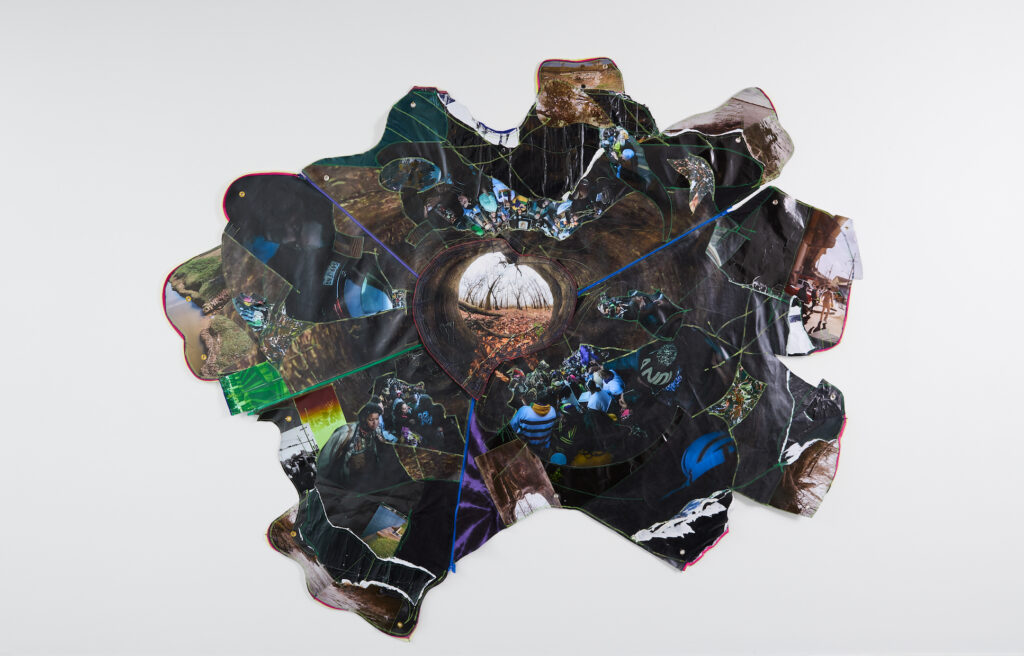
I was fourteen years old when Hurricane Katrina made landfall in my hometown. For the first few years after the storm, I viewed Katrina as a traumatic tragedy—somewhere between an anomaly and a mistake. However, my young, discerning mind had a suspicion that the impact was engineered. It didn’t make sense that the desperate people I saw on TV were Louisiana’s most vulnerable populations: working-class Black, white, South American, and Indigenous communities. I was glued to CNN for days, watching my people beg for help from their rooftops, seeing boats stranded in the middle of unrecognizable intersections, and witnessing people trapped at the convention center and on I-10. It took me until 2020, fifteen years after the storm, to finally understand Katrina as a reverberation and a warning.
When the COVID-19 lockdown began in New Orleans, I was immediately reminded of the weeks leading up to and following Hurricane Katrina. I felt a similar sense of foreboding, aware that life was about to change forever. Once that reality set in, I embarked on a journey of accepting, adapting to, and grieving every kind of loss. All the while, I watched the exact same chilling statistics of death unfold alongside gushing projections of economic damage. In the fall of 2020, I tuned in to a Zoom talk by Andy Horowitz about his book Katrina: A History, 1915–2015. Inspired, I read his book and started a two-year process of reeducating myself about the history of water management, capitalism, and Indigenous history in Louisiana.
By examining these interconnected histories through the lens of Horowitz’s book, I was able to connect the dots myself. New Orleans and other cities in the US operate under the misconception that concrete walls can protect civilization from water. This belief has been disproved by generations of floods, both before and after Hurricane Katrina. There exists a similar fallacy regarding our skin—we generally believe that it protects our vulnerable internal organs from the sun and environmental toxins. But the high cancer rates in Louisiana challenge that notion. Home to “Cancer Alley,” we are at the mercy of more than one hundred fifty petrochemical plants in the state.
Furthermore, the same concrete walls and canals designed to protect against storm surges also restrict the movement of people throughout the city. Yet, on any given Sunday during Second Line season in New Orleans, you will see crowds of people dancing on top of walls, roofs, and fences. The idea that physical barriers can truly contain both water and people is absurd.
Katrina, along with every hurricane to follow, has taught me that surviving on this planet requires us to live in harmony with our environment. When city councils, mayors, governors, and presidents restrict the movement of people and water across land, we jeopardize lives, livelihoods, and landscapes. The future of the Gulf Coast, and this country, relies on allowing water and people to move freely across land. We should build porous structures and reinstate the Mid-Barataria Sediment Diversion Project. Our communities can adapt, and my artistic practice focuses on envisioning what that transformation might look like.
—ASHLEY TEAMER
As we set to commemorate and look back on the twentieth anniversary of Katrina, I think about what that means to me and I think of one word: resilience. Katrina was the first major hurricane that I had faced living in Houston. At the time, I was working for Brennan’s of Houston, the sister restaurant to Commander’s Palace in New Orleans, so I got to see the impact of a major storm on a city and on the restaurant industry that I love. We watched as the storm came through and as homes and lives were lost. We watched as people evacuated the best they could and Houston became home to many New Orleanians. I watched as Commander’s Palace staff showed up in Houston, trying to figure out how to get their checks, picking up shifts, and just trying to figure out the next steps. They rebuilt their city, not overnight but over years, and New Orleans is once again back to the hustle.
Fast forward to late August of 2017 in Houston. We all knew a storm was coming, but the rain, not the wind, became our big problem. We decided to shut service down early so our staff could get home and be safe. That is when the wind picked up, and the rains really came down. The storm came through very hard and then stopped and circled back around again. This caused multiple days of heavy rain and flooding in places that it never had before, and the city had to make decisions that would impact all of our futures. As the water receded and the damage started to reveal itself, we all knew we were in for a long haul of rebuilding. This is where we saw the true resilience of our city and communities. Neighbors helping neighbors, fundraisers to help those in greatest need, and showing love to each other—we had to take care of our own.
My wife, Lindsey Brown, and I had started a foundation a few years before to help a friend of ours raise money for the MS Society. After Hurricane Harvey, we sat in the empty dining room of our restaurant worrying about our staff, our farmers, and all of our food and beverage friends. We had our festival coming up in the next couple of months and decided to change it to a food and beverage fundraiser. We figured out how to take applications for assistance and put money directly into the hands of those F+B workers that were affected by Harvey. We granted one hundred and thirty-nine F+B workers $501,000, and the direction of the organization known as Southern Smoke changed. We knew that, as an industry, we needed to build this safety net where one didn’t exist.
This is what resilience looks like. We cannot control storms or disasters, but we can help each other get back on our feet and rebuild our communities together. We have learned to be better for each other and offer a hand to those when they are down.
—CHRIS SHEPHERD
In 1992, Category 5 Hurricane Andrew destroyed Homestead, Florida, and missed New Orleans. But it woke me up to the realization that Louisiana was totally unprepared for a direct hit from a major hurricane, especially New Orleans. So, my mission became to listen to the still-quiet voice in my head trying to get the state to wake up to the realities that were to come. I knew we were going to need good computer models. In 1994, as assistant secretary of the Louisiana Department of Natural Resources, I pushed the department into supporting fledgling modeling efforts. My main concern was storm surges and the need to educate the public and government officials.
Five years later, Marc Levitan and I convinced Louisiana State University and the state to allow us to set up a Hurricane Center at LSU, which precipitated some funding, but the big break came in 2002, when the Louisiana Board of Regents granted me $3.65 million to set up a Hurricane Public Health Research Center, with New Orleans as the study area. Now we were on our way. By the time Hurricane Katrina hit, the center, with researchers from three universities, had a very sophisticated and accurate storm surge model and LSU had a supercomputer powerful enough to run it. Using this surge model, we convinced the state and FEMA to undertake an exercise a year before Katrina struck, the infamous “Hurricane Pam Exercise,” as a tool to educate government and the general population. I personally gave hundreds of talks in Louisiana and elsewhere and the media now had our number, and I even had a few documentaries out there, all in an attempt to educate and help folks prepare. The center also funded transport engineers who helped set up the successful contra flow evacuation process; developed a seventy-layer digital GIS mapping and information system; and worked with hospitals and the state Emergency Operations Center and local governments. When Katrina hit, our centers were prepared!
So, what does Katrina mean to me? My colleagues and I had done just about everything we could to help prepare governments for such a catastrophe, including warning about possible levee failures. We were heavily involved in all aspects of the response, including rescues, water quality issue, GIS mapping, and, eventually, the forensic investigation into the catastrophic failure of the US Army Corps of Engineers’ inadequately designed and constructed levees, which resulted in thousands dying, and billions in loss of property and livelihood. Our forensic investigation, known as “Team Louisiana,” proved without doubt the federal government’s liability for the losses and advanced the science of levee construction in the US.
Very early in the response, I realized that the victims had no voice, but I was developing one, and I used the hundreds of media interviews and the tens of documentaries to the full extent I could to educate the world that what happened was not New Orleans’s fault. The fault lay with government. To give these folks a voice, I wrote a book with Mike Bryan, The Storm, which was published by Penguin a year after the levees failed. However, the so-called fame came at some personal cost. On campus, there was a lot of jealousy and animosity, and behind the scenes some plotted my demise. The federal government and, I believe, the large engineering companies that benefitted from federal levee contracts also pushed LSU hard to fire me, which they did four years after Katrina. No reason given; they were very satisfied by the millions I had brought in and no complaints about my performance. In my opinion, these administrators suffered from a lack of moral fiber. I had no job and no career, and I was not of retirement age. But the universe has treated me well and now I am retired and enjoy my sailing, fishing, biking, and walking.
Oh, would I do it all again? Damn right, I would!
—IVOR VAN HEERDEN
Ever since Hurricane Katrina pushed an eleven-foot storm surge in from the Gulf of Mexico, flooding our family home with marsh sediments and saltwater, we have been living through and learning from the lessons and truths revealed when the masquerade of man’s manipulations cannot contain or compete with the forces of nature. But some lessons learned can be easily forgotten, especially if corporate interests fuel desire.
The federal government built a twenty-seven-foot, $1.1 billion levee around my community in the years after Katrina. We call it the “Great Wall of South Louisiana,” also known by the Army Corps of Engineers as the Chalmette Loop. But it doesn’t make me feel safe. At the dawn of hurricane season 2025, the Gulf is breaking records with ninety-eight-degree temperatures recorded in the Florida Everglades, as the coast of South Louisiana keeps sinking into rising seas. The Army Corps of Engineers promises the Great Wall will provide one hundred years of “risk reduction” and five hundred years as a “resilience” levee protecting the port city of New Orleans. Back in 2016, however, the last news report was that the levee walls were structurally challenged. Now, the Port of New Orleans’s LIT (Louisiana International Terminal) project proposes to decimate the last little patch of intact coastal forest inside this “risk-reduction” system, just up the road from our land, for a global container terminal. And the old Southern Natural gas plant and pipeline nearby has recently been updated to support a liquified natural gas line feeding Venture Global’s mega-export terminal at the end of the Mississippi. I fear these projects more than the winds and waters of a hurricane and wonder what happens to these facilities and other industrial sites when the next big storm rolls in, how will that affect my community, and is there any corporate responsibility and accountability for biological and cultural diversity and generational wellbeing?
Hurricane Katrina was a warning that forced the world to witness and reckon with the side effects of climate change. Twenty years later, I find myself just north of Interstate 10, about twenty-seven feet above sea level, writing these words on a little patch of prairie where I am cobuilding a place for people, plants, and other living beings to retreat to in good times and in times of emergency. Knowing that there is nowhere that will be safe from extreme weather and there are many storms on the horizon, I am grateful to be in community, attempting to adapt and design support systems for surviving the unpredictable and changing political and environmental challenges happening globally and in my home water-wetlands at the edge of the Delta, where the estuaries meet the sea.
—MONIQUE VERDIN
Header image: Gentilly , by Ashley Teamer, 2022. Inkjet print, fabric, acrylic medium, cord, eyelets, thread, 88 x 78 in. Photo by Genevieve Hanson. Courtesy of the artist.
Jeff Bostick posts his observations about New Orleans on his blog Library Chronicles and on social media, under the name “skooks.”
Jarvis Deberry is an opinion editor for MSNBC Daily. From 1997 to 2019, he worked for the New Orleans Times-Picayune, first as a reporter and then as a columnist, and was part of a team of journalists that was awarded the Pulitzer Prize for Public Service for its Katrina coverage. A selection of his New Orleans writing has been published in I Feel to Believe: Collected Columns (University of New Orleans Press, 2020).
Karen Gadbois , a textile artist, cofounded The Lens, a nonprofit New Orleans news site, in 2009, after helping to expose corruption in Katrina recovery programs on her blog Squandered Heritage. Her journalism has been recognized with a Peabody Award, along with other prizes.
Leslie Harris is a professor of history at Northwestern University. Born in New Orleans, she is the author and editor of several books, including the award-winning In the Shadow of Slavery: African Americans in New York City, 1626–1863 (University of Chicago Press, 2003). She is currently writing “Leaving New Orleans: A Personal Urban History.”
Meherwan Irani is the cofounder, chef, and CEO of the James Beard Award–winning Chai Pani Restaurant Group in Asheville, North Carolina. Through his restaurant and spice empire in the South’s most essential culinary cities, he is changing the perception of Indian food in America.
Klaus Jacob, a geophysicist, has worked at Columbia University’s Lamont-Doherty Earth Observatory for more than fifty years. His research focuses on disaster risk management, and in 2005, he was a prominent voice calling for New Orleans to “constructively deconstruct” in order to forestall future catastrophe. During Hurricane Sandy in 2012, his home in New York flooded.
Mitch Landrieu served as mayor of New Orleans from 2010 to 2018, after serving as lieutenant governor of Louisiana from 2004 to 2010. From 2021 to 2024, he served as senior advisor to President Joe Biden, responsible for coordinating the implementation of the Infrastructure Investment and Jobs Act. He is the author of In the Shadow of Statues: A White Southerner Confronts History (Viking, 2018).
Karen Trahan Leathem has served as a museum historian at the Louisiana State Museum since 2004. She curated the museum’s exhibit Living with Hurricanes: Katrina and Beyond, which remains on display at the Presbytère in the French Quarter.
Danielle Lovell is a behavior interventionist in Los Angeles. Born in Rochester, New York, she lived in New Orleans from 2001 until she evacuated in 2005. She eventually resettled in California where, in 2024, she evacuated during the Los Angeles fires.
Vann R. Newark III is a senior editor at The Atlantic. In 2020, he hosted Floodlines, an eight-part podcast miniseries about Katrina, which received a Peabody Award.
Katy Reckdahl is the editor of the nonprofit New Orleans news site The Lens. She previously worked as a staff reporter at the New Orleans Times-Picayune and the alt-weekly The Gambit. Among her many journalism prizes are more than two dozen first-place New Orleans Press Club awards.
James Beard Award–winning chef Chris Shepherd, author of Cook Like a Local: Flavors That Can Change How You Cook and See the World, has helped change the landscape of the Houston, Texas, culinary scene since opening Underbelly in 2012. His foundation, Southern Smoke, has supported the Emergency Relief Fund and Behind You mental health program.
Ashley Teamer’s collages explore the relationships between the body, nature, space, and time. A DJ and visual artist, Teamer received her MFA from Yale University in 2022. She has had solo exhibitions at Siena Heights University (Adrian, MI) and 4th Ward Project Space (Chicago, IL). Teamer’s work has also been included in group exhibitions at the San Francisco Museum of Modern Art; Everson Museum of Art (Syracuse, NY); and Prospect 6 (New Orleans, LA). She has been an artist-in-residence at Skowhegan School of Painting and Sculpture, ACRE, and Ox-Bow School of Art.
Ivor van Heerden cofounded the Louisiana State University Hurricane Center in 1999, serving as deputy director until 2009. He led the State of Louisiana Forensic Data Gathering Team in their investigation of the Katrina levee failures. LSU fired van Heerden, who sued for wrongful termination; LSU later settled when emails showed the university had tried to silence his work exposing the Army Corps’ failures. Van Heerden is the author of The Storm: What Went Wrong and Why During Hurricane Katrina—The Inside Story from One Louisiana Scientist (Penguin, 2007).
Monique Verdin, a citizen of the Houma Nation, is an artist and storyteller. Among many projects, she is the protagonist, cowriter, and coproducer of the documentary My Louisiana Love (2012), the author of Return to Yakni Chitto: Houma Migrations (University of New Orleans Press, 2020), and part of the autonomous and alternative mutual aid project SwampNet.