I always talk about the paternal side of my family—Nana Boo, Paw Paw, Daddy ’nem—but rarely share about my maternal southern roots. Mommy’s side of the family is a mystery wrapped up in a legend that eggs on my curiosity ’bout where my Mommy’s people ’nem from. On her side, I got different types of southern blood running through my veins: My Oma Klara Viol is from Passau, a city in southern Germany, and my Opa Ray Stephenson is from Yazoo City, Mississippi. Two different Souths, one blended southern family. I never asked Mommy or my uncles and auntie if they felt southern in the same way I do as a Black girl predominantly raised in southwest Georgia, but I do wonder if those branches and roots of the family tree shiver with the fear of being forgotten. I don’t know much about Opa Ray ’cept that he took his Mississippi ruts and ran away to Chicago sometime in the 1940s. Ray isn’t even his real name—he changed it when he enlisted in the military. After Chicago, he was stationed in Germany, met my Oma, and well, the rest is family history.
I never got to interact with Oma Klara or Opa Ray. They passed before I was born. What I do know is that Oma Klara was blonde-haired and gray-eyed. Opa Ray was dark-skinned and handsome with a mischievous smile. And I know that my blood calls out to him because it’s a missing piece of my own southern identity. Opa Ray was a jokester, from what Mommy and my uncles told me about him. He may have left Mississippi, but he took them country ways with him—feasting on coon, squirrel, and mountain oysters. “IT’S BAWLS!” Oma, with a thick German accent, screeched in disgust. I have a whole side of the family that I haven’t met that lives in Chicago, placing me and mines in the longer shadows of the Great Migration of the early twentieth century. Conversations about the Great Migration are frequently tinged with anxiety. The South was a place to escape in order to be and do something better. Perhaps Opa Ray left Mississippi in terror late one night from committing some unknown sin that Mississippi wouldn’t forgive. Maybe he woke up determined to make a name for himself, hopped on a bus, and watched the southern landscape melt away and the possibility of betterment come into view. Regardless, the South stayed with him in his food, in his tongue, and in his mind.
I put Opa Ray in tandem with other Jim Crow–era Black Mississippi men like Richard Wright, who also left Mississippi but constantly revisited it in his writings. Like Opa Ray, Wright left the South to “fling [himself ] into the unknown.” The region, however, would haunt him. I wonder often if Opa Ray’s southernness haunted him or kept him grounded as a Black man moving through the challenges of an openly racist postwar society. From what I’ve been told about him, Opa Ray was up for the challenge, raising a family of biracial children with an equally strong-minded and determined south German woman. Opa Ray and Oma Klara would eventually settle in Northern California.
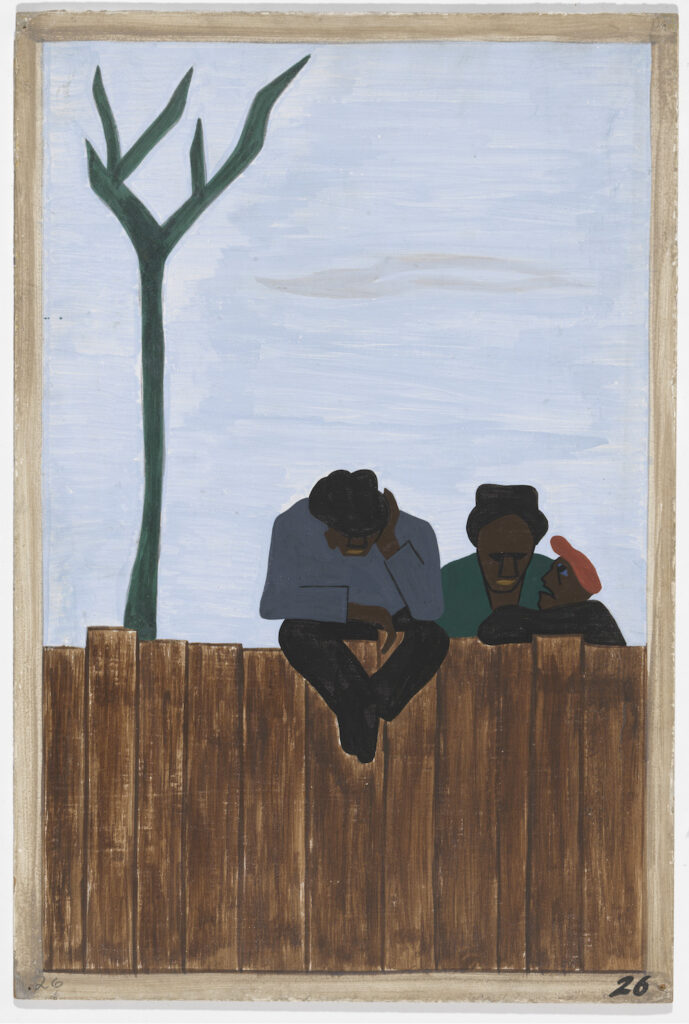
Digital Image © The Museum of Modern Art/Licensed by Art Resource, NY.
As I’ve written elsewhere, I’ve long been fascinated by Toni Morrison’s theorization of Black literature and the tool of literary archeology, the construction of a Black interiority that was often unknown or intentionally hidden from public view. In considering the secret and often quiet or silenced interior lives of Black men and Black women, we can understand interiority as the making of a place for their truest and deepest sense of self, one that society often discouraged and misunderstood. For me, Opa Ray’s southern heritage is his well-kept interior secret. I know he is a Black Mississippian but know little else about his southern background. My researcher tendencies kick in, and I think about the questions I would ask him if he was still around. We’d probably sit on the porch and laugh a little, and then the conversation would get more serious: What was Opa Ray’s real name? What made him run from Mississippi? Did he ever miss home? Did he take the Blues with him? Did he ever think about coming back? Was he ashamed about being southern? What does he have to share with me, a fifth (and some change)-generation Black southerner who studies the importance of the Black American South? Those generational ties spin quickly and endlessly, intersecting and weaving a dynamic tapestry of memory, ancestry, and intentions.
I’ve learned with growing older that ancestry and intentions are interconnected. They feed or starve one another. Perhaps Opa Ray intended to erase his past to make way for his future self. My intention is to remember and honor his actions as touchstones to my own. I do not want to starve my ancestors, both known and unknown, of the love and attention they deserve. To preserve memory is to ask questions and acknowledge answers. Sometimes it’s to do a little digging and make space for the discomforts that the past offers us to reckon with the truths of our present and future. The nation struggles with acknowledging the discomforts of the past, often embracing flattened and myopic ideas that serve a more valorous narrative. There is heroism and virtue in our history, and it is not concentrated in one people or era—or in one region, for that matter. The challenge in acknowledging the South’s multifacetedness is finding a balance between the performance of southernness, its truth, and the reception of its realities. The South ain’t perfect, but it ain’t disposable, either.
This is the first general issue of Southern Cultures in more than five years. We’ve collected some intriguing voices and perspectives for this issue that grapple with the South’s complexity and how we are communal in spirit, in blood, in truth, and in action. It takes up questions of memory, ancestry, and family (both blood and chosen) and does not shy away from the discomforts of southernness and what those discomforts imply about identity, race, and class. Sometimes the ancestors got it wrong. Sometimes the only tool we have to reckon with the past is the historical record. Other times, we have only what we’ve been told about our people ’nem and have to connect the dots in imaginative and unconventional ways. The South is substantial and speculative, traditional and unorthodox, and all perspectives are necessary to appreciate the dynamic sociocultural landscape of our region.
Header image: Detail from The trains were packed continually with migrants, by Jacob Lawrence, 1940–41. Panel 6 from “The Migration Series.” Tempera on gesso on composition board, 18 x 12 in. (45.7 x 30.5 cm). Gift of Mrs. David M. Levy. Digital Image © The Museum of Modern Art/Licensed by Art Resource, NY.
Regina N. Bradley, an award-winning writer and researcher of the Black American South, is an alumna Nasir Jones HipHop Fellow (Hutchins Center, Harvard University, Spring 2016), associate professor of English and African Diaspora Studies at Kennesaw State University, a faculty editor for Southern Cultures journal, and cohost of the southern hip hop podcast Bottom of the Map with music journalist Christina Lee. A leading scholar on contemporary southern Black life and hip hop culture, Bradley has discussed her work on a range of media outlets, including NPR, Netflix’s hip hop docuseries Hip-Hop Evolution, Washington Post, and Atlanta Journal-Constitution. In May 2017, Bradley delivered a TEDx talk, “The Mountaintop Ain’t Flat,” about hip hop in the American Black South. She is the author of Chronicling Stankonia: The Rise of the Hip-Hop South, the editor of An OutKast Reader, and coeditor of the third edition of That’s the Joint!: The Hip Hop Studies Reader, with Murray Forman and Mark Anthony Neal.