It was a two-hour drive from New Orleans to Hattiesburg, Mississippi, in the sweltering heat of summer 2024, when I first met Dr. Tammy Greer. Just the day before, I had taken an early morning walk to Nanih Bvlbancha at Lafitte Greenway, a project she helped bring to life alongside a collaborative group of artists and educators. Dr. Greer greeted me as I arrived at the Library of Hattiesburg Petal & Forrest County. Her long pink hair and spoken cadence immediately made an impression. As I made my way home, it struck me just how much I respected Dr. Greer—an awareness that came alongside an unfamiliar ache in my back. I suddenly realized the source of the discomfort: I had been sitting up straighter than usual, a subtle yet telling reflection of how I thought of her.
Although our meeting occurred in 2024, I had long been acquainted with Dr. Greer’s work, particularly her expertise in Indigenous plant sovereignty, which I encountered while researching our shared heritage with the United Houma Nation. Dr. Greer introduces herself as an associate professor of psychology at the University of Southern Mississippi and the director of the Center for American Indian Research and Studies. These positions only scratch the surface of the many responsibilities she holds. Dr. Greer plays a key role in a variety of cultural initiatives that inspire and foster community engagement, working closely with numerous organizations to create a lasting impact, including the establishment of the Medicine Wheel Garden at the University of Southern Mississippi, all while laying the groundwork for future generations to understand and honor their cultural heritage.
Any opportunity I have to interact with her is a fond experience that continues to enrich my own library of knowledge, while also bolstering my strength and sense of security in who I am. So, of course, I jumped at the opportunity to learn more, revisit Nanih Bvlbancha, and, importantly, carve out some much-needed time for meaningful conversation.
—Mariah Hernandez-Fitch
Mariah Hernandez-Fitch: Thank you for joining me today. To begin, could you provide an overview of Nanih Bvlbancha? I’d love to hear about its origins, historical context, and the inspiration behind it.
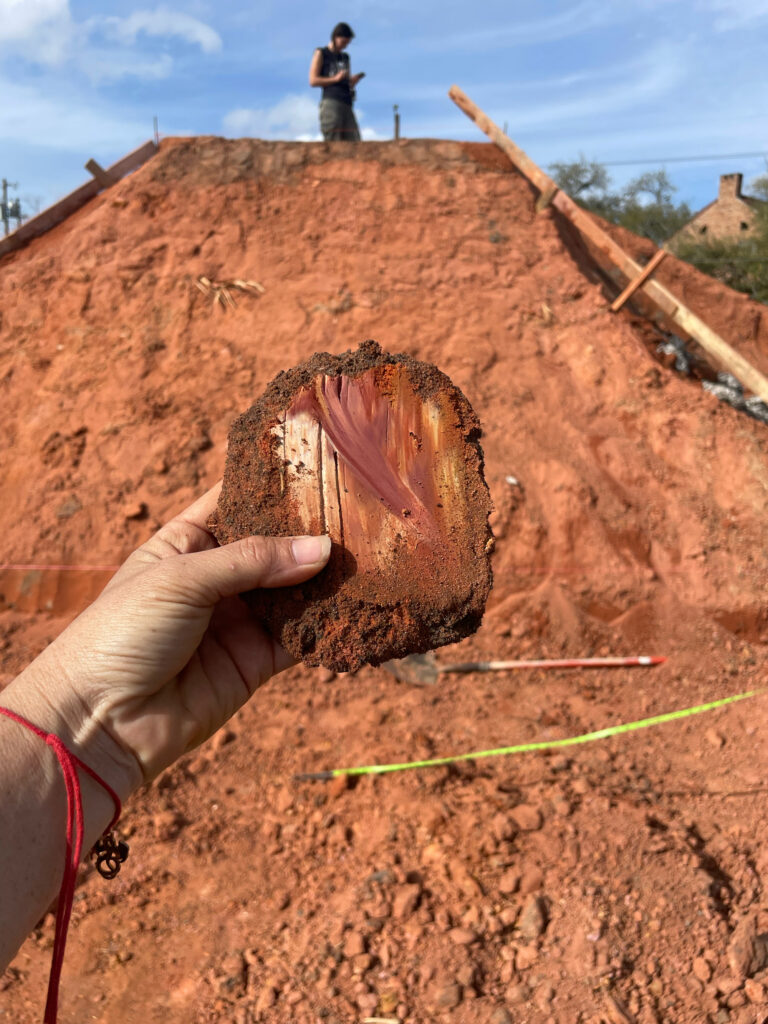
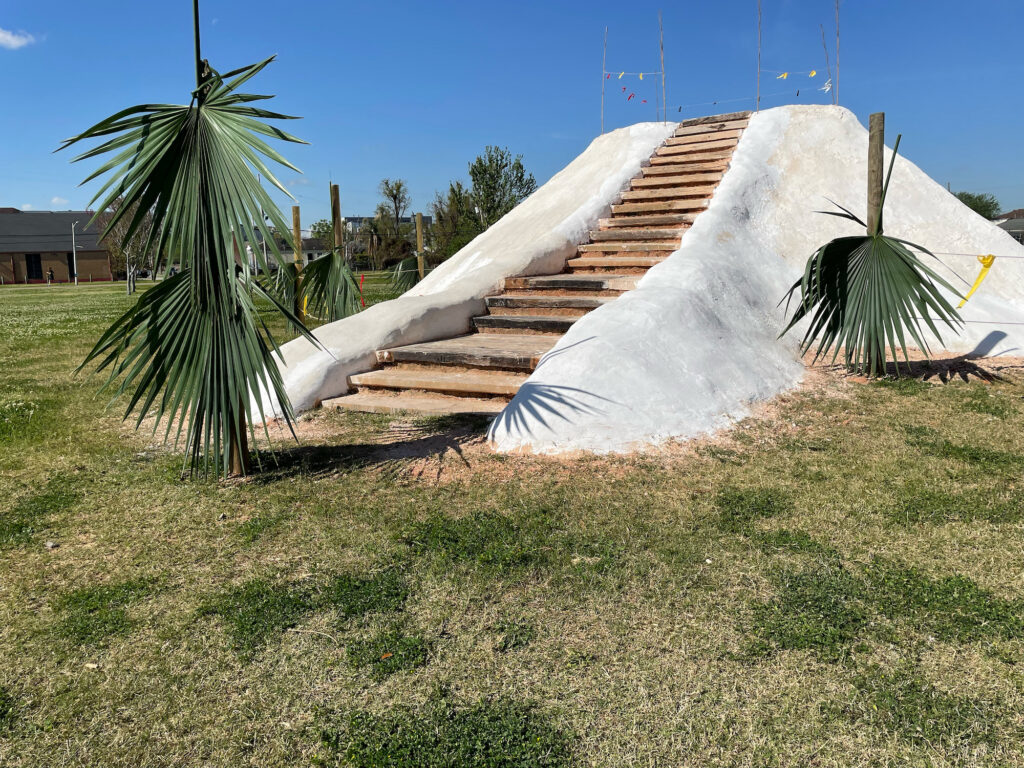
Tammy Greer: Well, Nanih Bvlbancha is a ten-foot-high flat-top mound, constructed in the style of mounds found in this region of the Southeast, dating back to around eleven thousand years ago, ten thousand years ago, or even five thousand years ago. When the colonists arrived (in the late seventeenth century), people were already living on and actively building mounds. This is a mound that was built with the intention of pointing to those ancient mounds and honoring them.
MHF: And the introduction on the project website mentions that it also incorporates sediments from various locations. Is that correct? What was the intention behind including these different sediments?
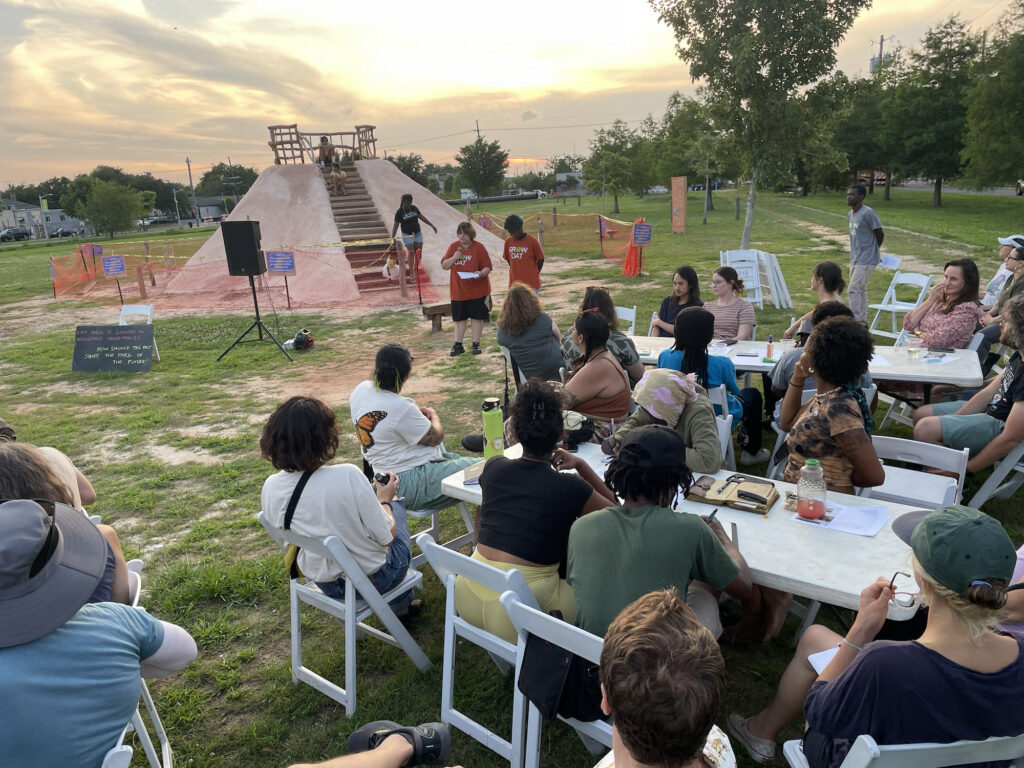
TG: The idea behind ancient mounds was to bring communities together. These mounds often served multiple purposes: They were sites for burials, feasts, ceremonies, and settlements. The flat tops of some mounds were used to elevate significant individuals or highlight important community events. In many ways, they functioned like town squares or central places for communal activities.
We built this mound with that same spirit of community in mind, not only honoring the Indigenous community but also including the broader New Orleans and Bvlbancha communities. The dirt used for this mound came from many places, even overseas. We asked Native tribes to contribute, we asked people on reservations to contribute, we asked our friends to contribute. People even mailed in dirt from overseas to put on this mound, symbolically saying that this mound is a community structure built in the same vein and for similar purposes as the ancient mounds, which were built to gather people.
MHF: You mentioned that this project serves as a remembrance of mounds that once existed here, many of which have been wrongfully demolished, unearthed, or lost to environmental factors. What does the project say about the urgent need to protect coastal and tribal communities, and how does it speak to the broader environmental challenges facing the region?
TG: Some of the ancient mounds, like those at Poverty Point, were actually built to elevate homes. For example, the elevated semicircles at Poverty Point likely had houses on them. People lived near water because water is essential for survival, but water levels naturally rise and fall. Elevation was one of the ways communities protected themselves from rising waters. Another protection was canebrakes, which acted as a natural barrier but have largely disappeared in Louisiana and Mississippi. By elevating the land, people created spaces to live above flood levels, ensuring their safety when water rose.
What’s truly remarkable is how the people of that time worked with the natural environment rather than against it. They didn’t try to dominate nature but instead adapted to it in sustainable ways. For example, they didn’t dam rivers to control water; they understood that water is a living entity that needs to flow to sustain itself, the surrounding vegetation, and the animals that depend on it. Instead of obstructing the water, they shaped the landscape to coexist with it. That’s a level of sustainability and ingenuity we often overlook today. Ancient communities didn’t resist nature. They worked in harmony with it, surviving and thriving by finding creative solutions to meet their needs without damaging the ecosystem.
Another reason we built this mound was to inspire and educate our youth. For generations, Native children were told, or [it was] implied, that their heritage wasn’t worth valuing. They were portrayed as backward or primitive, incapable of contributing to a modern world. Many of their parents and grandparents were discouraged from seeking education, being made to feel that their connection to the land was something to be ashamed of. But that’s not the truth. Their ancestors were not just surviving; they were thriving as engineers, architects, astronomers, and artists. These mounds have existed for thousands of years, outlasting modern levees. The mounds are aligned with the cardinal directions, sometimes mapping the constellations or pointing toward neighboring mound groups.
We built this mound to remind Native youth that their ancestors were creators, innovators, and visionaries. They were delivering babies, building beautiful things, and excelling as artists, singers, and dancers. I mean, that’s these kids’ heritage.
MHF: Yeah, if anything, right now is a moment in time where people are starting to realize that Indigenous stewardship is the future. I’m seeing that with the fires in California. It’s dry, and the land wasn’t meant for this type of development. Indigenous peoples, like the Gabrieleño/Tongva and Chumash, understood this—they knew not to build there. They warned us, but we ignored the traditional ecological knowledge they’ve cultivated over their entire existence.
TG: Yeah, exactly. Or they knew how to use fire wisely. For instance, down here, the dirt is a kind of clay that gets pretty hard, and people used to use that to their advantage. Around their homes, they’d clear a twenty- to thirty-foot area and keep it as just clay with no vegetation. It looked different, sure, but there was a reason for it. If vegetation caught fire, it could burn their house down. Plus, clearing that area helped keep away pests like fleas, ticks, mites, and red bugs that lived in the brush.
People would sweep the area clean and maintain it to prevent fires from coming too close. They didn’t clear one hundred acres just to put a house on it; they worked with the environment instead of against it. The rest of the forest remained intact, so they could still forage for berries, fruits, nuts, and other resources. It was brilliant and it still is brilliant when you think about it.
MHF: Why do you think these teachings are especially crucial now, and how can they contribute to the health of both our communities and the environment?
TG: My gosh, we’ve been living in what I call a domination paradigm. It’s this mindset where, if a tree is in the way—say, if a branch is hanging too low near a sidewalk—we just cut the branch off without a second thought about the tree. We don’t think about the health of the tree, its needs, or how it might grow taller, making the branch high enough for everyone to pass under in time. If we build a house, we clear acres of land and not just the space needed for the home and a little more for safety, but acres and acres. That’s pure domination of the environment.
It’s rooted in this Western teaching that the Earth exists for us to dominate, and we’ve acted on that belief over and over again. But domination isn’t sustainable. It’s like a woman under someone’s thumb, she’ll take it for a while, but eventually, she’ll push back. And the Earth, too, has her balance to maintain. When she can’t take it anymore, she pushes back. Just look at what’s happening now. She’s pushing back, and it’s terrifying because we’re all in danger. This domination paradigm has brought us to where we are today. We’ve pushed too far, thinking there will always be another piece of Earth to dominate. When the oil’s gone, we just find something else to exploit. But there’s another way. For southeastern Indigenous peoples, it wasn’t about domination; it was about cocreation.
Take the mounds, for example. You’d find a place, navigate and negotiate the space because there were other tribal people all around. Then, you’d dig a borrow pit to gather dirt for the mounds—whether for platforms, houses, or burials. Afterward, the borrow pit wasn’t left barren; it became part of the cycle. Bones, food remains, and other materials went back in, filling it up. When one pit was filled, you’d dig another and repeat the process. It was a cycle of give and take, a reciprocity with the land.
This wasn’t limited to mounds; it extended to everything. If you needed firewood, you didn’t just cut down any tree. You’d walk through the forest, looking for damaged trees, beetle-eaten trees, or dead standing ones. Some you’d leave for the critters that rely on them, but the ones you took made the forest healthier. That’s a sustainable way of living, one that the Earth can support forever. But look at what we do now. We drain thousands of acres of swamps because we think they’re useless. How arrogant is that? To assume that something we don’t find immediately useful must be worthless? You see the craziness in that?
MHF: You’re right. It’s crazy thinking about the power of humans and how silly it is that we displaced everything living in the swamp. It’s like we’re so blinded by our self-centeredness and only years later do we realize what we’ve done when things stop working out for us.
TG: Well, yeah, “it’s useless because it’s not useful to me.” That’s self-centeredness. People always say humans are at the top of the food chain but think about being at the top of a pyramid like one of those Jenga games. The top is the most vulnerable place to be because anything that gets removed can bring the whole thing crashing down. We depend on everything else to hold us up. And it’s a different mindset, you know? The culture that came here was willing to leave their land, their home, their plants, and their animals to take a shot somewhere new. As Natives, we’re tied to our place. We don’t want to leave it. It was a different culture we hadn’t encountered before, or at least not to that degree.
When they [colonists] came, we taught them about our medicines and our food. And now we still need to teach, because we need to remember how to live in harmony with the natural world, with each other, and within ourselves. Indigenous cultures, all over the world, carry those teachings, and they’re so needed now.
MHF: That’s a good point. I mean, we have to live with ourselves our whole lives, so it’s really important to be in harmony with ourselves. And that becomes a reflection of how we treat our surroundings.
TG: It starts right there. It starts with being in harmony with ourselves, and then it extends to other humans, to each other, and then to everything that isn’t us—the beings we share this world with. You hear a lot about being in harmony with yourself, and a lot about being in harmony with communities of different races or gender identities. But we also need more talk about being in harmony with the natural world. Not just with one another, but with the other beings that aren’t human. They too are part of this world, and we depend on them just as much as they depend on us. In fact, we’re more dependent on them. We could leave the Earth, and it would go on, but if they leave, we might not be here.
MHF: This leads me to connecting what you just said to Katrina. Do you think the storm reshaped, changed, or maybe reaffirmed your understanding of displacement and reciprocity?
TG: You know, the animals had to run too. I noticed there were no squirrels or birds around here in Hattiesburg for a long time after Katrina. They were blown away, and it took a while for them to come back. They were stressed out as well. But what stood out to me with human beings was how some saw Katrina as a disaster, while others saw it as an opportunity. Some people took advantage of the situation by buying property cheaply and creating their own villages by displacing people who were in dire straits, some of whom had lost family members. That was a big lesson for me.
It was also an opportunity to help people regain their villages in a better way, and sometimes that worked. But it really made it clear that there are people who see others’ disadvantages as an opportunity for themselves. It reminded me of when they tried to move Natives out of the West, like killing the bison, which was a disaster for the Natives, but an opportunity for those wanting to take the land. You see what I’m saying?
MHF: Yeah, there is a parallel between these things in the past and present, or it is a continuation.
TG: We have to be mindful of that opportunistic mindset, you know? It’s like with dogs. You walk away from a bowl of food, and the dog will take it. There’s something in us, that instinct, to seize opportunities for personal gain, and we need to watch for that. Right now, there are people who still aren’t back in New Orleans, people who no longer have homes because of Katrina. They used to have homes, but now they don’t. I’m not sure how it played out in precolonial times, but from what I’ve read and heard, when tribes were displaced, other tribes would take them in. They weren’t left to wander alone with no place to go. That’s part of what the Houma people represent. Different tribes came together for protection and community. The Earth is writing herself, pushing back, and we need to find another way to adjust. With the fires, hurricanes, and tornadoes, there needs to be a new way to adapt. We need to adjust so we can stay a community.
MHF: There’s a lot to learn, and we’re seeing it in real time. I guess, going back to the mounds, how do you see them pushing back against this mindset or the erasure of history?
TG: I think this mound has the potential to really, literally, stop the erasure of history in this way. We thought about this when we were building it. I’m giving you a couple of reasons, but here’s another one. People are literally erasing history by plowing down mounds. They flatten them to make more space for farming because the mounds get in the way; you have to plow around them, so they literally destroy these historical mounds, which often contain artifacts and sometimes human remains. They’re disturbing many important things without recognizing the value of these historical monuments to our Indigenous ancestors.
This mound, if people think about it, is like the American Girl dolls that were so popular. People used to not value them as much, but if you saw an ad where one was selling for four hundred dollars, you’d think, “Wait a minute. I’m not getting rid of my American Girl doll!” That’s what I want this mound to do. If someone is thinking about plowing it down, they’ll see that there’s a community building around it, getting all kinds of attention. That might make them reconsider. The mound literally has the ability to stop the ongoing erasure of our ancestors and our monuments.
I tell the crew who built it, “Anytime someone wants to come and do something at the mound, we have to support it.” That’s what she’s here for. She’s here to be an ambassador for mounds. The more attention she gets, the more likely it is that someone else won’t just throw away their American Girl doll.
MHF: So, like you’re saying, this role of active participation fosters a sense of belonging and cultural memory, or maybe just aids in that cultural memory.
TG: Well, it reestablishes the culture, bringing it back. It’s like when Ms. Janie [ Janie Verret Luster, a member of the United Houma Nation, who is regarded as a master basket weaver] brought back the half-hitch basket, and people hadn’t done it in fifty years. But here’s Ms. Janie doing it, and people started learning it, people started seeing it, and people started recognizing it. She brought back that culture. We brought back this culture. People haven’t built mounds in a long time, not down here, not in our territory. But we did.
MHF: When I visited the mound, it was just so picturesque with the New Orleans skyline in the background. It’s symbolic. What do you hope visitors take away from their experience with Nanih Bvlbancha?
TG: I want them to realize that southeastern Native Americans are still here. We’re restoring our culture and sharing the fantastic parts of who we were as a people with our youth. Our youth have grown up with a history that has been diminished, and we are here to bring that back. We’re telling the real story of southeastern Native Americans—not just to everyone, but to our youth as well, so that they can take pride in their heritage. They need to understand that they come from people who came from the stars. Our belief system includes three levels of the world: the underworld, the middle world, and the over world. There are even stories about us being Star People, and if you think about that as your inheritance, Mariah, imagine what you can do with that knowledge of yourself.
MHF: Ahh, that’s beautiful.
TG: That’s powerful. I want for us to know that, and for us to behave accordingly, and for us to use this mound to center ourselves in that realization. But see, not only us, all the cultures around here, the South Americans. Look at the Irish people. Their Indigenous cultures as well had mounds, had these monuments that they built that aligned with the stars that spoke to their incredible ingenuity and brilliance as a people. If we could get in touch with that part of ourselves, not just the Indigenous people of this place, if we could get in touch with our Indigeneity from all over the world, they all lived in harmony with not only one another but also with the other. They had to, that’s how they survived.
We could figure this out, how to go forward in a better way, not by domination, but by co-creating with the trees, the animals, and with one another, and undo this. What we’ve done, we’ve been doing a lot since we got to the Americas, since settlers came. We’ve been doing a lot that needs to be absolutely undone. We need the swamps back where they belong. We need some cane breaks along the river. See what it means to undo some of what we’ve done. This mound is showing us that our ancestors had an idea. They knew how to live in harmony with the rest of the environment. Look at what they could do. Look at what they built for the community. Look at how they cycled things. They recycled things and cycled things and paid attention to the seasons and the environment. We could do it again. We could all have it in us, because it’s our heritage.
Tammy Greer, a citizen of the United Houma Nation, is an associate professor in the School of Psychology and director of the Center for American Indian Research and Studies at the University of Southern Mississippi. She mentors students, supports Indigenous-focused initiatives, and promotes food sovereignty, health research, and holistic wellness, blending traditional knowledge with modern practices to serve Native communities.
Mariah Hernandez-Fitch, a citizen of the United Houma Nation from Dulac, Louisiana, earned her BA from Dartmouth in 2023 and MA from UCLA in 2025. Based in New Orleans, she will begin law school in fall 2025. She explores public policy, tribal sovereignty, identity, memory, and land through her creative work.