
We understand history in hindsight. Or, as the German philosopher Hegel writes, “The owl of Minerva spreads its wings only with the falling of the dusk.”
Twenty years have passed since Hurricane Katrina destroyed all of our family’s belongings as it devastated New Orleans neighborhoods and the Gulf Coast. When I think of Katrina, the word refugee comes to mind, because in the weeks after Katrina, when we were on the road, people referred to us that way. Twenty years later, our country’s president boasts that he is enacting the largest domestic deportation operation in American history. He purports to make America great again by suspending the US Refugee Admissions Program and reasserting an anti-immigrant, nativist agenda.
After Katrina, my husband, Michael, my two young daughters—Adelaide, then two years old, and Cecilia, then three months old—and I were American climate refugees. This label used to make me uncomfortable, because at that time, we did not have a concept for climate refugees. The term is not to be equated with those who flee wars and seek political exile. Nonetheless, a hurricane, the erosion of our Gulf Coast, and our federal government’s engineering failures all played a part in forcing us to flee our home. For months, our city and our homes were uninhabitable. Katrina’s water displaced our neighborhood and those around us. It turned everything on its head and set it back down in a different place. It split houses in half; it separated families; it changed the course of our futures. In my family’s case, it created the conditions that prompted another country to welcome us and offer us shelter for a year after the devastation.
Our lives were stripped of all our identifiable markers—our belongings, our jobs, our plans. Michael’s parents, aunts and uncles, grandmother, and our friends had lost their homes as well. Nothing was certain. I had just started graduate school and had a teaching job at the local community college. Michael was almost finished with his PhD in Philosophy at Tulane. But after the flood, we knew our family could not return to the city for a long time.
After evacuating, we stayed with friends in Houston for a week, followed by other friends in rural Texas. After that, we drove north, crashing with my cousin’s family in Tennessee, with an uncle in Kentucky, and with some college friends in Pennsylvania. When we reached New York State, September’s cool air reminded me how far away our old life was already. We stayed at my parents’ house in upstate New York and considered our options for the future. We filled out FEMA paperwork; we accepted help from the Red Cross and donations from friends and family; we looked for work. Once or twice a week, Michael escaped the frustrating idleness of unemployment by auditing a class at Cornell, forty-five minutes away in Ithaca. At this time, many universities opened their doors to displaced students.
One bright orange-and-red-leafed October afternoon, after reading Kant in German, Michael attended a meeting held by a representative of the DAAD (Deutsche Akademische Austauschdienst, or German Academic Exchange Service) at Cornell. At the meeting, he learned that the German government was offering ten Katrina-relief scholarships to scholars who were no longer able to study in New Orleans because of the devastation. This announcement was uncanny: The opportunity seemed tailor-made for him, since he had been putting together a research proposal to study in Germany in the months before Katrina. In July, Michael received a letter from Freiburg from the director of an archive that houses the unpublished works of Edmund Husserl. He invited Michael to research the material, which was central to his dissertation. Somehow, when we evacuated New Orleans, all of the family photographs I had packed in a brown paper grocery bag stayed in our house, but that letter from Freiburg was tucked in the trunk of our car. The hand-typed piece of paper was the key to our future. By the end of the month, the DAAD had secured us a three-month student grant and a family stipend for the four of us to live in the foothills of the Black Forest.
Nothing we saw in our new home in Germany resembled what we heard from our family about New Orleans—no uprooted trees, no ash-colored grass, no heaps of rubble. We had landed in an organized, efficient society. Over the months, Cecilia learned to crawl up the steep, creaky wooden staircase to our apartment door, and Adelaide learned German. I remember telling her, “You’re speaking English now,” as we walked through our new neighborhood. “German sounds different than English. You might not understand what people are saying at first when they speak in German.” And just after Thanksgiving, Adelaide started kindergarten at the end of our street. It was one of the only places where no one spoke English to us. I was grateful for her teacher’s limited knowledge of English and for her patience with my German. Many times, I encountered “switchers”—Germans who’d shift immediately to English when I stumbled through a sentence.
I resembled Adelaide: my world was new; my vocabulary was limited. I had taken two semesters of German in college, but most of it had dissipated in the six years since. What remained were some verb scraps, numbers up to twenty, various greetings and weather observations, and some vocabulary words that my mind had indexed according to sound rather than semantics—schatz; schlect; scheiss (treasure; bad; shit). At the market, ordering food was an exercise in public embarrassment. The farmers set up tables under green-and-white-striped umbrellas and waited while my brain recalled a new word or as I stumbled over an awkward pronunciation. Often, I missed the luxury of American grocery stores where we could grab an item, toss it in the cart, and push on to the next aisle without a word.
Adelaide had no choice. The children in her kindergarten knew nothing but German. For months she listened to German children chant, shout, sing, whine, play. After mornings of silence, she came home for lunch and played in her room. As I washed dishes in the kitchen or fed Cecilia in the living room, I listened to her speak German-sounding gibberish. At first, she sang the words to songs. Then one day in March, she started to speak in complete and accurate German sentences. The kindergarten and the playground near our house were our lifeline to engaging in the culture and establishing a social life in this place where we felt welcome and somewhat settled. Luckily, we managed to prolong our three-month stay to twelve months through an extension from the DAAD and a grant from Tulane.
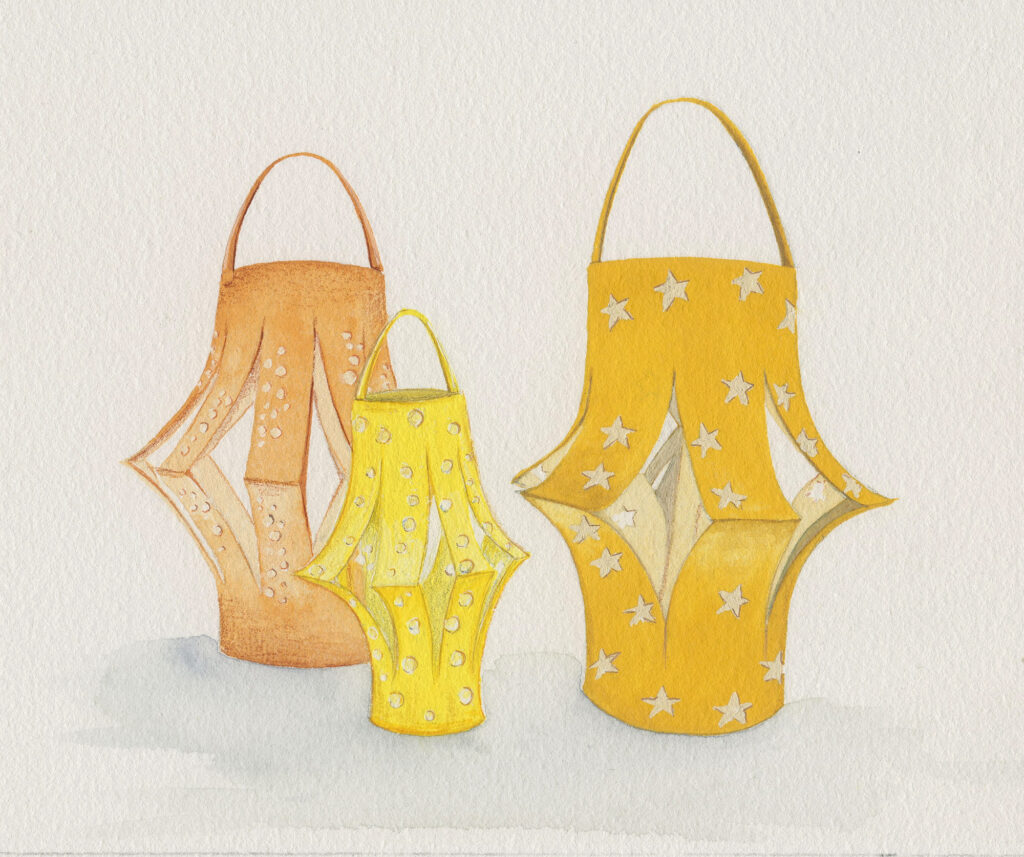
A week before we moved back to the US, we celebrated a German holiday, the feast of St. Martin of Tours. In many German towns, children mark the evening of November 11 by processing through the streets at night with homemade candlelit paper lanterns. The legend of the Roman-soldier-turned-bishop celebrates an act of kindness toward a needy man. Mounted on horseback, on his way into the city gate, St. Martin took pity on a beggar shivering in the cold. Cutting his cloak in half with his sword, he offered a piece to the man. At the kindergarten, children learned about the legend through role playing. One photograph I have shows Adelaide dressed up in a red cloak, wearing a cardboard helmet and brandishing an aluminum foil sword. Playing the beggar, her classmate kneels on the floor. Adelaide is about to take off her cape, draw her sword, cut along the Velcro strip sewn down the middle of the cloak, and offer it to him.
On the evening of St. Martin’s Day, the school’s procession wound through residential neighborhoods. The children sang about St. Martin, their lanterns, and the stars, songs that they had practiced for weeks: “Sankt Martin gibt den halben still, der Bettler rasch ihm danken will.” The air was cold; I spoke to another child’s father of uncertain plans upon our return to the United States. I said, “We’re sorry to leave. We’ve had a wonderful year.” The children walked deliberately with their paper lanterns that hung on hooks at the end of thin dowels, careful not to let them go up in flames. We stopped outside the church, where the crowd gathered. Sharing the tradition of Martin’s generosity, children broke and shared soft, buttery pretzels with each other. Many acquaintances bid us warm farewells as the celebration ended. Even though we had been there for a year, I lacked the German words to express my gratitude to this community. Like the beggar, I wanted to rush to thank everyone who gave us refuge from disaster and carried us away from trouble for a while.
In 2010, we moved back to a different part of Germany for work. Again, we ended up staying longer than planned—this time for seven more years. Ten years after our displacement from Katrina, we witnessed Angela Merkel, the prime minister of Germany, open wide the doors of Germany to a million Syrian refugees with these confident words: “Wir schaffen das” (We will manage this). We witnessed her promise come true, as we saw our friends and neighbors welcoming strangers where we lived.
In 1930, people suggested that our small town in German wine country be renamed Hitlerhausen. They even printed a postcard before they decided against this proposal. The greeting on a panoramic photo of this town said, “Gruß aus Hitlerhausen,” or “Greetings from Hitler’s Houses.”
Germany’s history underpins the motivation for acknowledging [A1] asylum seekers. Why would so many people welcome one million refugees from Syria and another million from Ukraine? Germans have experienced the horrible consequences of nativist rhetoric. And German culture disdains the idea of parallel societies because they breed suspicion, and it generally holds that in order for a society to thrive, diverse groups of people should intermingle. This intermingling is the treatment for warding off extremism.
Curious to know how refugee integration looked in our small village, I attended a coffee hour one Sunday afternoon in the fall of 2016. The room was crowded with Syrian refugees and Germans who wanted to welcome their new neighbors, the men and women who had fled their war-torn homes. During the hour, local groups sang and danced, and refugees shared their stories of how they came to Germany. The local men’s a cappella group started with a song about wine. They had changed the words from a German pop song into an ode to Germany’s largest wine-growing region, called Rheinhessen. You could translate the refrain like this: “Please . . . gimme just one glass . . . please, please, one more glass of wine.” It was funny to me that they chose this song since more than half of the people in the room were practicing Muslims who don’t drink alcohol. But, if you looked outside, you would see that the place was surrounded by vineyards. People have made wine in the village since the Romans were there. And in this part of Germany, wineries are almost as common as fast-food joints are in America.
The next song, “Country Roads,” also surprised me, as German men bellowed John Denver to people who fled al-Assad’s brutal regime and ISIS. Then again, the song fit the occasion. We were in the countryside with refugees who had had a long journey behind them, and a long road ahead of them—language courses, job training, bureaucracy. They were certainly longing for home too—the one they left and the one they hoped to build.
The a cappella group, the Schnorresänger, performed at almost every event in town, and Cecilia’s friend’s father was a member. I first met him and his family in the weeks after we moved back to Germany. This coffee hour felt like a church picnic, an awkward social event where you feel compelled to speak to people with whom you normally wouldn’t. So, I approached one of the refugees and introduced myself.
“I’m Muhannad,” said a young man in his twenties. I asked him about his journey. I wanted to hear his story. How did he end up in this town in Stadecken-Elsheim?
He told me his story: Things in Syria were getting worse and worse. After he got married, he wanted to search for a better life, so he thought about leaving Syria. Although he grew up in Damascus, he is a Palestinian citizen, so he knew he couldn’t enter most other countries in the Middle East, as well as Turkey. One night, he paid a smuggler to help him cross the Turkish border. Once he reached Turkey, he paid another smuggler 6,000 Euros to book his passage on a ship to Italy. Many have died trying to get to Europe, so he wanted to find a safe passage, but this man only wanted his money. It turns out, the boat was overcrowded with 227 passengers. There wasn’t enough water to drink. They were served moldy bread, and they bathed with sea water. They slept back-to-back on the ship’s deck. Muhannad said he drank half a cup of water a day and decided he would only use the bathroom once a day—it was so crowded, he was afraid his spot would be taken if he left it. At one point, the ship broke down, so an Egyptian boat towed them to an engineer who was able to fix the ship. He said the last two days were awful. There were many, many big waves. When the ship lurched to one side, they all had to run to the other side of the deck. Back and forth, back and forth. He didn’t think he would survive. People’s faces were yellow—they were so afraid. The whole time, he said, he had one thought: his mother. He wanted her to know he was OK. On the last day, the boat was rescued by a Red Cross ship, which brought them to Crotone, Italy. He said he can’t forget the nine days he spent on the boat. Now, he said, he just wanted to live a good life, to learn German, and find a good job.
After mingling, we helped ourselves to the potluck buffet of local homemade kuchen and Syrian specialties. The music performances continued, and a young Syrian man sat down to play a song on the keyboard. Some folks in the audience clapped along. Afterwards, Muhannad and two other young men went to the front of the room and told stories of how they left Syria and arrived in Stadecken-Elsheim. A man named Yussef told the crowd about dashing to the shore in Greece to get a spot on a boat, and how he and a friend were caught at the last minute by the Greek police. The police let Yussef go since he happened to know Greek. And eventually, he was smuggled into Germany on a tractor trailer headed to Munich.
A third young man told his story. Afraid he would be stuck at the Hungarian border, he turned back and took a different route through Austria. After he spent a few nights sleeping on the street in Frankfurt, hunger, thirst, and fatigue set in, so he turned himself in to the police. Smiles were what struck him here as he walked down the street. He said that after five years of war and then, leaving Syria, he had forgotten how to smile. He thanked the locals for their humility and said that he hoped somehow, someday, he could pay them back.
After the gathering, as we headed home on our bicycles, pedaling slowly past the kindergarten, our friends called out to us. They were standing quietly under a chestnut tree, urgently waving us over to take a closer look. “Da oben in den Baum sitzen ganz viele Eulen!” (There are tons of owls sitting up in the tree!) our friend said softly. I didn’t see the birds at first since they were obscured by the leaves. But after a few seconds, I finally noticed more than half a dozen owls roosting in the branches. The longer I looked, the more I detected.
In absolute stillness, their gaze pierced through the tree’s thick leaves as though their farsighted marble eyes were contemplating a serious matter. The sun cast hues of red, gold, and purple on the vineyard slopes that surrounded the medieval town. The owls roosted, mindful of that last hour of light. Then, I imagined them spreading their wings and flying out in magnificent silence.
Undoubtedly, we had it a thousand times easier than most Katrina victims. We had a car; we could escape the flood. We didn’t return to clear the mess. We didn’t see the destruction in New Orleans until more than a year had passed and we had returned from another country that had welcomed us with immense generosity.
I imagined the water seeping into our house in New Orleans—in the dark after the storm left, every now and then, a loud crash or creak, water forcing a door open and knocking furniture on its side. What was the sound of that water?
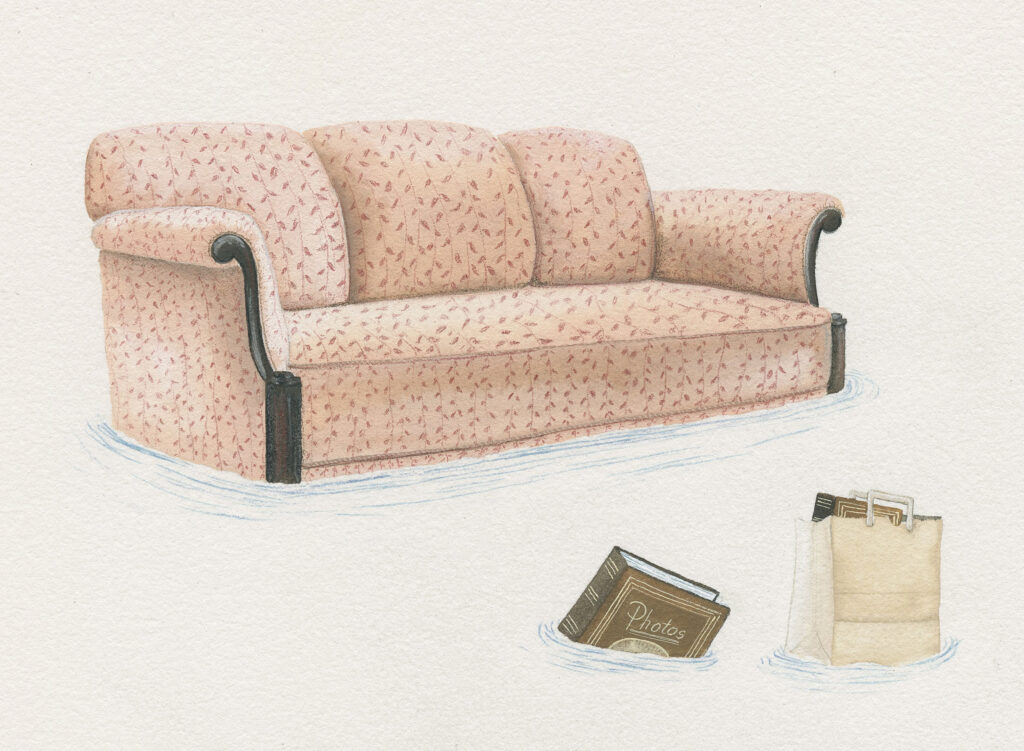
When we returned to New Orleans in December 2006, we visited our rental. The glass in the large picture window was blown out, the front door flung open. The water had turned Michael’s great grandparents’ recently reupholstered sofa 180 degrees around to face the street through the picture window. I sat on the sofa and looked at Milne Boulevard with the cold air blowing on my face. I had no desire to look through any of our moldy belongings. Nothing in me wanted anything material from the past. In 2006, a bulldozer would push our furniture, our clothing, our books, and the contents of our cupboards, drawers, and closets one block down to the West End Boulevard’s neutral ground and into a half-mile-long pile of trash from our neighborhood.
Twenty years later, at ages twenty-three and twenty, Adelaide and Cecilia argue and tell jokes with each other in German. Both picked up additional foreign languages easily. This year, Adelaide won an award for her undergraduate thesis on refugee reception in southern Italy. The generosity of another government opened up a transformative path for our family.
When I think of Katrina’s mark on history, I think of the verses that I once saw on the marquee of a small church in Alsace: “For here we have no lasting city, but we seek the one that is to come . . . Do not neglect to do good and to share what you have” (Hebrews 13:14–16). We received an incredible gift from a country that once had been decimated by nativism. Because its citizens recognized the dangers of this path, they welcomed the stranger. Now, they expect their inhabitants to participate in a collective society, one in which people believe that sacrifices should be made to benefit the greater good.
Sheila Madary studied, taught, and raised her daughters for more than a decade in Europe after Hurricane Katrina. Her writing has appeared in Panorama, Dogwood, Brevity, and elsewhere. She currently lives and teaches in California’s Central Valley.
