I’ll eat when I’m hungry,
…..I’ll drink when I’m dry;
If the hard times don’t kill me,
…..I’ll lay down and die.
Those four forthright lines begin “Rye Whisky,” poem number 276 in The Oxford Book of Light Verse (1938), chosen and edited by W. H. Auden. But that can’t be how I first encountered them, on page 493 of an anthology published in England well before I was born. Surely I heard that verse at the Mountain Dance and Folk Festival in downtown Asheville, during the late 1960s or early 1970s, which I attended as a member of my high school square dance team. It may even have been sung by eighty-something-year-old Bascom Lamar Lunsford, “Minstrel of the Appalachians,” founder and presiding eminence of that annual event, who had recorded a version of the song for Columbia University way back in 1935. But I didn’t know that at the time. I was just a naïve teenage boy from south Buncombe County, hearing another melancholy yet spirited old song about the lethal desirability of drinking and gambling, one rooted in the hills and hollers of my native place, western North Carolina.
The second stanza of “Rye Whisky,” as presented by Auden, is called “Chorus”:
Rye whisky, rye whisky.
…..Rye whisky, I cry.
If you don’t give me rye whisky,
…..I surely will die.
I’m a poet and anthologist myself. I’ve happily labored in the vineyards of poetry—reading it, writing it, publishing it, editing it, teaching it—my entire adult life. However, I must say: neither of the two quatrains above tickles my funny bone, as light verse traditionally does. I appreciate the hyperbolic irony of the last two lines of each (one will definitely die, whether felled by hard times or alcohol poisoning), but any humor in those opening lines is tragicomic at best.
And then there are seventeen more stanzas. While not as long as the interminable murder ballads I heard Virgil Sturgill sing at the same Asheville festival, playing his dulcimer with a turkey quill, that’s a lot of versified booze—maybe not enough to kill you, like the eighteen straight whiskies Dylan Thomas claimed to have drunk at the White Horse Tavern before he lay down and died, but more than enough to demonstrate the speaker’s unquenchable thirst, especially if the chorus is repeated between verses. For a long time now, I’ve been wondering: how in the literary world did a celebrated British poet discover this weird southern folk song, in the years before his country plunged into the horrors of World War II? And what made him consider “Rye Whisky” a poem worthy of inclusion in a collection of light verse?
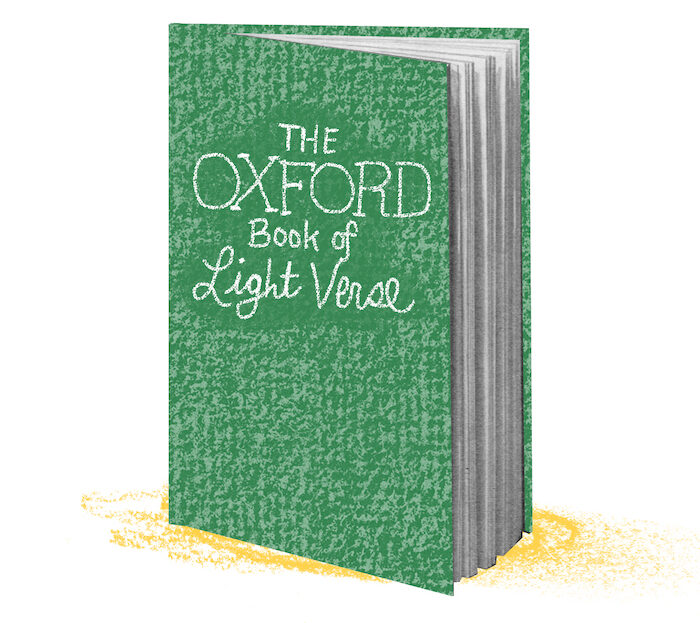
How could a poor bookish student resist so much gilt?

I bought the Auden book in Boston in December 1976, following my first semester in the masters in English Literature program at UNC-Chapel Hill—not because I was a budding scholar of humorous poems, but because I was infatuated by hardback Oxford poetry anthologies, donnish volumes smartly dressed in blue cloth with (as one online seller describes it) “gilt decoration to the front panel and backstrip, and gilt titles to the front panel and backstrip, and gilt to top text block edge.” How could a poor bookish student resist so much gilt?
The following summer, I worked as a graduate assistant to Professor William Harmon in Chapel Hill, assisting him with The Oxford Book of American Light Verse (1979). What fun—helping to check texts, reading comic poems on the page and aloud, and expanding my concept of poetic levity: I’d never considered how cleverly Gershwin or Porter or Bessie Smith or Stephen Sondheim composed their lyrics until I saw them on the page. “The verses themselves are enjoyable,” Harmon says in his introduction, “they have meant a lot to a lot of people, and they can even matter in the study of heavy verse. But the operative word is ‘enjoyable.’”
Both Auden and Harmon include a short poem by Samuel C. Bushnell, titled “Boston”: “I come from the city of Boston, / The home of the bean and the cod, / Where Cabots speak only to Lowells, / And Lowells speak only to God.” That’s vintage light verse, in concept and execution, the meter and rhyme crisp, the timing joke-perfect: rim shot. But its tone is very different from the fourth quatrain of “Rye Whisky,” which follows “Boston” in the 1938 light verse anthology and also ends on a godly note: “Beefsteak when I’m hungry, / Red liquor when I’m dry, / Greenbacks when I’m hard up, / And religion when I die.”
The author of “Rye Whisky”—identified only at the end of the poem: Auden’s anthology has no Table of Contents—is “ANON.” Four more anonymous poems follow, including “The Man on the Flying Trapeze” and “Cocaine Lil and Morphine Sue.” An astounding 163 of 304 poems in that 1938 book were written by ANON: it’s not exactly The Oxford Book of ANONYMOUS Light Verse, but it’s over halfway there. By comparison, Harmon’s selection, with almost exactly the same number of pages, has just fourteen anonymous poems. Why—in a poetic mode known for authorial ingenuity, for the kind of wit and polish that Auden himself displayed in feats of light verse throughout his long and prolific career—is he so interested in literary anonymity?
One clue can be found in The Poet’s Tongue (1935), an anthology for schoolchildren he co-edited with schoolmaster John Garrett. “Those who try to put poetry on a pedestal,” they say, “only succeed in putting it on the shelf. Poetry is no better and no worse than human nature: it is profound and shallow, sophisticated and naïve, bawdy and chaste in turn. It seems to us that the first approach to poetry should be with an open mind, free from the bias of great names and literary influences, the first impression that of a human activity, independent of period and unconfined in subject.” Rather than feature Greatest Hits by Famous Poets in Chronological Order, they presented poems alphabetically by first line, with no authors named in the text itself (they are listed in an index): a Folk Song is followed by P. B. Shelley, a Sea Shanty precedes Lewis Carroll, and Anon appears throughout. This is an egalitarian approach, offering work that the editors consider of the people, by the people, and for the people, a production of the community rather than poetry written by poets for other literary insiders.
Familiar examples of the people’s poetry—including “All the Pretty Little Horses,” “John Henry,” and “This Train”—are in the vicinity of “Rye Whisky” in Auden’s Oxford Book of Light Verse. And though that anthology was edited by a York native and Oxford graduate, then published in that ancient college town at the Clarendon Press, at least half of its three dozen folk songs are not British but firmly situated in the American South.
On his side of the pond, Auden could have found those anonymous songs in collections like Cecil J. Sharp’s English Folk Songs from the Southern Appalachians (1932) and John A. and Alan Lomax’s American Ballads and Folk Songs (1935). “We offer the songs of the people,” the Lomaxes write in their introduction, “an art that reflected and made interesting their own customs, dramas, and dreams. Furthermore, the individual author is so unimportant that he usually is lost sight of altogether.” Those sentiments are echoed in Auden’s own introduction to his Oxford anthology, which defines “light” verse as poetry “spoken or sung before an audience [e.g. Folk-songs]” as well as poetry “having for its subject-matter the everyday social life of its period or the experiences of the poet as an ordinary human being.”
“Rye Whisky”—all nineteen quatrains—appears in “Cocaine and Whisky,” section VII of American Ballads and Folk Songs. It’s one of their “composites,” made up “of what seemed to be the most freshly interesting stanzas, or even lines, from widely separated sources.” John Lomax, who grew up in Texas, may have first encountered it there as “Jack of Diamonds,” but that gambling song traveled and morphed, borrowing lines and stanzas, changing titles, adapting to new singers and locations—there are probably as many versions of it as there have been performances, with slightly different takes on intemperance. At one point, “Rye Whisky” clearly landed in Appalachia, given the penultimate verse set in upland Tennessee/Virginia:
Way up on Clinch Mountain
…..I wander alone;
I’m as drunk as the devil,
…..Oh, let me alone.
Carl Sandburg—who lived the final decades of his life at Connemara outside Flat Rock, twenty Blue Ridge miles from my parents’ house—presents “Way Up on Clinch Mountain” as the first song in the “Southern Mountains” section of The American Songbag (1927), a collection he describes as “a terrible tragic book and one grinningly comic.” “This song has a thousand verses,” he declares, “perhaps going back to the Scotch of the 17th century.” He only includes five; the fourth is a belligerent “Variant Chorus” in Lomax: “Rye whisky, rye whisky, / You’re no friend to me. / You killed my poor daddy, / God damn you, try me.”
John Lomax and his son acknowledge Sandburg and other collectors who recorded folk songs across the region, including “Professors Howard W. Odum, Guy Johnson and A. P. Hudson, all of the University of North Carolina, that is, along with near-by Duke University, the folk song collecting center of the South.” Hudson was a mainstay of the North Carolina Folklore Society, whose work led to the seven-volume Frank C. Brown Collection of North Carolina Folklore (1952 to 1964). Volume III, “Folk Songs,” includes “Jack of Diamonds” as “a gambler’s song, an aggregate of stanzas some of which may be used in other songs,” and Volume V has a very early version of “Rye Whiskey” sung by the aforementioned Bascom Lamar Lunsford, “recorded at Turkey Creek, Buncombe County, in 1921.” (Some Americans and Irish spell the noun differently, with an “e.” But it’s all usquebaugh, the water of life.)
Another professor, Frederick Koch, was brought to Chapel Hill in 1918 to teach playwriting; he encouraged his classes to write “folk plays,” not “searching for characters and plots in distant lands” but dramatizing the daily life of common people “right back there in your hometown.” One of his students was Paul Green, whose In Abraham’s Bosom won the Pulitzer Prize for Drama in 1927. “The ‘folk’ are the people who matter most to me,” Green later wrote. “There is something in their life which seems of deeper significance so far as the universe goes than the characters who might be termed sophisticated.”
When I opened Sharp’s English Folk Songs from the Southern Appalachians, checked out of UNC’s Music Library, I was delighted to see this—written in cursive, in blue ink—inside the front cover of both volumes: “Paul Green – Christmas, 1954.” Chapel Hill’s most famous writer of folk plays and outdoor dramas must have enjoyed the conclusion to the book’s preface: “Thus, a song, originating in England and carried to America, lives there by oral tradition for some hundreds of years; it is written down and taken back to England by Cecil Sharp; then some thirty years later the song is carried back in printed form to the country of its adoption and takes on a new lease of life. Such are the devious ways of tradition.”
The Lomaxes, like other collectors, tried to transcribe the songs as they heard them sung. Most of their written-out texts are in fairly standardized English, though “Rye Whisky” is lightly tweaked to make it sound more oral: the final stanza includes both “En’” (“and”) and “’Twill” (“it will”).
That last verse is followed by a “Negro Variant,” which concludes: “But I know whar’s a henhouse, / De turkey he charve; / An’ if ol’ Mas’er don’ kill me / I cain’t never starve.” American Ballads and Folk Songs includes many texts rendered in supposedly “Black” dialect, like “Dese Bones Gwine to Rise Again” and “Honey, Take a Whiff on Me.” “We attempted to spell the words as the Negro singer pronounces them, with the same faithfulness with which the machine recorded the tunes he sang,” they explain, “having in mind always the reader who is unacquainted with the Negro’s distinctive and often beautifully expressive dialect.”
Vernacular is a slippery and perilous slope. What seems more accurate to the transcriber—more faithful to local accents, to verbal color and texture, to words as they actually come from peoples’ mouths rather than some neutral verbal ideal—may hit most ears as racist, classist, and unacceptable. Even Sandburg’s painstaking distinctions between four kinds of the word “the” in a “negro sentence,” or three kinds of the word “here” in a “mountaineer sentence,” feels offensive and demeaning. And the Lomaxes’ earnest attempt to establish a “norm” for African American dialect—ironically, since they were fellow southerners, devoted to recording the music of “the Negro, who has, in our judgment, created the most distinctive of folk songs”—sounds like tone-deaf stereotyping by privileged white men.
One might assume that a writer like Wystan Hugh Auden—an aesthete, a connoisseur and practitioner of European high culture, a poetic sophisticate if not a snob—would have no interest in raucous American folk songs. But he clearly savored what Sandburg called the “patter and jabber of vulgarity,” where “blasphemies from low life and blessings from high life are brought together.” Auden knew decadent interbellum Berlin and its cabarets firsthand, and he appreciated what he called “the accidental beauties” of American blues and jazz, their unplanned pleasures. Perhaps the inclusion of “Rye Whisky” had as much to do with his listening habits as any left-ish politics, with his fondness for human turmoil converted into catchy songs: “Jack o’ diamonds, jack o’ diamonds,” the down-and-nearly-out speaker addresses his irresistible demon, “I know you of old. / You’ve robbed my poor pockets, / Of silver and gold.”
Given his lifelong obsession with opera, one might expect Auden to read his poems aloud in a theatrical manner, as if delivering verbal magic to enchanted audiences. Far from it. His recorded readings sound less like musical performances than a man talking his way through texts dispassionately, offering words to listeners as flat matters of fact, without any showy effort to charm or awe. “The author of a good book should remain anonymous,” he writes, “for it is to his work, not to himself, that admiration is due.” A truth-telling poet like him would say—as the author ANON does, twice, in “Rye Whisky”—“all them that don’t like me, / can leave me alone.”

There must be hundreds of recordings of “Rye Whisky” and its many variations on YouTube. Some are of historical interest: Jilson Setters fiddling “Way Up on Clinch Mountain” in 1928, or cowboy Jules Allen singing “Jack o’ Diamonds” in the same year, or Tex Ritter delivering “Rye Whiskey”—a song that made him famous—while riding a donkey in the 1936 movie Song of the Gringo. Some performances are quietly beautiful, like Woody Guthrie’s ruminative version in the Library of Congress recording by Alan Lomax, or Bill Monroe’s lyrical instrumental, using mandolin harmonics as hiccups, or the New Lost City Rambler’s spare arrangement with intriguing timing. Some were surprising: I did not expect to hear U.S. Senator Robert Byrd of West Virginia play and sing “Rye Whiskey” with such gusto, on his 1978 album Mountain Fiddler, or to be reminded how painfully corny Homer and Jethro could be (they describe their Fractured Folk Songs as “music to hoot your nanny by”).
As with any song, the performers make it their own. John Lee Hooker turns “Jack of Diamonds” into Delta blues, and Odetta renders it as a low-pitched song about “the hard card to play.” Ramblin’ Jack Elliott whoops and hoots his typically lively way through “Jack of Diamonds,” apologizing for imitation hiccoughing at the end. Stringbean, Waylon Jennings, Steep Canyon Rangers, Yodeling Slim Clark, Nick Cave and the Bad Seeds, Wallumrød, Dave Matthews: their takes on “Rye Whisky” or “Drunken Hiccups” may not seem as authentic to my hillbilly ears as Frank Proffitt on banjo or Hobart Smith on fiddle, but these singers and players embody this anonymous song in their distinctive way for a few minutes. They keep its durable tune alive a little longer.
There are two versions I can’t stop playing. Pete Seeger’s brief audio of “Rye Whiskey”—only 2:18 long—seems merely charming at first, his singing lucid and his banjo playing wistful. But the more you listen to his forceful chorus outbursts (“rye whiskey I cry-YYYYYYY!” he sings, that terminal vowel shifting up an octave), and to how the singer quiets down at the end, the more you think: those are cries of anguish, not joy. And Tommy Jarrell’s performance of “Drunken Hiccups” is thrilling: it’s just him, the white-haired virtuoso of Toast, North Carolina, alone in a chair in a nondescript corner of some community center or fellowship hall, playing his dark weathered fiddle for seven powerful minutes. Jarrell does sing some verses, but the fiddling—the way he bows and fingers, deftly syncopated yet rough and hard-driving—is the thing, not the mumbled vocals, though both sounds charge the air with simultaneous uplift and ache. His mock-intoxicated noises at the end are less cornball fun than staccato barks reminding us what fools we mortals be. Whisky (or cards, or love, or whatever) may have ruined us, but we just can’t give it up: “Oh whisky, you villain / You’ve been my downfall, / You’ve kicked me, you’ve cuffed me— / But I love you for all.” As Jarrell says into the stunned silence, after he stops playing: “Well, I guess that’s about it.”
As an anthologist myself, I know one thing for sure: somebody is going to disagree with the collection you put together. How could you leave out this poem, or include that one, or think such an approach to the material was a good idea?
As an anthologist myself, I know one thing for sure: somebody is going to disagree with the collection you put together.
I may not find Auden’s peculiar concept of light verse—emphasizing the populist voice in poetry, rather than humorous poems across the centuries—especially convincing; but he assembled the book, not me. Despite a mixed critical reception, the anthology sold well enough for Oxford to reprint it in hard covers for three decades, reissuing it a few weeks before he died, in 1973, as a paperback titled W. H. Auden’s Oxford Book of Light Verse, implying that it was more of a personal selection than one sanctioned by that august press.
We’ll never know if he found “Rye Whisky,” or any of the other folk songs he included, funny in any traditional sense; but as with one’s preferences in music or poetry, when it comes to humor, there really is no accounting for taste. Auden clearly enjoyed the ballad stanza; around the time he was editing his Oxford anthology, he wrote three poems-in-quatrains (“Miss Gee,” “James Honeyman,” and “Victor”) that are gruesomely comic and capable of being sung to the tunes of then-popular songs. Even his bawdy limerick “The Aesthetic Point of View,” included in Harmon’s Oxford anthology—Auden became an American citizen in 1946—is as much about the dark as the light: “Death takes the innocent young” and everybody else, no matter how handsome or rich. Maybe he found “If a tree don’t fall on me, / I’ll live till I die,” toward the end of “Rye Whisky,” a droll observation.
“The soul squawking to the body about its days being numbered,” says poet Charles Simic: “that’s what most blues songs and lyric poems are about.” In music and poetry and life, it’s not that there’s a fine line between grief and joy; it’s that they’re inextricably intertwined. Sandburg connects them with blunt eloquence, in his dedication to The American Songbag: “To those unknown singers—who made songs—out of love, fun, grief—and to those many other singers—who kept those songs as living things of the heart and mind—out of love, fun, grief.”

Finally: why rye whisky, and not the much more common corn? Most southern moonshiners used rye less for flavor than as a catalyst or as paste to seal seams in stills. And we know that the speaker of this song hardly has a discriminating palate: he’s a thirsty feller, and it looks like any potent potable will do—red liquor, rum, brandy. “I’ll drink my own whisky, / I’ll drink my own wine; / Some ten thousand bottles / I’ve killed in my time,” he boasts, or admits.
Could it have to do with how “rye” sings, the way its open-vowel monosyllable chimes in the air? The first three-letter word in the chorus rhymes with the last, “die,” and its second line begins and ends with the same sound: “Rye whisky, I cry.” That long “i” is echoed in every “my” or “I,” first-person pronouns abounding in each quatrain except the last, whose all-flesh-is-grass epitaph must have pleased wry unsentimental Auden:
You may boast of your knowledge
…..En’ brag of your sense,
’Twill all be forgotten
…..A hundred years hence.
“Either as a dance or a song, this tune has had many titles,” writes musicologist Samuel P. Bayard: “the air has had the names of ‘Johnny Armstrong,’ ‘Todley Hame,’ ‘Bacach,’ ‘Robi Donadh Gorrach,’ ‘Wagoner’s Lad,’ ‘Clinch Mountain,’ ‘The Cuckoo,’ ‘Rye Whisky,’ ‘Jack of Diamonds,’ and a number of others,” including “The Rebel Soldier,” a Civil War version.
Bayard’s approach—focusing on the tune and not the text—is exactly right for the metamorphic “Rye Whisky.” Though its titles and lyrics may be a crazy quilt, stitched together by singers over the centuries, each of whom heard and felt and remembered the quatrains differently, what’s constant is the melody propelling it. Verbally, it’s an oral (which is to say, aural) composition, individual and highly variable; musically, it’s pretty much the same song, whose variations are branches on a family tree.
That’s why the composite version of “Rye Whisky” included by Auden doesn’t cohere particularly well on the page, as a “verse.” It could be much shorter to much better effect, as either song or lyric poem. Its phrasing could be improved—performers often sharpen the lines. Some stanzas are utter nonsense: “If the ocean was whisky, / And I was a duck, / I’d dive to the bottom, / To get one sweet suck.” And even if it’s read as a celebration of cantankerous American individuality—“I’ll buy my own whisky, / I’ll make my own stew; / If I get drunk, madam, / It’s nothing to you “—all those declarations of independence get a bit repetitive.
But that barely matters, because “Rye Whisky” is more about the music played than the lyrics sung. It’s driven by sound, not sense—the infinitely flexible words are instrumental flourishes, not language telling a tidy story. It’s got momentum, it’s got lilt and lift, it’s got a sweet arpeggio whose broken chord (plucked or played) descends 1-2-3, 1-2-3, 1-2-3. Some performers yip or caper or fake the drunken hiccups over that falling triplet. Anytime I hear “Rye Whisky,” especially when presented as a song of the Appalachian folk, my ears and feet and heart perk up. The music starts to play me. Isn’t that what verse, light or heavy, should do?
Michael McFee is the Doris Betts Term Professor of English and Comparative Literature in the Creative Writing Program at UNC-Chapel Hill. His seventeenth book, A Long Time to Be Gone: Poems, is forthcoming from Carnegie Mellon University Press in October 2022.