We gathered some of our friends to reflect on Dolly Parton’s life and work. “She was,” as producer T Bone Burnett told us for this piece, “the all-time greatest country girl.” And so much more.
Dolly was part of the sparkle glue that held us all together. She was the very best of the South, a keeper and curator of bluegrass, Appalachian ballads, gospel, and so much of our American songbook. Her philanthropy will outlast her by generations. If the belief in Judaism is correct that thirty-six righteous people hold the world in place, we’re down to thirty-five now.
—Rosanne Cash, singer-songwriter, author
I have always been drawn to people who understand that where we come from is not something to overcome.
Dolly Parton took the language, music, humor, hardship, faith, work, and beauty of East Tennessee and carried it into the world. She did not flatten that place to make it universal or turn it into cliché. She went deeper and made the invisible visible to those willing to look and listen. In her work, our stories became larger than our geography—stories of longing and ambition, family and poverty, dignity and joy, and what it means to be human.
Her generosity of spirit inspired my own work and helped me connect to my place—to the stories, labor, and love shaped by this geography. My place within this place wasn’t always apparent growing up, listening to Dolly on a battery-operated portable radio at my grandparents’ house. It took years, thousands of books, leaving this place, and coming back home to understand the depth and consequence of Dolly Parton’s legacy.
Perhaps this is culture at its best. We inherit something. We live it deeply enough to make it our own. We add what we can. And then we pass it forward. This is legacy. This is Dolly’s enduring gift.
A book, a story, a narration of our place arriving in the hands and heart of a child says: There is a world beyond what you can see from here. It also says: Your own world is worth seeing, naming, and carrying forward.
—Natalie Chanin, founder, Alabama Chanin and Project Threadways
Dolly Parton was one of our greatest musicians and songwriters. This may seem obvious—I sure hope so—but it’s also necessary, as veneration (and deification) surrounds her legacy. Not only does sanctification obscure both her good works and her contradictions, but it ironically obscures the very music that made her legendary. Hers is one of the richest and most diverse catalogs in the country canon, collecting sounds and subjects with a fluidity that makes genre lines seem less fluid than meaningless. She was a brilliant interpreter of others’ songs, and her own compositions range from the graceful to the gripping to the gloriously rowdy. She paid particular attention to the poor and working southerners—especially women—from whom she grew and learned: Her 1980 album 9 To 5 and Odd Jobs is one of the best albums about work ever recorded, with a couple originals (including the title track, a working-woman’s anthem for that age and any) paired with labor songs from “Dark as a Dungeon” to “Deportees.” She tended the roots with care, from her more “traditional” recordings to her collaborations with family members. But she never let such commitments act in opposition to her stylistic curiosity, from girl-group ache to disco flash and beyond. She was a fantastic guitar player, with a springy style derived from Maybelle Carter and accentuated by the long acrylic nails that became her one-woman rhythm section. And I must note that her masterpiece, “Coat of Many Colors,” is my favorite song by anyone. Dolly Parton mattered for more than her music. But, without her music, none of that would have mattered. Or maybe happened at all.
—Charles L. Hughes, Associate Professor of History and Urban Studies, Rhodes College
On September 16, Dolly Parton appeared onscreen at Ryman Auditorium to accept a Lifetime Achievement Award from the Americana Music Association. Three weeks earlier, she had left this earthly plane. But in the video, a vibrant Parton recalled her 1997 turn back to the Americana “roots music” of her Smoky Mountains youth and how it launched the album Hungry Again and ultimately a career-shifting “musical renaissance.”1
Parton’s website frames Hungry Again as a return to the music she’d made when she was “hungry to learn, grow and express herself.” “I went back to my old home place,” she recalled, “wrote all those songs and they just came straight from the heart.” The 1998 album charted in country’s Top 25, and each album in her return-to-roots trilogy—The Grass Is Blue (1999), Little Sparrow (2001), and Halos & Horns (2002)—followed suit.2
Parton collaborated on Little Sparrow with stellar bluegrass, country, and Irish folk musicians. She described the album’s “blue mountain music” as a “cross between bluegrass and mountain” that was true to her background, heart, and soul. “Heartfelt, gut-wrenching,” it was “the best music there is,” but to make a living she’d had to pursue other avenues.3
The sunny Parton was never more powerful than in this frequently stark, Gothic music. She drew spellbinding effects from modal inflection. Dorian mode subtly haunted “Jolene.” But in “Little Sparrow,” a ballad of betrayal and transcendence, Parton leaned into Dorian. The opening verse, “All ye maidens heed my warning,” builds tension into verse two. When Parton floats up to the inflected note, “If I were a little sparrow / O’er these mountains I would fly,” the effect is otherworldly.4
To close her AMA video, Parton chose familiar words bearing new inflections, otherworldly in the event: “Just know that I will always love you.”
—Dean Hubbs, Professor of Women’s and Gender Studies, Music, and American Culture, University of Michigan
Has anyone else better embodied country music, in all of its possibilities and contradictions?
As Dolly often said, she looked like a woman but thought like a man. It took a lot of money to look that cheap. She never called herself a feminist and yet her songwriting and life decisions suggested otherwise. Total authenticity with the veneer of artifice. But for as much as she acknowledged that manufactured exterior, the impact of the character she created was deeply real. Country music is a place where many do not feel welcomed, and she built a space where anyone could be themselves. It’s hard to think of anyone else, from any other time, that is so universally beloved. I’m having a hard time believing that she’s gone because it’s hard to believe she could have ever been real in the first place.
—Amanda Marie Martînez, Assistant Professor of American Studies, University of North Carolina at Chapel Hill
One time I was hired to sing on a track (“Coming Down from Dover”) but lost my voice two days before the session. Steve Buckingham said come anyway, help work out two harmony parts that Maura O’Connel and I would contribute. The morning of the session, in hopes I might get my voice back, I made a hot concoction of ginger, cayenne, garlic, lemon, and honey and drank it. Then I made another cup like the first one and brought it in the car to the session. I arrived 15 minutes early so I stayed in my car and answered some email, sipping on the tea. I finished with the email and opened the door and got out of my seat, forgetting I had half a mug of what was still hot tea between my legs on the seat. The tea spilled, leaving a wet circle all around my crotch, and it was either call it a day or go meet Dolly Parton. I figured what the hell, so I walked into the studio looking like an idiot and smelling like an Indian restaurant. Dolly wasn’t there. I helped Maura find a part that would work with Dolly’s vocal (already recorded), one I could add my own part to later. Dolly heard Maura’s part the next day and Steve told her it will be even better when I sang my part, but she said, oh it sounds great as it is. I can attest that it did and that Dolly was correct. It’s a great song by the way.
Once I watched her do an unannounced guest spot with Chis Thile at the Station Inn in Nashville. I knew it was about to happen but was sworn to secrecy. She burst through the side door with a wireless mic in hand and lit up the room for about 10 minutes. She’d written new words to Dylan’s “Mr. Tambourine Man” as “Mr. Mandolin Man.” She poked some fun at Chris, and I’m pretty sure she made a boob joke, then she sang like a bird and was gone. It was just the two of them, and she had memorized a new lyric just for the occasion and completely nailed it. Probably never sang it again. Amazing.
I was on the same bill for a live PBS show by the US Capitol on July 4, 2002. Dolly came out in a red, white, and blue hot pants ensemble and lifted the proceedings as only she can. At one point she sent out a prayer to the troops in Iraq and said, “Of course I have my own secret weapons. I call ’em shock and awe.”
—Tim O’Brien, singer-songwriter and multi-instrumentalist
I really had to think about this a bit, but after a little reflection an idea did hit me, just so—why not talk about my favorite HBO watch in sixth grade, back in 1981?
I’m still perversely impressed I saw 9 to 5 both as often as I did and with my parents’ implied OK. At ten years old, there was a lot I later realized that I missed. (I had no idea what they were smoking, for instance. You know the scene.) But I kinda knew about Jane Fonda, and I definitely knew about Lily Tomlin, and I absolutely knew about Dolly Parton, so I watched and I laughed. And maybe a few early lessons and things to note settled in with me.
The scene I found myself thinking about in the days after is so very short but says so much. Dolly’s character, Doralee, is home with husband Dwayne, his character’s only scene, audibly a fellow from the country like her, playing an acoustic guitar. She’s feeling down at how she’s treated at the office for still unknown-to-her reasons, so he aims to cheer her up, admittedly playing the let’s-see-that-smile card, and the scene ends with a smooch and a clench and a clear implication of where it leads.
It’s kind and loving, and I kept thinking about how those characters could and would easily be ones listening to and loving Dolly Parton’s latest hit single “9 to 5” on the radio: a slight alternate universe, but not by much. It’s a sudden moment of presence, a claiming of space by two people not from the film’s generically urban setting, being themselves in a way that reads right. Doralee may say in that scene that she feels “like a bastard at the family reunion,” but Dolly found room for everyone to be at the table.
—Ned Raggett, journalist
Dolly Parton was an epic American poet.
I put her right up there with Emily Dickinson and Langston Hughes. Like Dickinson and Hughes, she told stories that were vividly particular, utterly universal, and powerfully transgressive. Three of her best—“Jolene” (1973), “I Will Always Love You” (1974), and “Me and Little Andy” (1977)—seem simple.
They are not.
Nothing simple about the little girl, Sandy, and the puppy dog, Andy, slaughtered by poverty and family crazy, but not before the child spits out the only poetry she knows—nursery rhymes—and dares,—defiantly demands,gingerbread, and a safe place to sleep. Is “Jolene” a love triangle with two women vying for one barely mentioned, truly invisible, man, or a stunning declamation of one woman’s keen-eyed appreciation of the beauty and power of another woman? “I Will Always Love You” depicts liberating oneself from the beloved as an act of self-love.
The songs, extraordinary as they are, are only an element of her art. What too often goes unacknowledged? Her place in the pantheon of performance artists who use every inch of their body and every gesture connecting them to, and disconnecting them from, their audience. She stands above Salvador Dalí, Yoko Ono, and Laurie Anderson.
Dolly Parton was a walking, talking, singing, songwriting, guitar-playing, movie-making, money-gifting poem. Hair, makeup, stage clothes, stage strut, microphone hold, pocketbook, poetry. Wearing thick, stylized make-up as a visor, jacked-up-to-Jesus blonde wigs as a helmet, and huge breasts as shields, she enters the stage fully armored, fully armed, provoking questions and bearing gifts.
Do we want her, or want to be her? Are the words coming out of her mouth weapons or presents? Maybe they are both. Before Dolly wrote and recorded “Me and Little Andy,” she wrote and released “Coat of Many Colors” (1971) and later, in1982, she would record (but not write) “Hard Candy Christmas,” depicting, in turn, poverty that kills, poverty that shames, poverty that haunts. The syllables and sounds of these songs are only a fraction of her performance.
The greater art? Dolly Parton turned her intimate knowledge of poverty into songs, then turned her profits from the songs into generational curse-breaking philanthropy. She put more than 300 million free children’s books into homes, where they could be read in bedrooms, in kitchens, in living rooms, in hallways, and even in bathrooms. That’s transforming the stage and transformative stage.
You know some of those kids read those books with a special excitement because somebody told them the book was a gift from Dolly. Her performances were public and private, loud and quiet, every gesture of her poetry boldly flashing, humane human.
—Alice Randall, author, songwriter, and producer
As a queer Black feminist who writes about country music, I feel there’s a lot to love and praise and miss about Dolly Parton: her poignant voice and the genuine life writing she offers in her songs; her support of Black artists in country music spaces, from Charley Pride to Beyoncé; her respect for Black soul and gospel; and her championing of literacy, LGBTQ rights, and the Black Lives Matter movement. In the wake of protests of the murder of George Floyd, Dolly commented, “I understand people having to make themselves known and felt and seen.” She added, “Of course Black Lives Matter. Do you think our little white asses matter? No!”
But what I loved best about Dolly Parton was her outsized style, which helped me embrace my own queerness as a teenager in the 1980s. Dolly was in my High Femme Hall of Fame, together with Tina Turner, Patti LaBelle, and Sylvester. In an origin story that she has repeated over the years, Dolly said that her girlhood inspiration for her look was from the “town tramp,” as her mother called her. “I just thought she was gorgeous. And I told my mother, ‘That’s just what I want to be.’” Dolly admitted that her own look was sometimes meant to shock. But I’ve always also appreciated the bedrock of self-love and humor that bolstered her. In a 1978 interview with Barbara Walters, she said “I enjoy making jokes about myself, because I am sure about myself as a person . . . I like the kind of person that I am.” Parton, rejecting an assimilationist school of white womanhood, was not ashamed of her body or her life, and she rejected the shaming of others too. I think that generosity made her a powerful ally.
—Francesca T. Royster, Professor of English, DePaul University
On June 24, 2026, I arrived at Exit 22 on I-65 and missed Dolly Parton’s last public appearance by a few minutes. Having spent the day conducting research at the Country Music Hall of Fame, I was headed to visit my parents in north Alabama. I knew that day was the ribbon cutting at “Dolly’s Tennessean Travel Stop.” I had stopped there before for a glass bottled Sun Drop––the taste of my childhood at its best and a regular treat from my grandmother, Mama Kat. I wanted to see Dolly, but mostly, I wanted a Sun Drop. The confetti still littered the parking lot.
Like many people, I felt strangely close to Dolly, and her death hit me harder than I expected. That intimacy started as a kid when I played a doppelganger game in which I imagined people in my life as country music celebrities. My barber was Roy Clark. A church deacon was Charlie Daniels. Mama Kat was Dolly Parton.
Mama Kat was a petite, fashionable, and dye-assisted blonde, who sometimes wore a hair piece she called Myrtle. She was a feisty but sweet woman from Anthony Hill, Tennessee, who loved me and loved country music. She died in 2009. Both she and Dolly gave me music along with the feeling of unconditional love, and now both are gone. It’s time to sweep up the confetti, have a Sun Drop, and honor the women who show us the meaning of grace in this world. Don’t be late.
—Joseph M. Thompson, Associate Professor, Mississippi State University
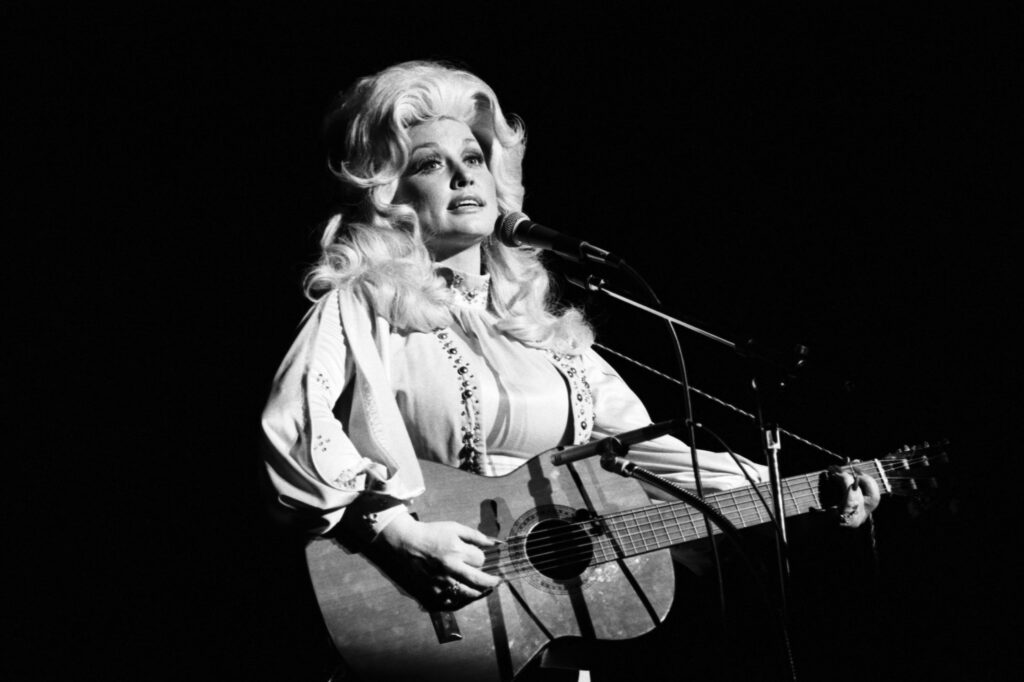
Header image: Dolly Parton, August 1978. Photo by Richard E. Aaron/Redferns.
NOTES
- “Dolly Parton’s posthumously released acceptance speech for Americana Lifetime Achievement Award,” Chris Willman Channel, YouTube, September 17, 2026, https://www.youtube.com/watch?v=rv128cq7pVA.
- Hungry Again, discography, https://www.dollyparton.com/album/hungry-again.
- Jon Weisberger, “Dolly Parton Sings Like a Little Sparrow,” Country Standard Time, January 2001, https://www.countrystandardtime.com/d/article.asp?xid=682.
- Nadine Hubbs, “‘Jolene,’ Genre, and the Everyday Homoerotics of Country Music: Dolly Parton’s Loving Address of the Other Woman,” Women and Music: A Journal of Gender and Culture 19 (2015): 71–76; The note, G# (scale step 6 in B Dorian), occurs here in Parton’s performance, live with an all-star string band, of “Little Sparrow” on The Tonight Show with Jay Leno, February 27, 2001, https://youtu.be/KoS5I5E54NM?si=56Cfje_VcReHvaXs, 2:06. In the 2001 studio track Parton first sings this inflected note in her a cappella opening, in the second statement of “lit-tle sparrow,” 0:04.