
“The Welty House speaks to the author’s love of travel, art, music, and the centrality of family to her life. But it is, above all, a home designed for work, which, in Welty’s case, meant reading and writing.”
Twenty-five years after the author’s death, Eudora Welty’s home phone number remains the same as it ever was. Her house looks just like it did during her lifetime. Visitors still find her books stacked on every available surface: shelves, dining room tables, coffee tables, side tables, sofas, a bed, the floor. These furnishings are Welty’s. She purchased or was given the art on the walls. Each picture or object remains where she placed it. The curtains, the everyday china, the vintage rabbit-eared television with built-in VCR, the can opener anchored to a kitchen cabinet, the stove-top percolator: With very few exceptions, everything in the house belonged to her.
These days, calling the author’s number rings the front desk of the Eudora Welty House & Garden Visitor Center, located just next door. A dedicated staff cares for Welty’s home and garden, gives tours, and presents public programs aligned with the author’s love of books and reading, her belief that “great fiction shows us not how to conduct our behavior but how to feel. Eventually, it may show us how to face our feelings and face our actions and to have new inklings about what they mean.” Through the stewardship of the Mississippi Department of Archives and History (MDAH), visitors can experience Welty’s home as she inhabited it. Before opening the Welty House to the public in 2005, the MDAH made only those changes necessary to ensure the integrity of the structure and of Welty’s possessions. First order of business? Central air conditioning.1
Revered for her stories, novels, photographs, essays, and best-selling memoir, One Writer’s Beginnings, Welty still lives for us through her house museum. The interior of her Tudor Revival home strays from a traditional southern decor, in favor of the practical. Among so many other things, the Welty House speaks to the author’s love of travel, art, music, and the centrality of family to her life. But it is, above all, a home designed for work, which, in Welty’s case, meant reading and writing. As a reader, Welty was an omnivore, reading everything from ancient drama to the cutting-edge science of her time. She “followed a pattern set by her mother,” her friend and biographer Suzanne Marrs reports, “and would often have several books underway, one for each of the various rooms in her house.” As a writer, she created rooms of her own, the space she needed to be productive—co-opting the dining room table, for example, for her cut-and-pin method of revising stories. She also, on occasion, mined her home for the purposes of her art. Visitors who have read Welty’s Pulitzer Prize–winning novel The Optimist’s Daughter, for example, will recognize the real-life corollary of Becky McKelva’s secretary in the author’s own bedroom upstairs.2
Long after the deaths of Christian and Chestina Welty, the author continued to refer to her home as her parents’ house. She commissioned portraits of her mother and father from the Jackson painter Mildred Wolfe and placed these portraits in parts of the house she associated with each parent. When the time came to bolster the house’s foundation, which had suffered damage from more than fifty years on shifting Yazoo clay by the time it had to be repaired in 1979, Welty engaged an engineering firm, requesting “in her gentle, but pointed way” that the repairs “not do violence to my house.” She wanted to protect the home from environmental damage, of course, but she also wanted to preserve its original state. Just as she had kept and carefully stored her manuscripts and photographs, she sought to maintain the integrity of the dwelling her loving parents had entrusted to her, the place where she had written her stories and turned photographic negatives into prints. When MDAH later installed the central air conditioning that Welty herself resisted and made further foundation repairs, it did so not in contradiction but rather in support of what could well be called Welty’s archival impulse. Thanks to the efforts of curators and scholars, the Welty House is an unparalleled archive of one author’s home life.3
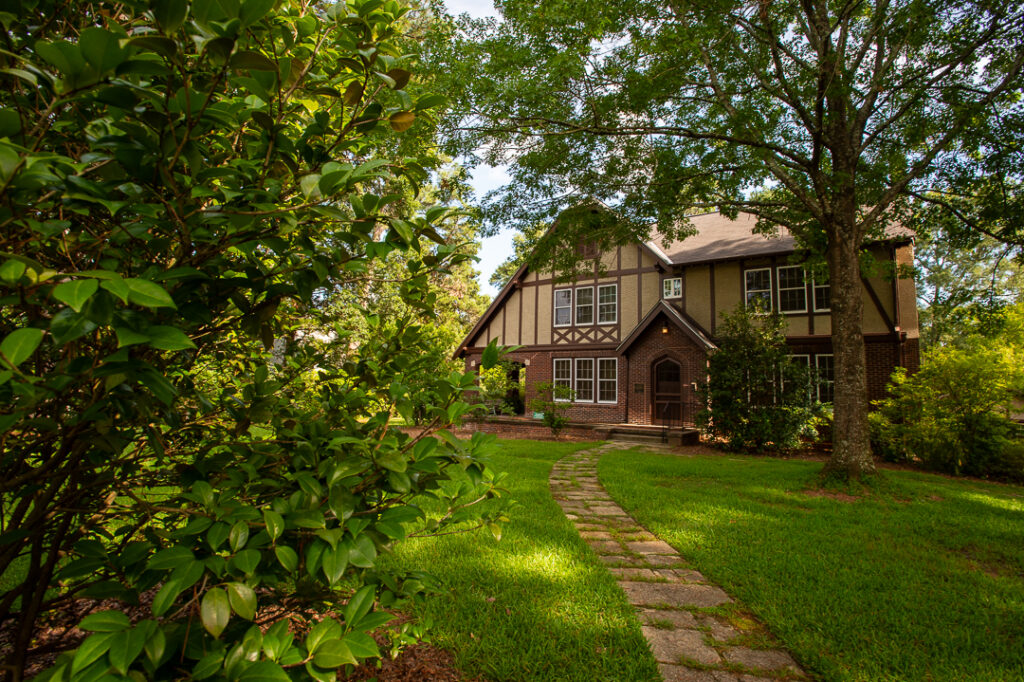
Designed by the architect Wyatt C. Hendrick in the Tudor Revival style (“à la Shakespeare,” as Welty once described it), the Welty House is located at 1119 Pinehurst Street in Jackson, Mississippi. Completed in 1925, the house has an asymmetrical facade with a brick veneer beneath half-timbered stucco. The house faces north and, at the time of construction, stood at the eastern end of Belhaven, one of Jackson’s first subdivisions. It is now much closer to the city center than the edge of town. Welty graduated high school in 1925. Although the house was not yet finished, the family held her graduation party in the house’s garden, which her mother, Chestina, designed. Welty helped her mother lay this walkway from the street to the house.4
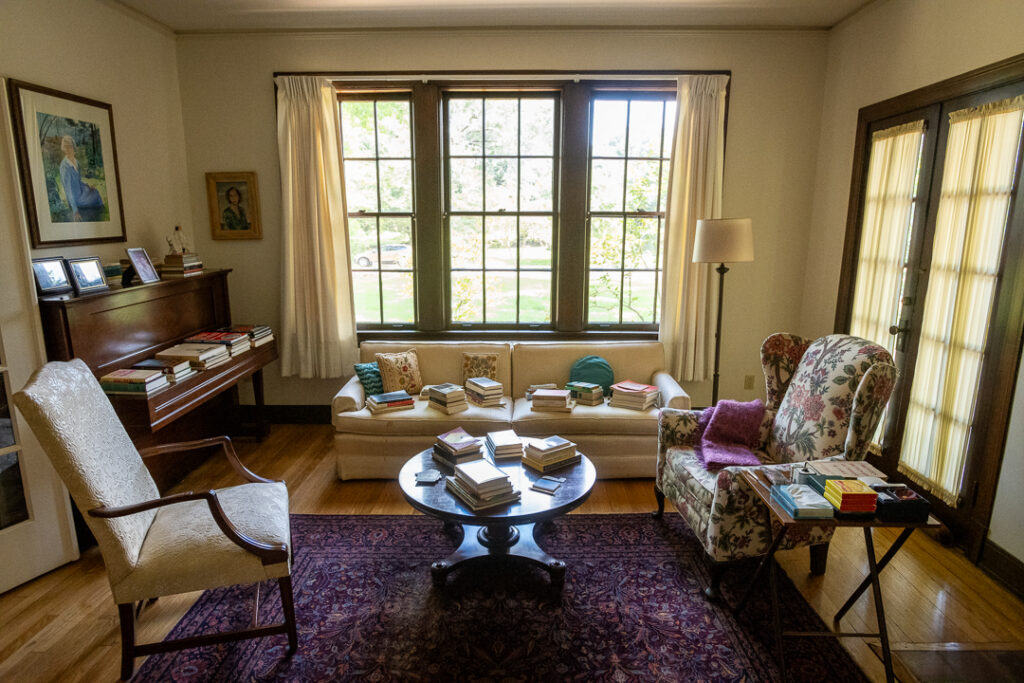
Entering Welty’s living room, one notes first the piles of books—on her sofa, her coffee table, her piano. The house is preserved in the style of the middle 1980s, when she gave her house in life trust to MDAH. Friends who visited her during these years report that, if anything, the curators have tidied these piles. Welty felt at home among books. On the right is her favorite armchair, which was her father’s and which she had recovered in this floral pattern. The family’s Steinway upright piano stands in the northwest corner of the room, beneath portraits of Chestina Welty (by Mildred Wolfe) and Eudora Welty (by Marcella Comès Winslow). In One Writer’s Beginnings, Welty recalls the piano being “beyond [the family’s] means” when they purchased it. Mrs. Welty helped pay for it by selling milk from a cow kept in the backyard of an earlier house on North Congress Street, and the author contributed by making deliveries on her Princess bicycle.5
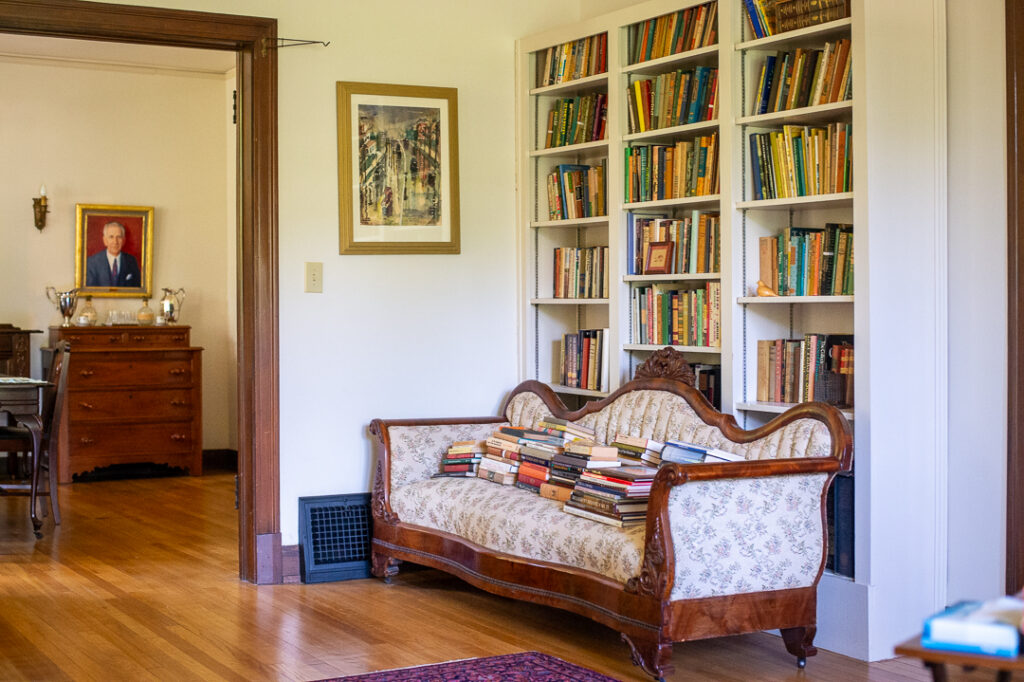
Welty described herself as “not really a [book] collector, except in the sense that I have tried to get all the books of all the writers I most revere.” On these shelves, she set her own books amidst those by her writer friends—Elizabeth Bowen, Guy Davenport, Ford Madox Ford, Henry Green, Seamus Heaney, William Maxwell, Katherine Anne Porter, Walker Percy, Reynolds Price, V. S. Pritchett, Elizabeth Spencer, Jean Stafford, Peter Taylor, and Robert Penn Warren—as well as ones by writers she never met but deeply admired: Willa Cather, James Joyce, and Virginia Woolf, among others. Welty purchased the watercolor hanging next to these shelves, “Wet Hill,” from her friend William Hollingsworth in 1936, “when we were both working for the WPA and both broke.” Hollingsworth also made the frame. Through the doorway is the house’s dining room. There, a Mildred Wolfe portrait of Christian Welty, the author’s father, hangs above a chest of drawers made of wood from the Ohio farm where Mr. Welty grew up, a family heirloom.6
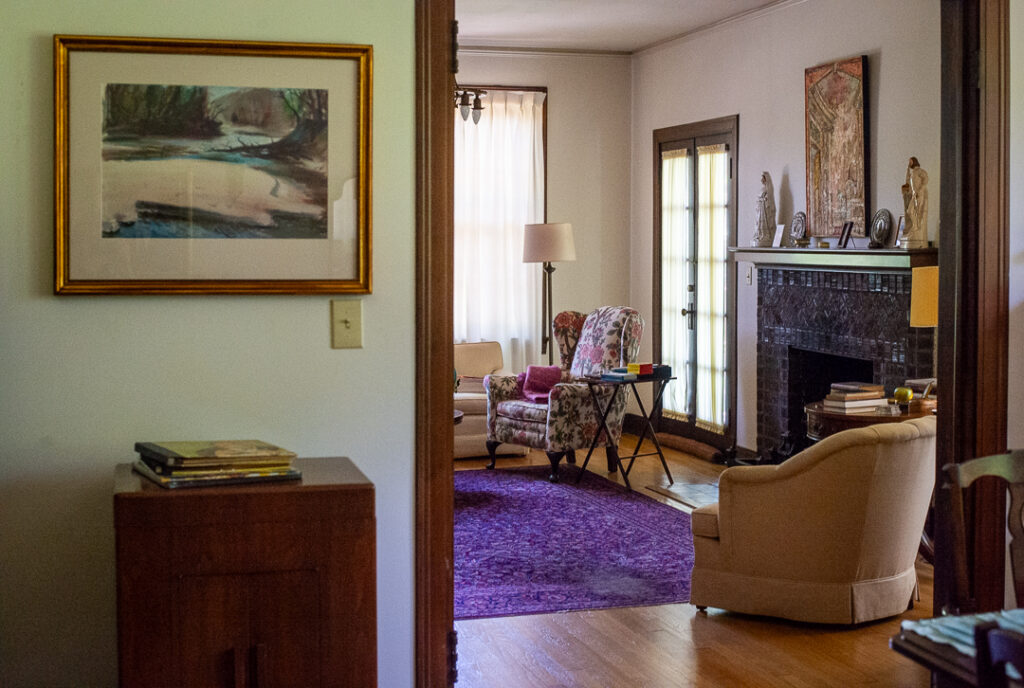
Welty purchased the record player (bottom left), an Ansley Dynaphone, in 1943 with money from an O. Henry Prize for her story “The Wide Net.” The Welty House shows the author’s life in great detail, but it is harder to imagine how the home sounded. In One Writer’s Beginnings, Welty describes her family’s love of music, and she often alluded to specific musical works in her fiction. Above the Dynaphone she hung William Hollingsworth’s watercolor, “Low River.” To Welty, the painting “shows the Pearl [River] in its true character, when it used to wind around and have sand bars and old branches lying in it … I think when I was writing my little story about ‘The Wide Net,’ I was visualizing something happening on that sandbar.” Fitting, then, that it hangs here. In the background is the living room mantel. Welty displayed objects collected on her travels, including Staffordshire figurines of Shakespeare and Queen Victoria and copper plates brought home from Italy. Welty bought the painting above the mantle, titled “Rome,” from the Santa Fe artist Agnes Sims, whom Welty knew through her friend Mary Lou Aswell.7
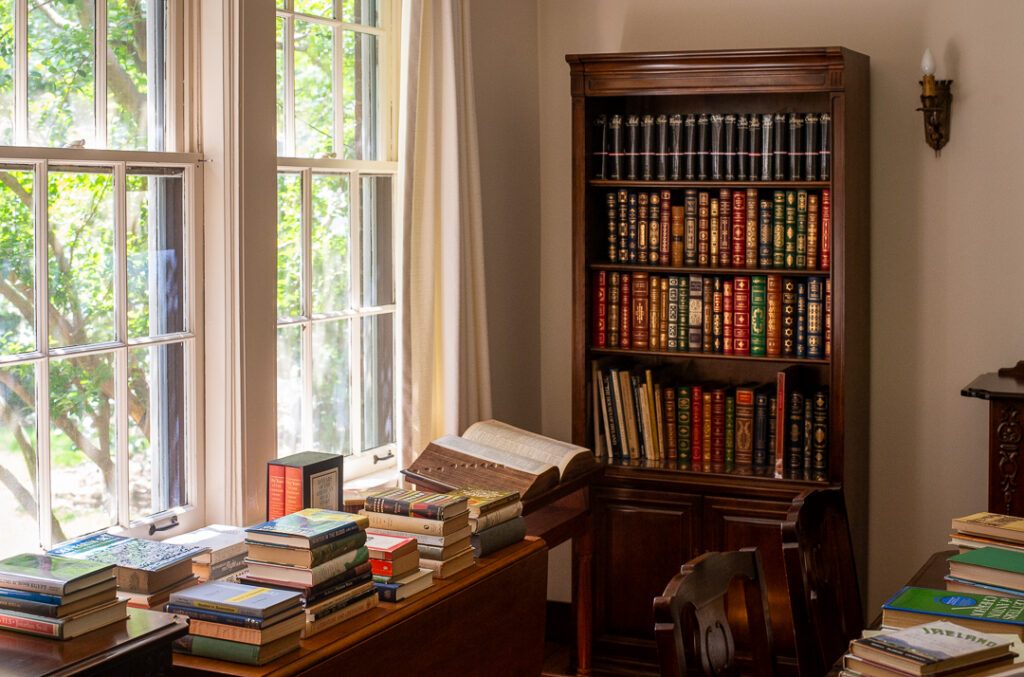
“Here to help us grow up arguing around the dining room table,” Welty writes in One Writer’s Beginnings, were “the Unabridged Webster, the Columbia Encyclopedia, Compton’s Pictured Encyclopedia, the Lincoln Library of Information, and later the Book of Knowledge.” The conversations that she remembers took place at the family’s North Congress Street home. By 1925, when the Weltys moved into this house, the author was preparing for college, and the 1913 Funk & Wagnalls New Standard Abridged Dictionary had replaced the Unabridged Webster. The bookshelf contains Welty’s collection of Library of America editions, as well as other collectable editions. In 1998, the Library of America published two volumes of Welty’s works, edited by Richard Ford and Michael Kreyling, making her the first living writer included in the series.8
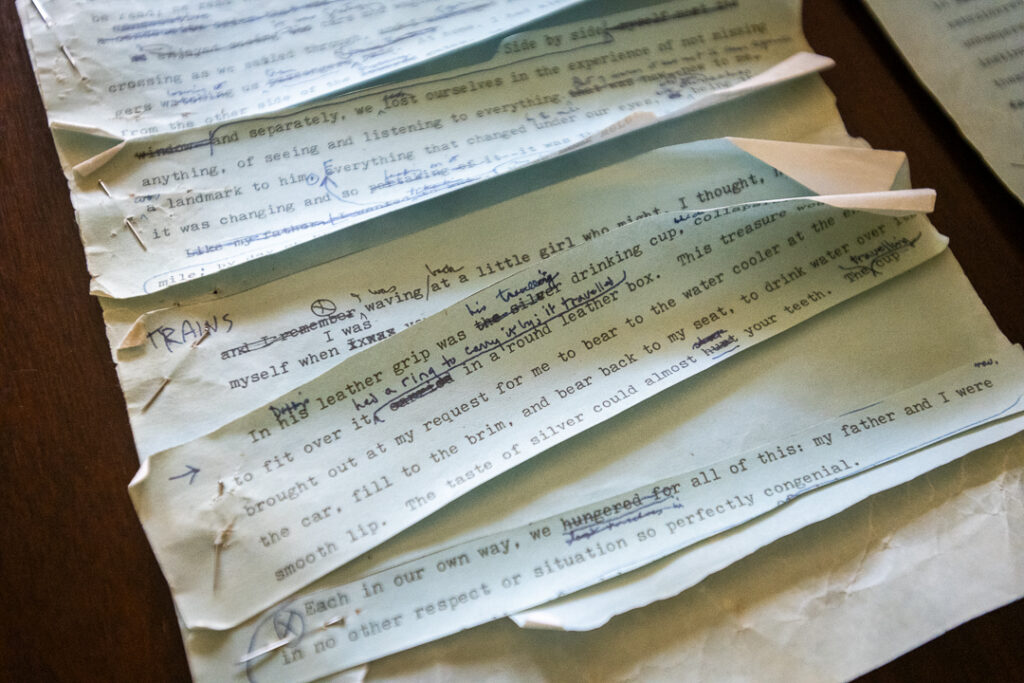
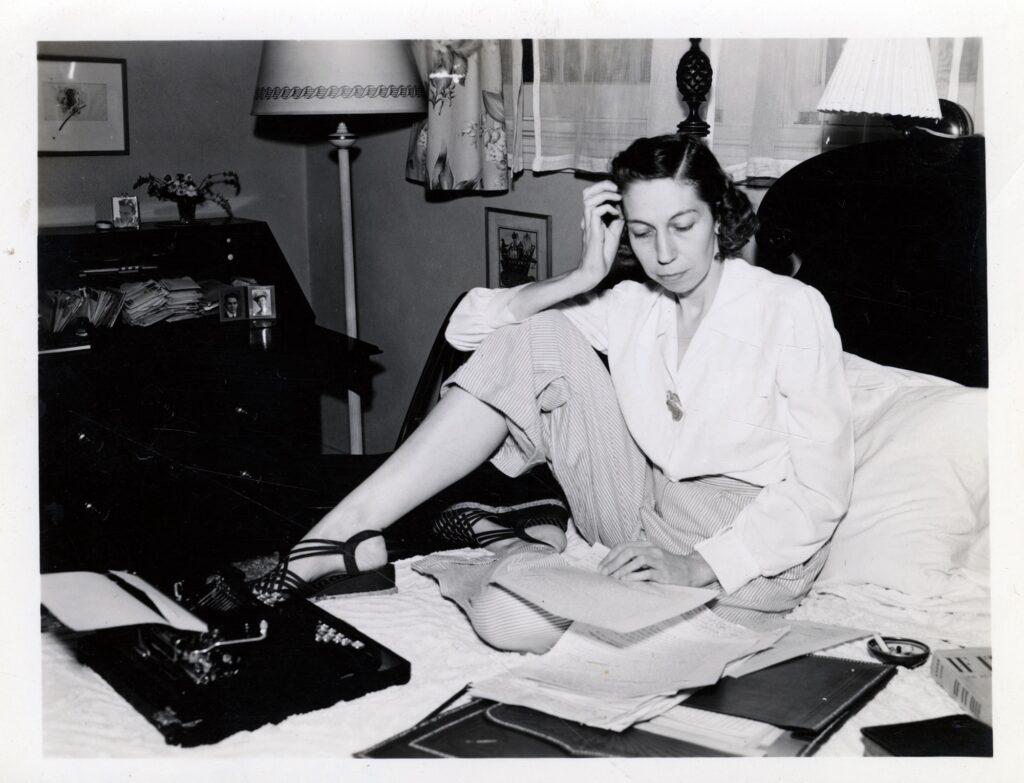
When she revised a story, Welty would sometimes cut it into sections and try the sections in different arrangements, pinning them to a sheet of paper. She might not have been the first or only author to use this cut-‘n’-pin method but knowing that her stories sometimes took shape in this way can help us better understand the published versions. In 1953, Welty’s friend William Maxwell, famed fiction editor of the New Yorker, tried to convert her to rubber cement. “I’m so used to writing with a pincushion,” she replied, “that I don’t know if I can learn other ways or not … The Ponder Heart was in straight pins, hat pins, corsage pins, and needles, and when I got through typing it out I had more pins than I started with. (So it’s economical.)” Using pins, she could do what she could not have done with rubber cement: move the pieces of her stories around, trying them in multiple places.9
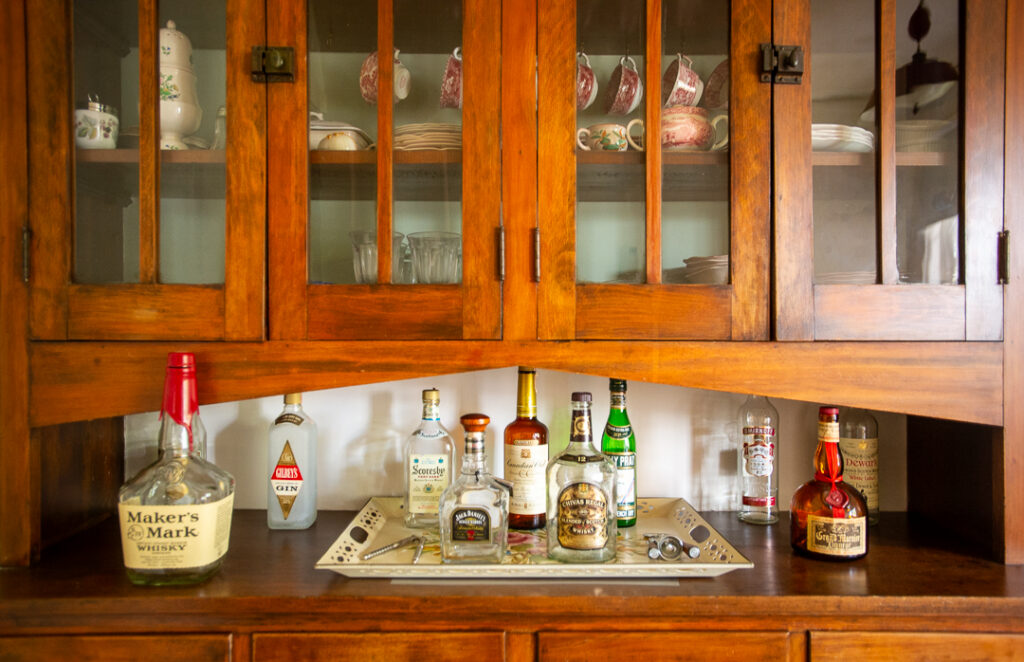
Affectionately known to docents as the home’s “entertainment center,” this built-in sideboard holds the family’s everyday china. Beyond the plateware one can glimpse the house’s original plaster walls, which have elsewhere been covered with sheetrock. Welty often had friends over for evening drinks and conversation. Bourbon was her drink of choice, and in later years she favored Maker’s Mark. When proposing a second round, she liked to observe, “You can’t fly on just one wing.”
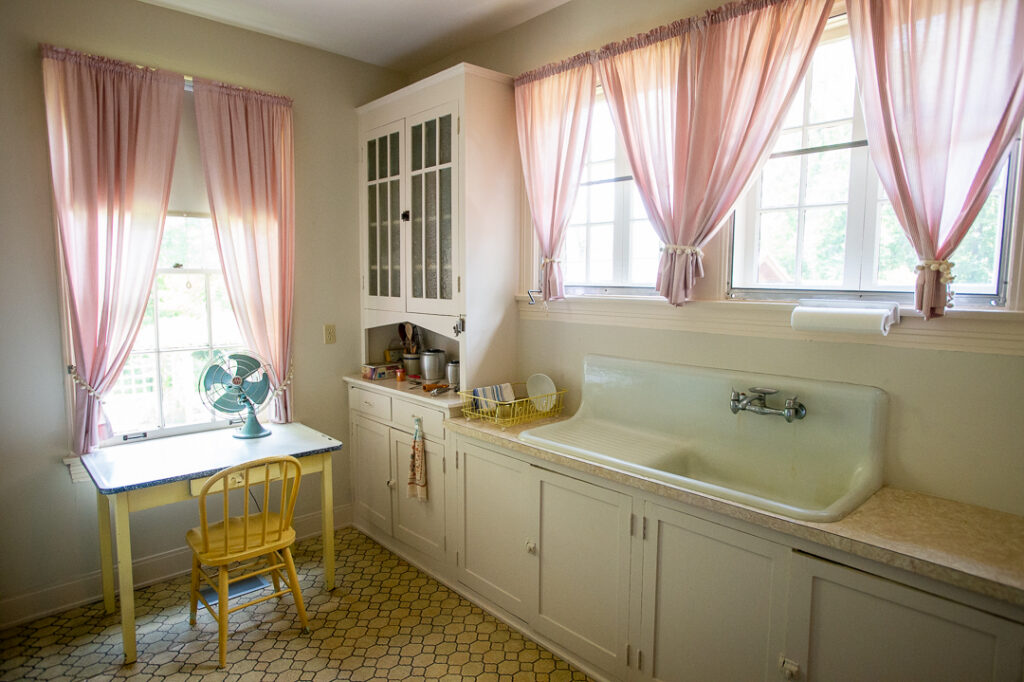
It might not seem an obvious choice, considering the light pouring in from the room’s three windows—two (with double casements) facing west and the other south—but Welty is known to have used her kitchen as a darkroom, developing photos by hand in this porcelain sink. Although the Weltys updated parts of the kitchen, replacing appliances, countertops, and flooring, they never fully modernized it. The fan on the table serves as a reminder that, for most of her life, the author lived without air conditioning. She also never owned a microwave, dishwasher, washer, or dryer.
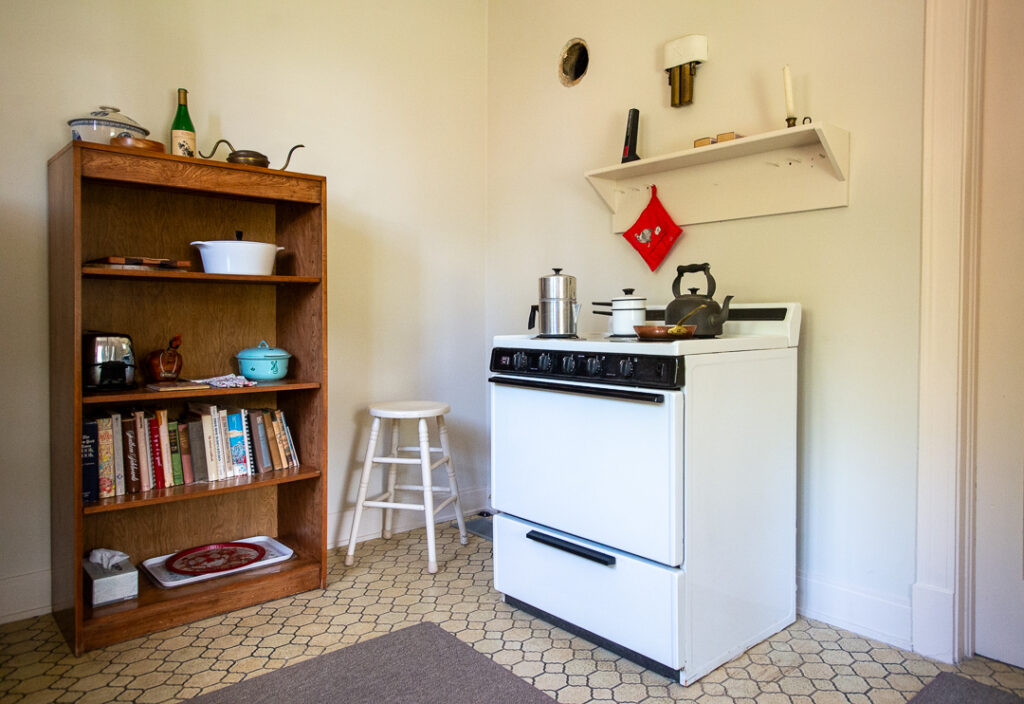
The Welty’s kitched originally had a “big iron range” and wood-burning stove. Over time, as the family updated the appliances, the flue was covered up. During the restoration of the house, it was exposed again, and the curators left it exposed, for a reason. Discouraged when the Southern Review refused her story “Petrified Man,” Welty threw the typescript, her only copy, into that stove, and up it went in smoke through this flue. Not long after, Robert Penn Warren, editor of the Southern Review, reconsidered. He asked Welty to see the story again, but there was no story. She left this request unanswered, but he persisted. Eventually, she rewrote the story from memory, and it has become one of her most anthologized and best-loved works. On the stove is a percolator Welty used to make coffee. The bookshelf next to the stove contains, among other things, cookbooks, cookware, and a carafe in the shape of a dodo bird, given to Welty by her niece Mary Alice White. As children, Mary Alice and her older sister Elizabeth had trouble pronouncing their aunt’s first name, so they settled on the simpler “Dodo.” Welty enjoyed cooking, but the kitchen was not the center of her domestic life.10
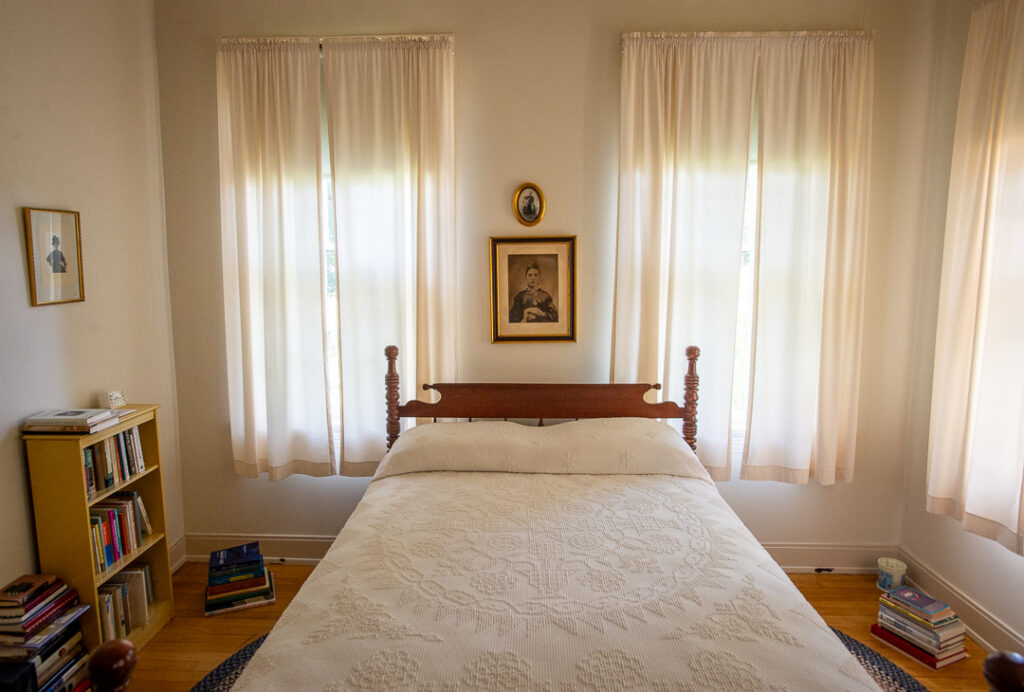
This small room was originally Christian Welty’s library. In the late 1930s, the family decided to take on roomers, and the library was converted into a bedroom. The most notable and longest tenured of these roomers was Fannye Cook, a conservationist whose eccentric character furnished the author with choice anecdotes, and whose remarkable life and accomplishments have themselves been the subject of a recent book. Cook lived with the Weltys for fifteen years. When Chestina Welty’s health declined in the 1950s, she took this room for herself. Mrs. Welty died in 1966. Afterward, the author used it as a guest bedroom. Even so, it retains its familial association through photographs Welty treasured. Here are portraits of her maternal grandmother Eudora Carden Andrews, after whom she was named. Here, too, visible at left, is a photograph of Chestina Welty in mourning, after the loss of her first child, an older brother whose brief life the author discovered by accident, as she describes in One Writer’s Beginnings.
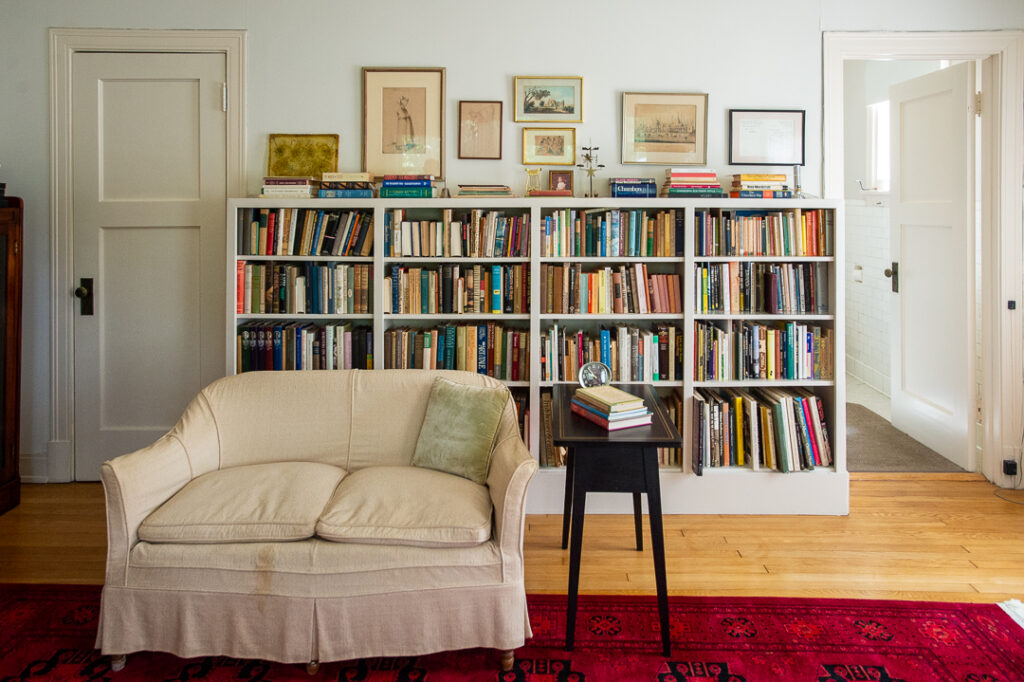
This room was initially the master bedroom, then part of the roomer’s suite. From 1955 onward, Welty used it as a sitting room. Here, in a box in the closet beside the bookshelf, she stored her Pulitzer Prize and other honors, which she did not keep on display. Here, too, is her television, just outside the shot. She watched little television but seldom missed her friends Jim Lehrer and Robert MacNeil on the MacNeil/Lehrer Report. With a few notable exceptions (the family set of Mark Twain, for example), Welty kept nonfiction in this room. Over this bookshelf, she displayed art anchored in memory and friendship: a piece by her friend, the Santa Fe artist Agnes Sims; Dürer and Holbein prints from her undergraduate days at the University of Wisconsin; a lithograph sent to her by Reynolds Price, a close friend; and a postcard from Bernard Berenson, the renowned art historian and collector, whom she met while traveling in Europe on a Guggenheim Fellowship. Perhaps dearest of all to her, however, is a letter she received in 1947 from E. M. Forster, who wrote to say how much he “enjoyed [her] work.” A long admirer of Forster’s fiction, Welty framed this letter, which hangs at the right end of the bookcase. A few years later, in 1954, she had the opportunity to visit with Forster in his rooms at the University of Cambridge.
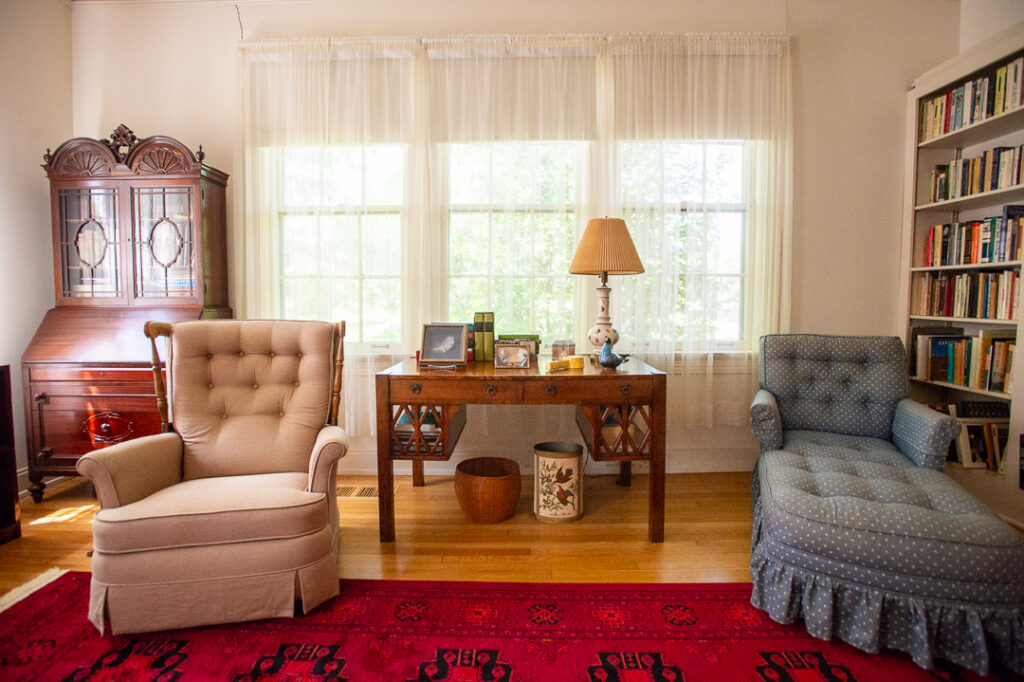
Welty’s young nieces Elizabeth and Mary Alice called this room the “cool room,” because it held the house’s only air conditioner—a window unit installed in the rightmost of these three north-facing windows. The author helped her father pick out the secretary in the northwest corner as a gift to her mother, Chestina. In the Mission-style library table in front of the windows, Christian Welty stored the puzzles and gadgets that amazed the author as a child and which revealed, as she put it, his “almost childlike love of the ingenious.” Displayed on top are a photograph of Welty and her friend Robert Penn Warren at the White House, where they received the Presidential Medal of Freedom from Jimmy Carter; and a swan feather from Coole Park, the home of the Irish writer Lady Gregory and a place Welty associated with W. B. Yeats, whose poetry she loved. In “The Wild Swans at Coole,” Yeats compares himself, as a regular visitor at Coole Park, with the swans which stop there on their annual migrations. The swans do not grow old in the same way as he does, but out of his experience of aging and the transience of his own life, he makes a timeless poem. The swan feather is an emblem of Welty’s house itself, which is, like Yeats’s poem, a timeless place keyed to one time.11
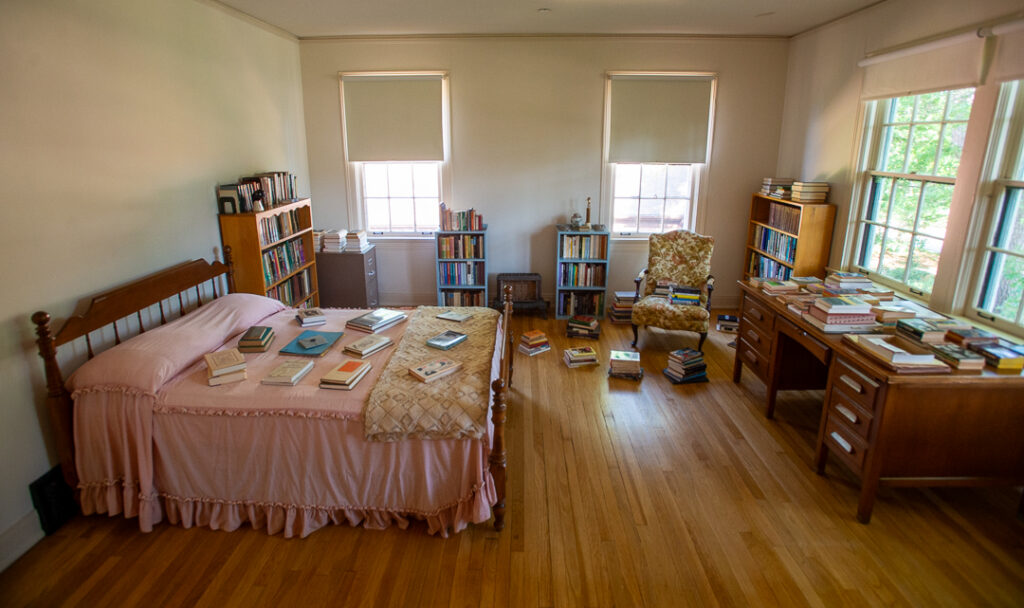
Welty’s brothers, Edward and Walter, first occupied this room, and it is known as their room today. By the time the family took in roomers in the late 1930s, however, both Welty sons had left to start their own lives. Chestina Welty moved upstairs and lived in this room for more than twenty years. After her death, the author used it for storage and as a guest bedroom. Welty offered it to the Anglo-Irish writer Elizabeth Bowen, for example, during her visit to Jackson in 1969. Within the house museum, the room bears traces of its original occupants. Both Welty sons excelled at golf and even competed against each other for annual city championships. Just visible in the photograph is a trophy claimed by one brother. On the bookshelf in the northwest corner (upper right) is Chestina Welty’s beloved set of the works of Charles Dickens. In One Writer’s Beginnings, Welty writes that her mother once braved a burning house, ill and on crutches, to save these volumes, tossing them out the window into a front yard. Residual mud from that yard still adheres to some of these volumes today. But this room also tells us something important about Welty herself, for here she kept the mystery novels that she loved to read, as well as the 1985 Raven Award for Mystery Reader of the Year, which she received from the Mystery Writers of America. It is the one award displayed in the Eudora Welty House & Garden.12
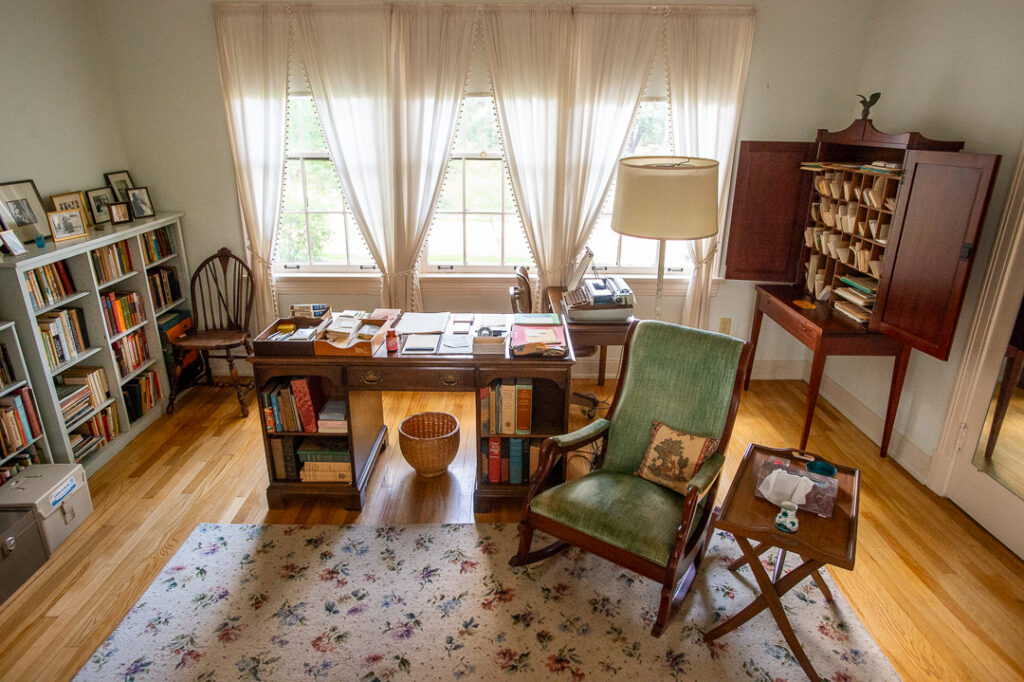
Welty said that as the eldest child and only daughter, she got the best bedroom in the house. Her room was also her primary workplace. This photograph shows the north side of the room, where she worked. Just visible in the bottom corner is one of several file boxes and cabinets in which she kept correspondence. The house held more than fifteen thousand items of correspondence at the time of her death. She kept books she enjoyed as well as books useful to her work on the shelf visible at the left edge of the photograph, and on top of this shelf she kept pictures of some of her writer friends and mentors: Katherine Anne Porter, Elizabeth Bowen, Mary Lou Aswell, Reynolds Price, William and Emmy Maxwell, Ross Macdonald. Alongside them is a photograph from the launch party for her first book, A Curtain of Green (1941), as well as a photograph of E. M. Forster, whom she first met in New York City and later visited in his rooms at King’s College, Cambridge. The double-sided desk faces into the room. Behind and perpendicular to it are her typewriter and stand. Welty didn’t let the world outside her window distract her as she wrote, but she could take that world in, any time she wanted, with a turn of the head.
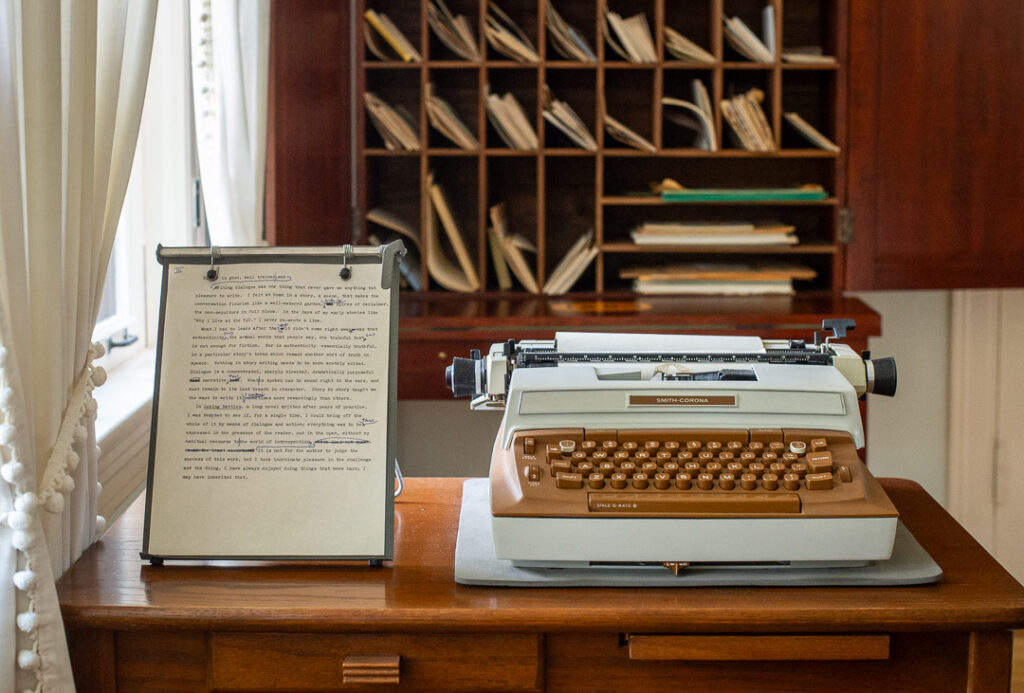
Sitting at this typewriter, Welty faced west, toward a piece of furniture known as a plantation desk. She bought this piece in 1946 and later wrote it into a pivotal scene of her Pulitzer Prize–winning novel, The Optimist’s Daughter. With a few exceptions, her description of it there could stand for the real thing: “It had been made of cherry trees … a long time ago; on the lid, the numerals 1817 had been set into a not quite perfect oval of different wood, something smooth and yellow as a scrap of satin … On its pediment stood a lead-mold eagle spreading its wings and clasping the globe … Within, the cabinet looked like a little wall out of a country post office which nobody had in years disturbed by calling for their mail.” The date on the real desk is 1804, but in her novel Welty changed it to 1817, the date of Mississippi’s statehood. Although arthritis forced Welty to switch to this electric typewriter, she did not like it as much as her old manual typewriter. The electric one hummed, she said, as if “waiting on you to do something.”13
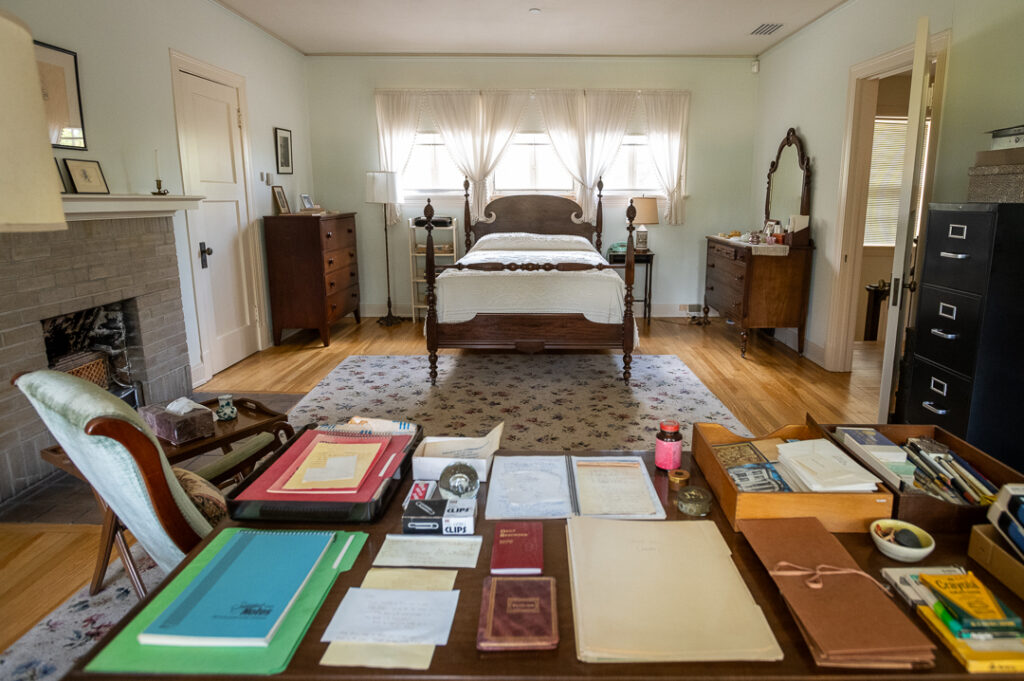
If Welty turned from typing to look across her room, this is what she would have seen. To the left, sitting on the mantel, is a set of three crayon drawings by the Irish author and artist A. E. (George William Russell). Welty came across A. E.’s writings in college and admired them. She was delighted, years later, when his son Diarmuid, who had moved to New York and founded a literary agency, asked to represent her. She agreed, and their initial business relationship grew into a close friendship. Diarmuid Russell sent these A. E. drawings to her as a gift. The bed stands beneath three windows on the south wall, and over the chest of drawers in the southeast (left) corner is a portrait of the British author V. S. Pritchett, another friend. Welty taped a copy of Pritchett’s autograph, which he sent her, to this portrait. Among the implements on top of the desk are a jar of rubber cement, a box of crayons, paper clips, manila folders, scraps of paper and old checkbook registers on which she scribbled notes, and a notebook containing potential names of characters.
“Set within the land is the dwelling,” Welty writes in a 1974 essay called “The House of Willa Cather,” “made by human hands to hold human life … The house is the physical form, the evidence that we have lived, are alive now; it will be evidence someday that we were alive once, evidence against the arguments of time and the tricks of history.” If Welty attributes this view of houses to Cather, then it also applies—as these photographs make clear—to her own dwelling place. Confounding the arguments of time and tricks of history, the Eudora Welty House & Garden offers more than evidence that Welty lived, evidence that she was alive once: daughter, sister, aunt, friend, reader, traveler, gardener, author. It attests to the ways in which she remains alive now: not only through the books, art, furnishings, checkbook registers, scraps of paper, and the everyday objects she left behind, but also through her own readers and visitors to the Welty House—this splendid physical form made more than a century ago by human hands to hold her family’s life.14
Michael Pickard is the Eudora Welty Chair of Southern Literature at Mill-saps College, where he directs the Millsaps Digital Welty Lab and serves as chair of the English department. As an associate editor of the Eudora Welty Review, he has published articles and book chapters on Welty’s fiction, as well as on eighteenth-and nineteenth-century British literature.
Kate Medley is a visual journalist based in North Carolina, whose work across the American South focuses on storytelling and environmental portraiture, often exploring issues of social justice and the shifting politics of this region. She regularly contributes to the New York Times, the Washington Post, and NPR. Medley is the author of Thank You Please Come Again.
NOTES
We thank Eudora Welty’s friend and biographer Suzanne Marrs for her invaluable support and assistance with this piece.
- Eudora Welty, “Must the Novelist Crusade?,” in Eudora Welty: Stories, Essays, & Memoir, ed. Richard Ford and Michael Kreyling (Library of America, 1998), 810.
- Suzanne Marrs, Eudora Welty: A Biography (Harcourt, 2005), 2.
- Robert C. Ewing, “Foundation Repairs Due to Expansive Soils: Eudora Welty House, Jackson, Mississippi,” Journal of Performance of Constructed Facilities 25, no. 1 (2011): 52.
- “Eudora Welty’s House: A Conversation with Charlotte Capers, 1987,” Eudora Welty Review 16 (2024): 45.
- Eudora Welty, One Writer’s Beginnings, in Eudora Welty: Stories, Essays, & Memoir, 905.
- “Eudora Welty’s House,” 59, 58.
- “Eudora Welty’s House,” 74–75.
- One Writer’s Beginnings, 842.
- The Ponder Heart is a novella first published in the New Yorker in 1953. Suzanne Marrs, ed., What There Is to Say We Have Said: The Correspondence of Eudora Welty and William Maxwell (Houghton Mifflin Harcourt, 2011), 41–42.
- “Eudora Welty’s House,” 49; Eudora Welty: A Biography, 58–59.
- One Writer’s Beginnings, 840.
- One Writer’s Beginnings, 886.
- Eudora Welty, The Optimist’s Daughter, in Complete Novels, ed. Richard Ford and Michael Kreyling (Library of America, 1998), 965; “Tour of the Eudora Welty House,” Eudora Welty House & Garden, Jackson, Mississippi.
- Eudora Welty, “The House of Willa Cather,” in The Eye of the Story: Selected Essays & Reviews (Random House, 1978), 56.