The American South holds a unique place in the history of US democracy. From the fraught political landscapes of Reconstruction to the mass movements of the civil rights era, the region has repeatedly served as a battleground where the meaning of democracy has been contested, resisted, and reimagined. At the same time, the South has served as a laboratory for civic innovation, where ordinary citizens, often excluded from political power, have modeled and crafted participatory and inclusive forms of democracy. This democratic tradition has advanced major social change across the country through bottom-up, movement-driven struggle—finding success against deeply entrenched and contentious power structures. As reactionaries and extremists work to overturn the achievements of these periods, it is important to remember that these transformations were made possible only through struggles that faced immense opposition from the very beginning. The region’s enduring tradition of democratic resistance and reinvention continues to offer a model for the nation.
Democracy at its best is understood not as a set of rigid institutions but a lived social ethic that is cultivated through collective action, solidarity, and sustained civic engagement. The South has historically demonstrated both the challenges and possibilities of sustaining a vibrant democratic life. By examining historical and contemporary examples of the southern freedom movement, the region’s struggles offer lasting lessons for defending and reimagining democracy in the twenty-first century, while also highlighting the broader challenges facing American society.1
During Reconstruction, newly emancipated Black citizens mobilized politically, rewriting state constitutions, holding office, and building institutions to influence public policy. Historian Eric Foner calls this the “first experiment in genuine interracial democracy in the South.” One such advocate was Abraham Galloway, a formerly enslaved man from Eastern North Carolina, who was deeply engaged in mobilizing Black voters, organizing resistance to racial violence, and teaching new citizens how to exercise their rights. At a time when many white southerners believed that democracy could only function under white control, Galloway insisted on political equality and interracial cooperation. After the 1868 election, he and other newly elected Black leaders wrote to voters, declaring that “we are men, and a part of the body politic,” asserting that American democracy must include formerly enslaved people. His actions not only helped expand political participation in North Carolina but also redefined southern democracy as multiracial and inclusive, demonstrating through his advocacy for racial justice, political equality, constitutional reforms like the 14th and 15th Amendments, women’s suffrage, and laws like the Shoffner Act that genuine democracy requires collective resistance against oppression. By challenging entrenched white supremacy and asserting Black political agency, Galloway shattered the notion that only white men could be political actors, advancing Reconstruction’s radical vision of justice and inclusion.2
Even as white supremacists rolled back Reconstruction’s gains, ordinary people continued to resist. Small farmers, Populists, and women’s suffrage organizers formed cooperatives, shared leadership, and risked social and economic retaliation to challenge entrenched white elites. These stories reveal that democracy in the South has never been handed down willingly; it is made alive by the courageous persistence of everyday people.
This lineage of grassroots democracy continued into the twentieth century, where small rural communities served as powerful engines for civic engagement. Ordinary people from church congregations to student organizers in rural areas like Lowndes County, Alabama, and Ruleville, Mississippi, built momentum at the local level that forced federal institutions to respond. In these communities, activists created grassroots institutions, nurtured local leadership networks, and challenged entrenched racial inequality, proving that democratic transformation could emerge even from the most marginalized communities. These efforts show how local networks create the infrastructure that sustains broader movements and counters political backlash. Here, democracy was not an abstraction, it was a daily practice of organizing, educating, and mobilizing against systemic oppression.3
Southern activist Ella Baker embodied just such a vision of participatory democracy that is collaborative and locally grounded. For Baker, democracy meant that every person, regardless of social status, had both a voice and a responsibility in shaping society. She saw potential leaders in every community and taught them to recognize their own agency. Her organizing style challenged the top-down leadership models dominating both southern institutions and much of the Civil Rights Movement. She explained that to organize effectively, “people first had to recognize their own right to participate in all the decisions that affect their lives.” Through this philosophy, she worked to train, empower, and support leaders who could sustain democratic action from within their own communities, ensuring that grassroots democracy could endure beyond individual movements. “In the long run they themselves are the only protection they have against violence or injustice,” she said. “They cannot look for salvation anywhere but to themselves.”4
Baker’s belief in radical democracy directly challenged the South’s paternalistic and hierarchical political culture by allowing those most affected by an issue to lead. She rejected the idea that social change required charismatic leaders or elite institutions, arguing instead that “strong people don’t need strong leaders.” Through her organizing model, Baker showed that genuine democracy depends on inclusion and equality, not domination and control.5
Guided by Baker’s principles, the Student Nonviolent Coordinating Committee adopted a non-hierarchical, grassroots approach that showed democratic action could emerge from ordinary citizens rather than national leaders. Across the South, SNCC paired protest with community-based work, sit-ins, Freedom Rides, voter registration drives, and the 1964 Freedom Summer campaign, which empowered communities directly to challenge systemic disenfranchisement in Mississippi.6
In a state where fewer than seven percent of Black adults were registered to vote, Freedom Summer united residents, students, and activists to challenge profound disenfranchisement. The project founded forty-one Freedom Schools, educated more than 3,000 young Black people in literacy and organizing, and registered nearly 17,000 Black voters, while confronting violent resistance. (Only 1,600 of those registered were accepted by white registrars.) The interracial group of organizers worked collectively to discuss strategy and build shared responsibility, leading voter registration drives, teaching civics lessons, and transforming churches and schoolrooms into spaces where community members could learn to organize, run local meetings, and claim political power. These efforts show communities can build democratic alternatives that empower everyday people and cultivate new habits of participation that last beyond any single political campaign. As SNCC organizer Bob Moses later reflected, “Leadership is there in the people. You don’t have to worry about where your leaders are, how are we going to get some leaders. The leadership is there. If you go out and work with your people, then the leadership will emerge.”7
Freedom Summer helped pave the way for the Voting Rights Act of 1965 and expanded the meaning of citizenship. Local activists and national volunteers found that it not only shaped their moral and political perspectives but also strengthened their organizing skills to help their own communities. “It opened up the gate for all other movements, opened up freedom for lots of people,” historian Taylor Branch recalled at a 50th anniversary commemoration of Freedom Summer. By placing communities at the center of democratic struggle, SNCC proved that democracy is sustained by everyday people exercising collective power.8
SNCC was also the political home for some of the most visionary thinkers on American democracy, including figures like John Lewis, Diane Nash, Julian Bond, and Fannie Lou Hamer. Hamer’s life embodies the stakes and struggles of grassroots democracy. Raised in the cotton fields of the Mississippi Delta, Hamer worked as a sharecropper before joining SNCC and helping to organize Freedom Summer. Despite only having a sixth-grade education, she became one of SNCC’s most valuable organizers. With Mississippi holding whites-only primaries, Hamer helped establish the racially integrated Mississippi Freedom Democratic Party to confront Democratic leaders on a national stage.
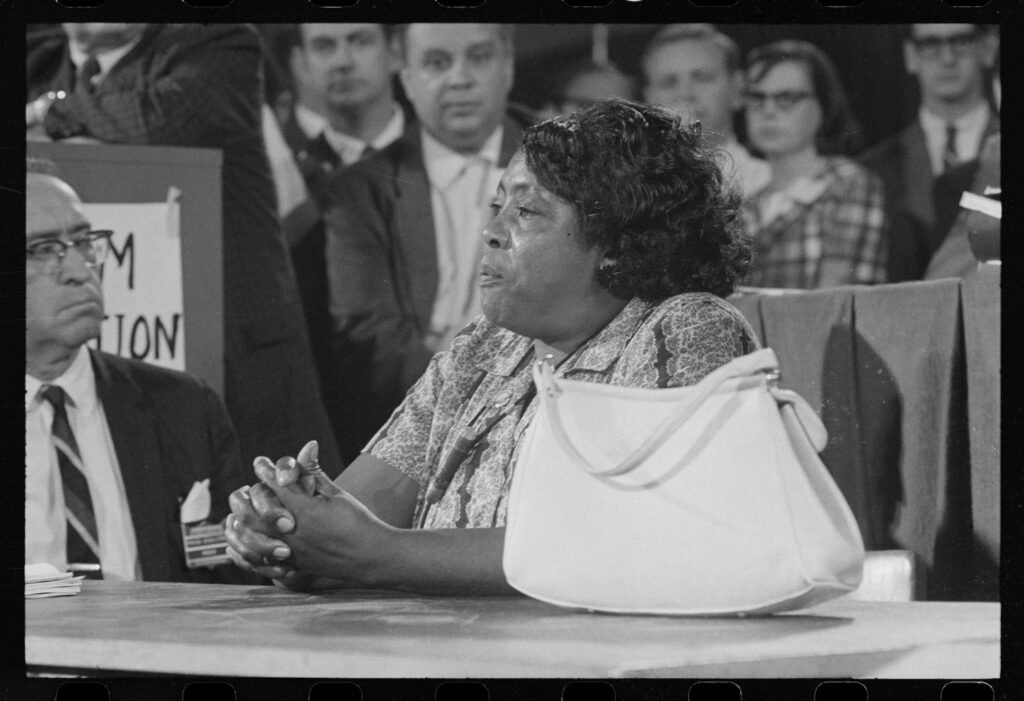
In 1964, Hamer’s nationally broadcast testimony about the brutal treatment she faced while attempting to register to vote shocked the nation and caught the attention of President Lyndon B. Johnson. She recounted being beaten and fired from her job yet returning to her community to teach others how to register to vote. She described the literacy tests and other discriminatory tactics white officials used to prevent Black citizens from voting, highlighting how southern elites rigged the political system to maintain their power. Hamer revealed that the racialized violence of the Jim Crow South was not an aberration but rather a deeply embedded pillar of the region’s political system.
Her words exposed the hypocrisy of American democracy and challenged the South’s exclusionary political system. “If the Mississippi Freedom Democratic Party is not seated now, I question America,” Hamer told the credentials committee. “Is this America, the land of the free and the home of the brave, where we have to asleep with our telephones off of the hooks because our lives be threatened daily, because we want to live as decent human beings, in America?” By insisting that true democracy must include those historically silenced, Hamer transformed the racial suffering of the South into a powerful call for citizenship.9
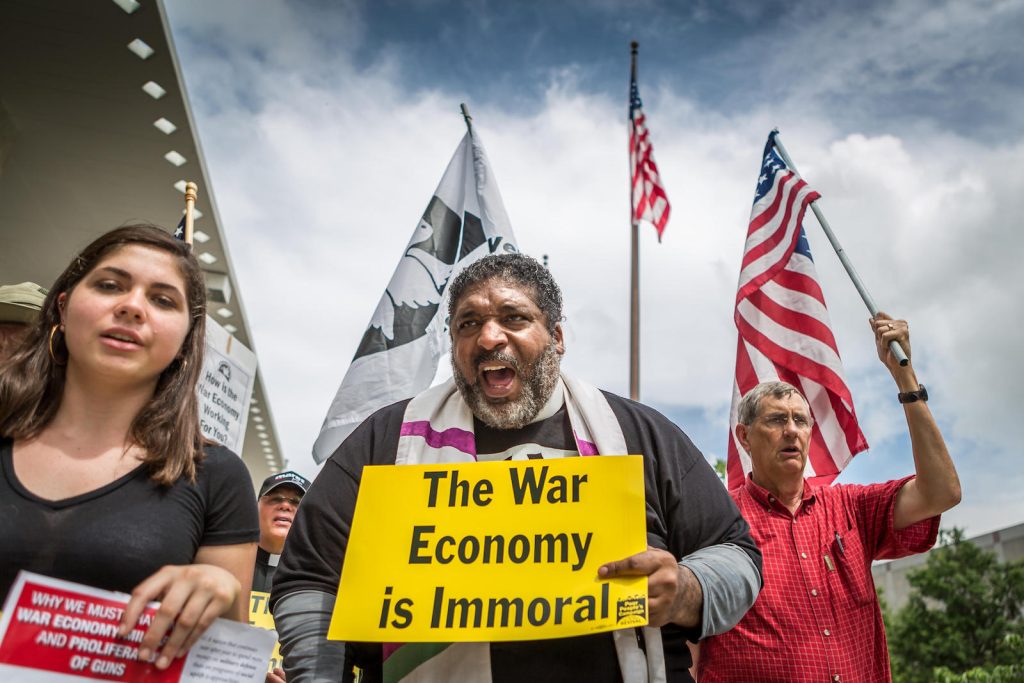
Decades later, these principles of grassroots, multiracial democracy inspired a new generation of southern activists. In 2013, North Carolina became the site of the Moral Monday protests, where thousands across race, class, and faith gathered weekly for rallies, teach-ins, and nonviolent civil disobedience against laws restricting voting rights and cutting public programs. For participants in the Moral Monday movement, democracy was lived and learned through building relationships, “by being on the mall together, workers and women’s rights activists understood each other’s issues better,” explained teacher and activist Bryan Proffitt. “Environmentalists heard, relentlessly, about why the attacks on voting rights were so devastating.”10
Rather than relying on political elites, Moral Monday participants organized themselves, coordinated actions, and risked arrest in one of the South’s most sustained direct-action campaigns, confronting entrenched hierarchies and the modern southern strategy of using political manipulation and social divisions to maintain one-party rule. They challenged voter-suppression laws, gerrymandering, and cuts to education and healthcare that eroded democratic participation. Filling the state legislature’s rotunda, they demonstrated that democracy extends beyond voting. As my father, Rev. William Barber II, said, “I think one of the great things it did was teach people to fight for what they believe in when in the minority politically. Moral Monday said, ‘No, you have work to do. You still have to keep raising dissent.’” The weekly rallies and civil disobedience redefined southern democracy as active, participatory, and accountable. Inspired by this model, Moral Mondays spread to other southern states, showing that grassroots organizing remains a vital force against political extremism.11
Today, the South faces a rising threat to democracy as voting rights are restricted through suppressive laws, gerrymandering, limited polling, and reduced mail-in ballots, all of which disproportionately affect marginalized communities. State policies and weakened federal protections echo historical disenfranchisement, while national trends, such as election delegitimization, politicized courts, militarization of cities, and suppressed dissent, exacerbate this authoritarian crisis. Economic inequality and social polarization deepen these challenges, showing that sustaining democracy requires not just voting access but also equity, civic education, and cross-community solidarity.
Despite these threats, the South remains a site of robust democratic resistance. Ordinary people continue to confront authoritarianism and the erosion of democratic norms through acts of solidarity. New coalitions, rooted in community, moral imagination, and intergenerational leadership, are reshaping the political landscape. From marches and court battles to the ballot box, everyday southerners continue to defend democracy through grassroots organizing, coalition-building, and civic engagement.
Mass demonstrations like the “No Kings” protests, mobilize against authoritarian behavior and emphasize citizen accountability and participatory engagement. Contemporary groups like Black Voters Matter, Siembra NC, and the Union of Southern Service Workers mobilize voters, educate communities, and hold institutions accountable. LaTosha Brown, cofounder of Black Voters Matter, asserts, “activists and organizers in the South, just like we did in the ’60s, are literally determining the next iteration of what American democracy is going to look like.”12
Elected officials empowered by these efforts have also acted to defend democratic representation, like the more than 50 Texas House Democrats who left the state in an attempt to block a partisan redistricting plan, while officials in cities like Durham, North Carolina, adopted protective measures to shield immigrant communities from federal enforcement actions. Policy initiatives like North Carolina’s Blueprint for a Stronger Democracy, developed by coalitions including the Institute for Southern Studies and North Carolina Voters for Clean Elections, further demonstrate democratic innovation through proposals on voting access, independent redistricting, election integrity, campaign finance, and judicial accountability. As the report’s authors write: “Now, as we face a new wave of attacks on democracy, including a resurgence of false claims about voting, the political weaponization of democratic institutions, and efforts to restrict voting access, it is more critical than ever that we offer a powerful and compelling vision for strengthening democracy in North Carolina.”13
Recent elections show this renewed democratic energy translating into significant political victories, hinting at a potential revival for democracy across the country. In the South, emerging coalitions of Black, Latine, Asian, and young voters, especially young women, are reshaping the region. These multiracial, younger coalitions are forming across suburbs, rural areas, and other changing communities, signaling a shifting southern political landscape.
In the 2025 off-year elections, post-election analysis noted that victories in southern states could signal broader political shifts heading into the 2026 midterms. In Virginia, Democrats won statewide races for governor, lieutenant governor, and attorney general, securing full control of state government, the only one held by the party in the South. The last time Virginia democrats held a trifecta, they passed major voting and clean-energy reforms; now they’re expected to prioritize constitutional abortion protections and a repeal of the “right-to-work” law. Their victory also strengthens state lawmakers’ ability to push back against GOP gerrymandering nationwide through their own redistricting plan.14
In Georgia, Democrats won two statewide utility regulator seats, their first statewide wins there since 2006, further indicating potential new competitive territory in the South. And in Mississippi, voters stripped Republicans of their supermajority in the state Senate. That shift is significant because it allows a party to override a governor’s veto, advance constitutional amendments, and use procedural tools like restoring legislation that has already failed. The Mississippi Democratic Party called the victory “a historic rebuke of extremism.”15
These wins were built on sustained grassroots organizing coalition-building, voter engagement, and community-based mobilization and demonstrate that ordinary people can reshape the political landscape even outside of presidential elections. They also underscore the stakes of the upcoming midterm elections, which have the potential to determine the future of American democracy. Several southern states will hold major contests, including US Senate elections in North Carolina, Georgia, and Texas, along with dozens of competitive House races that will determine control of Congress and whether there will be an effective check on executive overreach.
The democratic collapse confronting the country represents a systematic effort to cement inequality, suppress dissent, and replace democracy with oligarchic authoritarian rule. The hope for American democracy will not be found in decaying political machines or individual compelling leaders but in the vitality and imagination of an organized and determined people committed to fundamental social change. History demonstrates that democracy is never guaranteed; it must be practiced, defended, and reimagined by every generation. As Howard Zinn observed, “Many people had said: the South will never change. But it did change. It changed because ordinary people organized and took risks and challenged the system and would not give up. That’s when democracy came alive.” Each effort to defend democracy in the South breathes new life into the nation’s democratic ethos, showing that genuine democracy becomes real when communities and everyday people organize, engage, and act in solidarity.16
Benjamin Barber is a writer and advocate who is heavily interested in voting rights, democracy, and southern history. He currently serves as the Democracy Program Coordinator at the Institute for Southern Studies and as a contributing writer for Facing South.
Header image: People line up to vote on election day in Fairburn, Georgia, November 6, 2018. Brian Cahn/ZUMA Wire/Alamy Live News.
NOTES
- The Southern Freedom Movement: The Effort for Civil Rights in North Carolina,” DigitalNC, accessed December 10, 2025, https://www.digitalnc.org/primary-source-sets/the-southern-freedom-movement-the-effort-for-civil-rights-in-north-carolina/
- Terry Gross, “Historian Eric Foner on the ‘Unresolved Legacy of Reconstruction,’” NPR, June 5, 2020, https://www.npr.org/2020/06/05/870459750/historian-eric-foner-on-the-unresolved-legacy-of-reconstruction; Abraham Galloway,” Civil War & Reconstruction North Carolina (NC State University Libraries), accessed December 10, 2025, https://cwnc.omeka.chass.ncsu.edu/exhibits/show/republicans-kkk/abraham-galloway
- Hasan Kwame Jeffries, “Lowndes County and the Voting Rights Act,” Zinn Education Project, accessed December 10, 2025, https://www.zinnedproject.org/materials/lowndes-county-and-the-voting-rights-act/
- Mie Inouye, “Starting with People Where They Are: Ella Baker’s Theory of Political Organizing,” American Political Science Review 116, no. 2 (May 2022): 533–546, doi:10.1017/S0003055421001015; Paul McLennan, “VIDEO: Lessons from the Freedom Rides,” Labor Notes, May 13, 2011, https://labornotes.org/blogs/2011/05/video-lessons-freedom-rides
- Ella Baker,” SNCC Digital, accessed December 10, 2025, https://snccdigital.org/people/ella-baker/
- Olivia Paschal, “Before & after Freedom Summer,” Facing South, June 21, 2024, https://www.facingsouth.org/2024/06/after-freedom-summer
- U.S. Commission on Civil Rights, Voting Rights and Political Representation in the Mississippi Delta, in Racial and Ethnic Tensions in American Communities: Poverty, Inequality, and Discrimination, Volume VII (Washington, DC: U.S. Commission on Civil Rights, February 2001), ch. 3, “Chapter 3: Voting Rights and Political Representation in the Mississippi Delta,” accessed December 10, 2025, https://www.usccr.gov/files/pubs/msdelta/ch3.htm. usccr.gov+1; Freedom Summer,” The Martin Luther King, Jr. Research and Education Institute, Stanford University, accessed December 10, 2025, https://kinginstitute.stanford.edu/freedom-summer; Robert Parris Moses,” The Martin Luther King, Jr. Research and Education Institute, Stanford University, accessed December 10, 2025, https://kinginstitute.stanford.edu/moses-robert-parris.
- Chris Kromm, “It Was the Most Important Thing I Ever Did,” Facing South, June 6, 2014, https://www.facingsouth.org/2014/06/it-was-the-most-important-thing-i-ever-did.html
- Testimony before the Credentials Committee, Democratic National Convention, Aug. 22, 1964,” https://awpc.cattcenter.iastate.edu/2017/03/09/testimony-before-the-credentials-committee-democratic-national-convention-aug-22-1964
- Labor Notes, “‘Uh‑Oh, Instead of Defeating Us They Made Us Defiant,’” Facing South, September 24, 2013, https://www.facingsouth.org/2013/09/uh-oh-instead-of-defeating-us-they-made-us-defiant.html.
- Benjamin Barber, “Political Scientist Angie Maxwell on Countering the Long Southern Strategy,” Facing South, January 21, 2021, https://www.facingsouth.org/2021/01/political-scientist-angie-maxwell-countering-long-southern-strategy; Benjamin Barber, “‘My hope is built’: A father‑son talk with Rev. William Barber II,” Facing South, April 21, 2023, https://www.facingsouth.org/2023/04/son-interviews-rev-william-barber
- Benjamin Barber, “New South rising: LaTosha Brown on tilling the soil for political progress,” Facing South, October 12, 2022.
- Kayla Guo and Eleanor Klibanoff, “Texas House Democrats flee the state in bid to block GOP’s proposed congressional map,” The Texas Tribune, August 3, 2025, https://www.texastribune.org/2025/08/03/texas-democrats-quorum-break-redistricting-map/; Associated Press, “Durham declares itself a ‘Fourth Amendment Workplace’ amid immigrant fears,” WUNC, September 6, 2025, https://www.wunc.org/term/news/2025-09-06/durham-fourth-amendment-workplace-immigration; Benjamin Barber and Chris Kromm, “NC advocates release ‘Blueprint’ to strengthen democracy,” Facing South, September 23, 2025, https://www.facingsouth.org/2025/09/nc-advocates-release-blueprint-strengthen-democracy
- E.J. Dionne, Jr., Elaine Kamarck, Darrell M. West, and William A. Galston, “2025 Election Wrap‑Up: Insights from Brookings,” Brookings Institution, November 6, 2025.
- Ashton Pittman, “Mississippi Democrats Break Republican Senate Supermajority: ‘We Are a Battleground State,’” Mississippi Free Press, November 14, 2025.
- Chris Kromm, “Howard Zinn at Spelman: Hope,” Facing South, May 25, 2005, https://www.facingsouth.org/2005/05/howard-zinn-at-spelman-hope.html