I find it difficult to remember a time in my life when I wasn’t reading Wendell Berry. Obviously, those times existed, those early years of foundational children’s literature, the sports page of our local paper, Hardy Boys books, the World Book Encyclopedia, the usual. But my mature reading life seems to always have had the fiction, poetry, and essays of Berry seasoning all the other reading, reflection, and direction.
I was lucky to be introduced to Berry in my early high school years by our English teacher Charlie Fothergill, who took our class to a Berry poetry reading at the Louisville Free Public Library. On one of those school field trips you aren’t quite sure what’s in store, Berry read from his new book of poetry, The Country of Marriage (1973), along with a few poems from his earlier book, Farming: A Handbook. When he finished, he graciously stood near the podium to greet the class and shake hands as we attempted to thank him. My memory is that one of our classmates, a few positions in the line ahead of me, reached out to shake Berry’s hand and dropped to the library floor like a sack of horse feed. Did he faint from the awe of poetry or from some other momentary, not serious, condition? As he came to and eventually stood, it wasn’t clear what caused it, but I prefer to think that he, like the rest of us, was simply overtaken by the power of words, by the art of Berry’s poetry, by the extraordinary blend of familiar language with turns of phrase and thought we’d never encountered before.
That day changed forever the way I understand the intersections of language, place, imagination, and art. I will never have adequate words to give full measure to Berry’s life or to the feelings of knowing he’s, in his own words, disappeared “from his lifelong fields, from the streams he has walked beside.” I find myself remembering an essay in which he quotes Wittgenstein. “In art it is hard to say anything as good as: saying nothing.” And yet here I am trying to say something, truly attempting to offer nothing more than thanks.
Charlie Fothergill, in addition to exposing us to Berry through that reading, taught us Russian literature, classic American novels, and had us spend one third of the year reading Kentucky literature. For students who were conditioned to believing that all the great art and literature was from somewhere else—usually a place far away—this was a quiet but lasting lesson. We read some obvious Kentucky writers—Robert Penn Warren, Harriet Arnow, James Still—but many others as well like John Fox Jr., Harlan Hubbard, Gurney Norman, and of course Berry, among others. The Unforeseen Wilderness: An Essay on Kentucky’s Red River Gorge, a collaboration between Berry and Lexington photographer Gene Meatyard, had recently been published by the University of Kentucky Press in 1971. I don’t remember how, but I found myself with a friend at a gathering of writers and musicians at the Red Barn at University of Louisville who were actively protesting the proposed flooding of the Red River Gorge. Wendell Berry read and spoke that night. For a high school kid just waking to the awareness of poetry and politics, art and activism, this was a full seminar on the vital importance of knowing what is happening on your own home turf, and working to say something about it.
When my wife Jill and I married, we had several friends read pieces from our favorite writers. Randall Kenan read from Berry, an excerpt of one of the Sabbath poems:
I would not have been a poet
Except that I have been in love
Alive in this mortal world,
Or an essayist except that I
have been bewildered and afraid,
or a storyteller had I not heard
stories passing to me through the air,
or a writer at all except
I have been wakeful at night
And words have come to me
Out of their deep caves
needing to be remembered.
I would not be what I am were it not for all the words Wendell Berry has offered and left us. And his example of looking close and closer still, returning to listen, listening in order to return, remembering to remember.
One of my earliest favorite Berry poems is “To Know the Dark” from Farming, A Handbook:
To go into the dark with a light is to know the light.
To know the dark, go dark. Go without sight.
and find that dark, too, blooms and sings,
and is traveled by dark feet and dark wings.
I can measure the power of certain artistic expressions—both the darkness and the light—by memories of where I was when I first confronted or discovered a given piece of art. I was on a flight from Charlotte to Louisville when I was reading and finishing Berry’s novel Jayber Crow and I remembered leaving the sidewalk and walking into Harvard Bookstore in Cambridge to buy The Unsettling of America: Culture and Agriculture. I can see in my mind’s eye the row I was sitting in one afternoon in Chattanooga in 2017 when I heard Berry read his story “The Art of Loading Brush” to a large group. Are those memories time stamps or do they rather stamp time? For at least half of the nearly 40 years I’ve taught photography in universities, I’ve assigned a poem another of the Sabbath poems, one that questions of all things, photographing:
If you love it, do not photograph
the woods as it now is, the leaves
in sunlight and shadow hardly stirring
in the air of the hot afternoon.
Do not try to remember it, stopping
the flutter of leaves and wings,
the dead leaf slowly spinning
on an invisible thread. Do not ask
the trees to linger even to be named.
You must live in the day as it passes,
willing to let it go. You must set it
free. You must forget this poem.
Then, into its own time forever
gone, it is forever here.
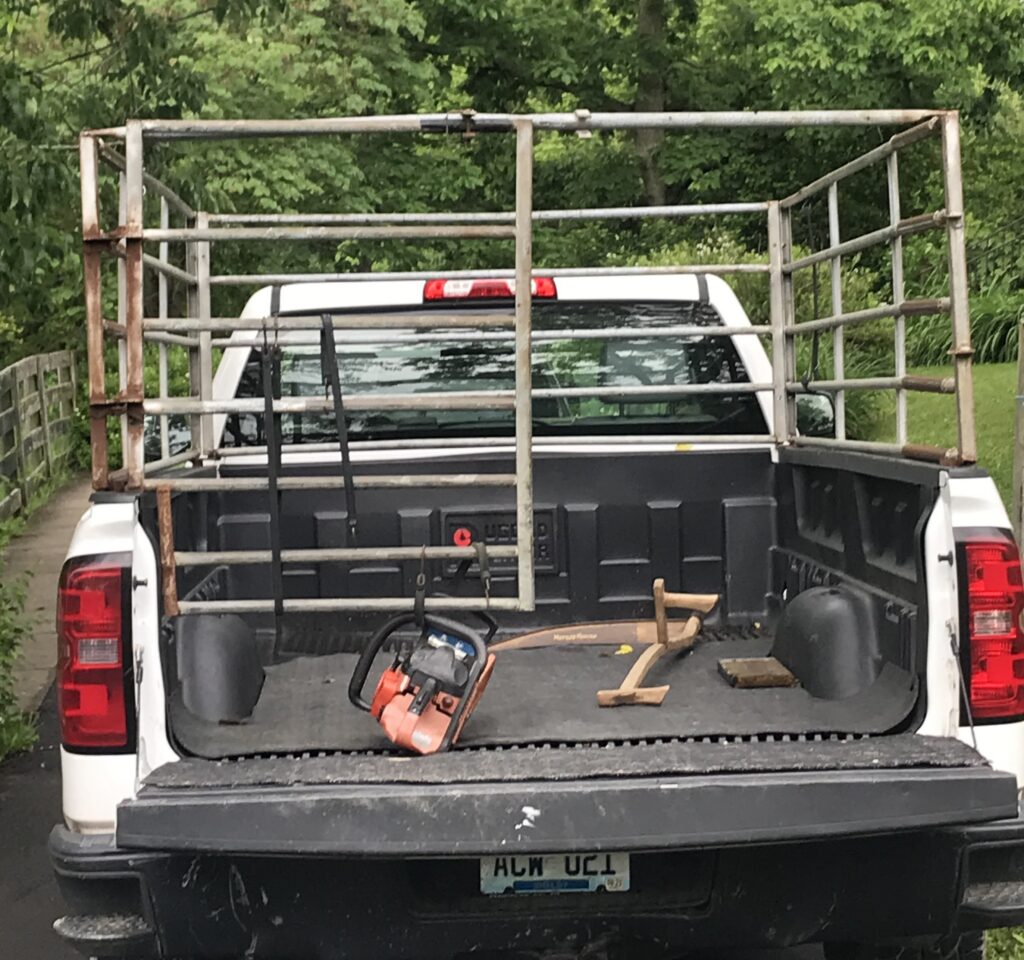
We visited Wendell and Tanya a few years ago on our way to be with family in Goshen, Kentucky. The four of us sat at the table in the Berry’s kitchen, traded stories, and caught up on this and that. As we walked to our truck to leave, I noticed the bed of Wendell’s Toyota, far cleaner and more orderly than the average truck bed, with two essential tool quietly at rest: a chain saw and a hand scythe. The span of time, skill, and care reflected in that small space prodded me to make a picture. Silent and still, what is spoken there is the life of two distinct kinds of solo handwork from across generations of labor and care, requiring markedly different know how and technique.
So many are giving thanks and praise to Wendell Berry for the all the words, the steady challenge of ideas, the example of covering and honoring whatever ground you stand on.
I close here the best I can with a timeless Wendell Berry reminder, an excerpt from his “How to Be a Poet (to remind myself)”:
Accept what comes from silence.
Make the best you can of it.
Of the little words that come
Out of the silence, like prayers
Prayed back to the one who prays,
make a poem that does not disturb
the silence from which it came.
Tom Rankin is Professor of the Practice of Art, director of the MFA in Experimental and Documentary Arts at Duke University, and former director of the Center for Documentary Studies. A photographer and writer, his work has been published widely in numerous magazines, journals, and books, and his photographs are included in numerous private and museum collections. Among his many productions is the seminal LP record “Great Big Yam Potatoes”: Anglo-American Fiddle Music From Mississippi, featuring 16-page booklet on Anglo-American fiddle music recorded in Mississippi in 1939. His books include Sacred Space: Photographs from the Mississippi Delta (1993); ‘Deaf Maggie Lee Sayre’: Photographs of a River Life (1995); Faulkner’s World: The Photographs of Martin J. Dain (1997); Local Heroes Changing America: Indivisible (2000), and One Place: Paul Kwilecki and Four Decades of Photographs from Decatur County, Georgia (2013), and, with his wife Jill McCorkle, Goat Light (2021).