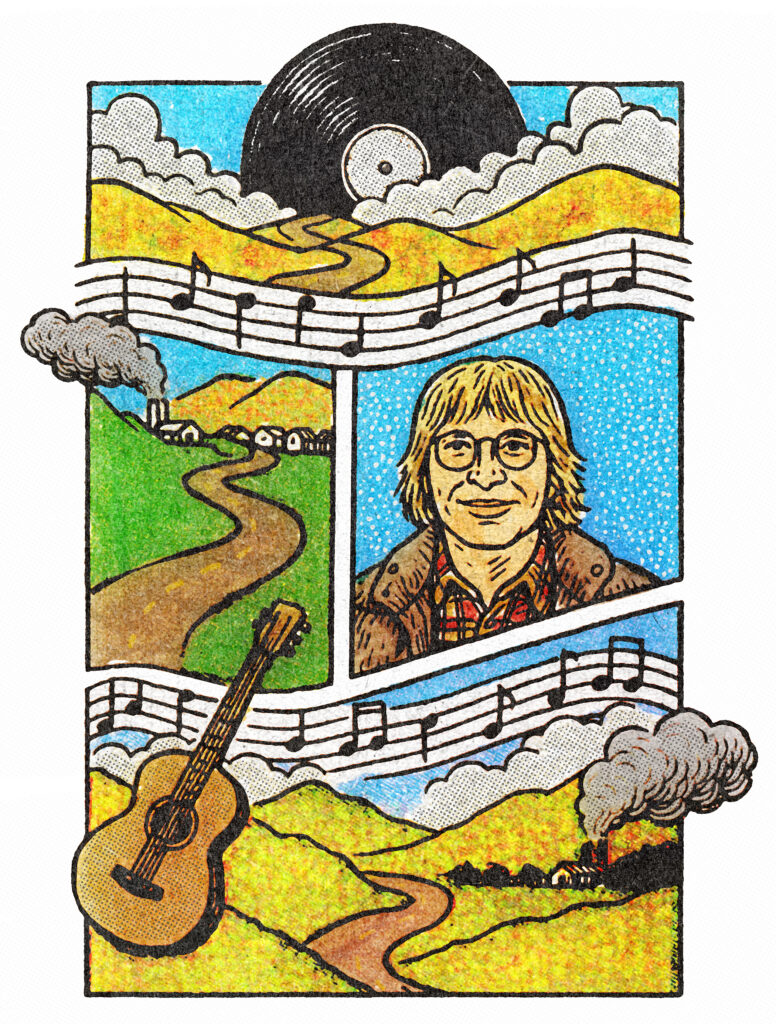
“Despite naming West Virginia,‘Country Roads’ is placeless in the way that it draws upon a sense of mythical, imagined place-belonging and community.”
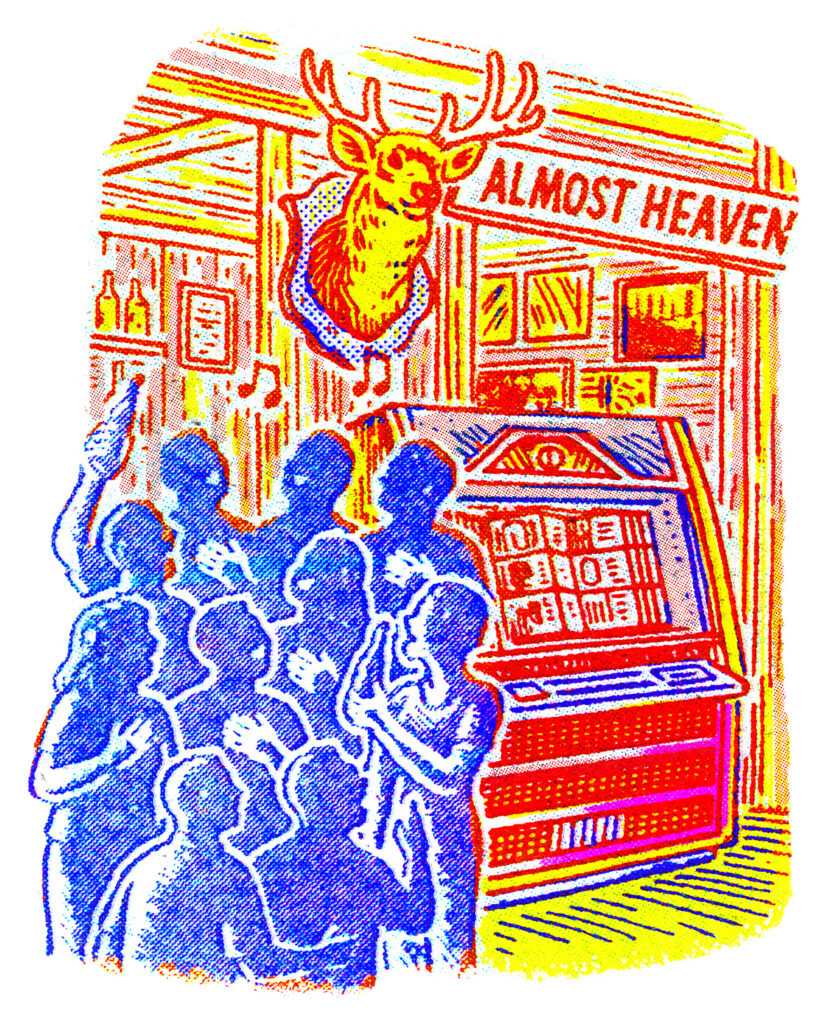
Sometimes, I like to sidle up to a jukebox in a dive bar and select the iconic “Take Me Home, Country Roads.” What happens next tells me a lot about the other people in the room and the atmosphere of the place. Often, clusters of folks who feel called toward homesickness get caught up in the melody and replace conversation momentarily with song. If the bar is in West Virginia, however, the response is more reverent: The entire room may come to a standstill, everyone singing. Depending on the hour and collective level of intoxication, sometimes people cover their hearts and wipe tears from their eyes.
Over the course of several years, I have documented audiences’ reactions to this song, conducted surveys, and interviewed musicians for a book project exploring the phenomenon that is “Country Roads.” I have found that it is more than a song: An anthem and a hymn, a marketing device, a homesick dirge, and a paean of place, it turns up in all kinds of settings and for all kinds of purposes. Pretty much everyone is stirred in some way by “Take Me Home, Country Roads,” and nearly everyone I talk with has a “Country Roads” story, but the song’s real significance is that it has played a key role in perpetuating constructed myths not only about country music but also about Appalachia, as it has been repurposed by and for West Virginians.
As a West Virginian born while Bill Danoff, Taffy Nivert, and John Denver’s classic was in regular rotation, I have never known a sense of home disconnected from the song. Released in 1971, “Country Roads” has remained relevant, with vast examples of commercial and cinematic uses in merchandise, marketing and memes, and recent recordings and reimaginings. A nearly universal symbol of place-belonging, “Country Roads” is present everywhere, reinterpreted and transformed across cultures and spaces, but it is particularly resonant in West Virginia, where the song is a marker of identity that also obscures reality. As a rhetorical symbol of place-based naming, “Country Roads” makes and remakes a mythology of home, codified and commodified in a way that flattens the complexity of the real place it names. The song is about conceptions of place, including places that never existed and do not exist now, yet it is applied in cultural conversation in specific ways that assume and perpetuate both musical and place mythologies. “Take Me Home, Country Roads” draws from myths of place, participates in mythmaking, and is leveraged rhetorically not only as a country classic but also to convey identities of place for Appalachians generally and West Virginians specifically.
The origin story of “Take Me Home, Country Roads” has been widely told. To summarize, songwriters Bill Danoff and Taffy Nivert were driving along in rural Maryland and began riffing on the words “country roads.” On to something, they worked the draft of the song, in practice and in performance, over the course of several months. One night in late December 1970, they shared the song with John Denver, who recognized its power immediately. Working through the early morning hours, the trio added a bridge and dropped a somewhat purple verse referencing hippie homesteaders they knew in West Virginia, and in doing so, made the song more generally applicable. They performed the final draft the next evening at the Cellar Door in Washington, DC. Danoff has recounted many times the standing ovation he and Nivert received the first time they performed the song with Denver on that cold night. Several West Virginians were in attendance, and they were thrilled to be named so openly and reverently. By Spring 1971, the song was recorded and released, soon to gain a life of its own.1
The recording on Denver’s album Poems, Prayers, and Promises was the first version, but far from the only one. When industry officials realized the hit they had, RCA moved quickly to share the song within and beyond the country music market. Loretta Lynn, Lynn Anderson, Tennessee Ernie Ford, and the Statler Brothers recorded covers within the first year. Olivia Newton-John’s country-pop interpretation and Ray Charles’s R&B cover reached beyond the Nashville crowd, rippling to global audiences. Widely recorded, “Country Roads” bends and defies genre, represented over the last half-century in nearly three hundred recorded versions in English and variations in more than twenty languages. Examples include Indonesian folk covers, pop, Celtic punk, Norwegian heavy metal, dance, industrial cyberpunk, reggae, techno, and operatic versions of the song.2
Always, though, it is touted as a country music anthem, as we see in versions like the 2016 “Forever Country” mashup, which blended “Country Roads” with Willie Nelson’s “On the Road Again” and Dolly Parton’s “I Will Always Love You.” We see it in the way it has recently been adapted by artists looking to cross genres, like Jelly Roll and Machine Gun Kelly and Lana Del Rey. Despite its wide-ranging, genre-bending appeal, what makes “Country Roads” feel like a quintessential country song?3

“Country Roads,” Hiraeth, and the Mythical Home
It is true that some members of the industry resisted Denver’s inclusion as a country artist. Though Denver actively avoided the country label his entire career, songs like “Country Roads,” “Thank God I’m a Country Boy,” and “Back Home Again,” with their rural imagery, acoustic instrumentation, and sentimental vocalizations, placed him squarely within the genre. Charlie Rich famously burned the announcement card when John Denver was named the Country Music Association’s “Entertainer of the Year” in 1975. As documented so well in the Country History X podcast, Rich himself was Nashville Sound–engineered from “a jazz, blues, and R&B guy” to a “Countrypolitan star” in his Silver Fox era. Much of the look and sound of artists at the time (and still today) was carefully constructed. Music scholar Richard Peterson refers to “authenticity” in country music specifically as a quality “negotiated” and agreed upon by listeners, producers, performers, and industry interests. The imagery of any commercial music is dependent on created conceptions of reality in both performers and the songs themselves, and we see this in “Country Roads,” even if Denver defied the label with his environmentalism, round frame glasses, and folk-troubadour persona.4
Country music as an industry had long been evolving in the years leading up to “Country Roads.” As Diane Pecknold documents in The Selling Sound: The Rise of the Country Music Industry, the genre evolved from regional balladry to the radio “barn dance” and hillbilly genre, and then to country and western in the 1920s, ’30s, and ’40s, to full commercial recognition as country music by radio and record labels after World War II. Moving from small-station, live variety shows to national sales–driven, programmatic format radio, the country sound in the 1950s and ’60s became more homogenized and tied to a mainstream class identity. Meanwhile, the Country Music Association (CMA) worked to appeal to advertisers as well as more upwardly mobile but working-class audiences of southern migrants finding success in cities throughout the nation, and newer audiences like college students and socialite listeners.5
American studies scholar Jeremy Hill traces the way the CMA harnessed economic and social change, prompted by southern outmigration in the 1950s and ’60s, to remake the genre for urban migrant rather than rural listeners, defying the hillbilly stereotype. This new “Nashville Sound” mirrored migration patterns to become more mainstream and digestible for popular audiences. Additionally, as Pecknold shows, much of country industry efforts focused on consumer culture and corporate image-making so that the genre became “the perfect cultural mirror for the new consumer citizenship” and, in this reflection, “listeners themselves became a commodity” as their purchasing power increased. A softer, widely marketed, more mainstream sound allowed for blurred genre lines.6
Scholar Amanda Marie Martínez documents a standing reciprocity between popular music and country music since before the inception of the CMA in 1958. However, in the 1960s, the CMA began to imbue the Nashville Sound with a sense of legitimacy beyond commercial levels, grounding it in history, tradition, and scholarship with the establishment of the Country Music Hall of Fame museum, as well as a library and archive, in 1967. As a result, crossover became more possible as “hillbilly” music faded into the mainstream, paving the way for artists to record across genres and for songs like “Country Roads” to be interpretable as country songs, to feel true to the experiences of those who were actively listening—rural, suburban, and urban, new and established audiences alike.7
Crossover is aided in that “Country Roads” has many musical and rhetorical qualities of a country song, including “authenticity signifiers in the music,” like references to other songs or through instrumentation. In addition to these signifiers, “Country Roads” also draws on pastoral and rural imagery. Historian Brian Hinton traces pastoral tropes back to folk collectors and songcatchers who, in the early 1900s, disseminated music gathered from the mountains that captured a rural sense of place and home and laid the foundation for modern country music. The country music pastoral Hinton describes holds three “staples,” or genre characteristics, including “sense of the mountains holding an ancient wisdom, unavailable elsewhere,” loved ones symbolized by landscape, and “journey” as a theme. Songs also rely heavily on “home and homecoming, the essence of yearning” as “the charter of country music,” according to scholars Connell and Gibson. Regarding Denver, they write, “Nothing epitomizes this perspective more than various saccharine lyrics” and, “above all, the bestselling ‘Country Roads, Take Me Home.'” The country music home is one of natural landscape and simple purity, romanticized beyond difficulties of everyday living.8
The original version of “Country Roads” uses banjo and slide guitar; other versions, like Oliva Newton-John’s, Johnny Cash’s, or Loretta Lynn’s, perhaps do this more, making them more recognizably country versions. These instrumental elements make the song feel country. Yet, while it leverages country music signifiers—enough to make it a staple of the genre—it also has too few of these signifiers to limit it. As Hinton observes, “Country Roads” has “a hint of banjo in a backing that is otherwise quality pop. It’s a performance about country music more than really of it.” Combining pastoral themes and more modern references to leaving and longing, “Country Roads” resonates beyond genre and across time and geography to tap into a universality. Its lasting power lies in its flexibility. We see this in the way versions of the song incorporate homeward longing and romanticized landscapes, even when the lyrics are changed and genre bent to reflect artists’ own homes (Toots and the Maytals’ version, for example).9
Danoff, Nivert, and Denver cobbled together what they knew about West Virginia, relying on a mix of firsthand knowledge, media, and encyclopedic information, and in doing so, they captured a felt sense of everyplace, of home. This universality can be understood through the Welsh concept of hiraeth, which is present in many texts that evoke a longing for land, simple life, and rurality that depends more on feeling than reality. Though it has no direct English translation, hiraeth can be described as “an unattainable longing for a place, a person, a figure, even a national history that may never have actually existed.” Hiraeth is different from nostalgia because of its connection to something beyond the known; it moves past previous experience and memory and into the ineffable. By capturing this existential longing, “Country Roads” becomes a stand-in for every home.10
Hiraeth is useful for considering “Country Roads” because of the way the song conjures a flexible and general dream space that represents any longed-for home: one of the past or future, even the afterlife, as we see in its use in memoriam. Despite naming West Virginia, “Country Roads” is placeless in the way that it draws upon a sense of mythical, imagined place-belonging and community. It is a good example of the kind of image patterns of home, journey, and return that are repeated in folklore to connect people to place and story: a faraway home where life is old but still growing, the memory of a loved one’s voice echoing in the early morning hours, conjuring an urgent need for return. As folklorist Kent Ryden explains, these images are “created and repeated for a reason, because they encode and carry important personal and cultural messages.” Likewise, the song taps into what political scientist Benedict Anderson calls “imagined community” as a “cultural product” that fosters attachment to place and identity through shared vocabulary of kinship and home. Particularly resonant in the “place I belong” lyric, the speaker in the song is drawn toward a universal home, an idyllic “almost Heaven.” This is why we see it used so widely: in commercials for tires, beer, and technologies; at weddings, funerals, and sporting events; at political rallies, public celebrations, even at protests. But it takes a different shape when applied directly to real places.11
Production of Place and the Romantic Myth of Appalachia
Danoff and Nivert, as songwriters looking to make a living, applied all they knew about musical formula to write hit songs, including instrumentation, vocal tone, and Irving Berlin’s essential elements—easily sung melody and lyrics, and natural and concrete imagery. Their hard work came to fruition when they collaborated with Denver. “Country Roads” even carries its own mythology: For example, it was widely reported that none of the songwriters had ever been to West Virginia, but this is not true. Danoff knew West Virginia only peripherally through interactions with fans and other artists, but Denver’s band, the Mitchell Trio, toured the state, and Denver played solo shows at West Virginia college campuses prior to collaborating on “Country Roads.” Nivert had perhaps the best sense of the state: As a college student, she lived near Wheeling, West Virginia, and spent leisure time there. Outside her dorm window, the mountains rising across the Ohio River sparked her imagination. Years later, when working on the song, Nivert called on these memories for description and details, evoking the romantic sense of “motherland” she felt, and this sense of home resonates in the song lyrically. Despite their connections, and despite being named honorary residents, however, none of the musicians ever lived in the state. Their knowledge was peripheral rather than personal.12
The home to which the speaker returns in a country music song is typically a pastoral landscape of simple purity—but one so romanticized that the difficult realities of the day simply do not exist. In “Country Roads,” the repeated refrains of “take me home” and “place I belong” emphasize return and safety, the deep longing of hiraeth rather than West Virginia as a tangible and complicated destination. Peterson observes that country music is defined by “fabricating authenticity,” and this is true of “Country Roads” because it creates new images and mythologies of the state it names, ones that feel true, even if they are not. “Country Roads” is not clearly about West Virginia, in contrast to the many songs written by West Virginia musicians, such as Hazel Dickens, Mike Morningstar, Daniel Johnston, Kathy Mattea, John Ellison, and others, which address more granular and personal descriptions of life lived within and displaced from the state. Based on romantic and lyrically beautiful imagery, “Country Roads” is geographically inaccurate (though I acknowledge the goal of a song like “Country Roads” is not perfect accuracy but commercial success). The natural features it cites, the Blue Ridge Mountains and Shenandoah River, though both sonically and physically beautiful, are present in only a small portion of the state. Other, specific references to place, like mining, pollution, and moonshine, represent more accurate, if romanticized, glimpses of life in a complex place drawn from the headlines of the time.
In the 1960s and early 1970s, West Virginia was already present in sociopolitical discourse as part of a constructed conception of Appalachia, a long-lasting economic, sociological, political, and rhetorical mythology long documented by Appalachian studies scholarship. This mythology portrayed Appalachian people as both deficient and noble, and the place as impoverished and pristine. It is important to note that “Country Roads” exists within a centuries-old cultural discourse, with portrayals of people in the region as poor, lazy, and dirty traced to explorer accounts of the 1700s. In the modern era, scholarly writing has depicted Appalachia as culturally and geographically separate and, concerning West Virginia particularly, simultaneously portrayed “mountaineers” in the literature as pure, courageous, and true of heart. These stereotypes of homogeneity and deficiency have persisted.13
By the time “Country Roads” was written, scholars were immersed in studying the “Appalachian problem” to shape public policy, again reinforcing long-standing stereotypes. Appalachia “was on every well-informed American’s map,” as continued outmigration from the region garnered national attention alongside distorted popular culture depictions of Appalachian people. In the 1960s, West Virginia was influential in the election of John F. Kennedy, who took an interest in the state. From there, the establishment of the Appalachian Regional Commission in 1963 named and bounded the region, and subsequently funded education, highways, timber management, and tourism, often centered in West Virginia, further cementing perceptions of the state in the American cultural imagination. In addition, the environmental movement of the 1960s and ’70s focused on strip mining, acid mine drainage, and air pollution, bringing forth the Clean Water Act, the Clean Air Act, and the National Environmental Policy Act. West Virginia was central to the establishment of the Mine Health and Safety Act of 1969, as mine disasters placed the state’s tragedy in the national spotlight. A rhetorically, socially, and politically created space, Appalachia garnered significant national attention in the years leading up to “Country Roads,” and as the only state wholly within the region, West Virginia sat at the center of the discourse.14
As Washington, DC, residents in the 1960s and 1970s, Danoff and Nivert would have been familiar with the concerns about the region in discussions of environment, politics, and cultural revival. Within this social, political, and environmental conversation arose a folk revival of art and music, in which many West Virginians participated. The Smithsonian Folklife Festival began in 1967, and West Virginia artists and musicians were well represented. West Virginia–based bands, including Asleep at the Wheel, played in DC often. One account reports that Danoff and Nivert performed an early version of “Country Roads” for Asleep at the Wheel singer Ray Benson at district bar Tammany Hall before they shared it with Denver.15
So “Country Roads,” with its easy melody and descriptive lyrics, alluded to the conversations of the day, but it did so gently. In its poetic and pastoral imagery—the absence of “blue waters,” the “dark and dusty” sky, the waiting “miner’s lady”—there was just enough specificity to capture the imagination of West Virginians and offer a counternarrative to dominant characterizations of poverty, depression, and hillbilly stereotypes. The pastoral stance in Appalachian art, as literary scholar Parks Lanier describes, is “intensely lyrical in celebrating the mountains and mountain people,” but the risk of it is “too much nostalgia and sentimentality.” However, it is exactly this “too much” sentimentality that moves beyond nostalgia and evokes regional longing and hiraeth in “Country Roads,” similarly resonant in the ways writers have traditionally and positively addressed Appalachia.16
In her reception study of Appalachian literature, Emily Satterwhite demonstrates that setting is about aesthetics and production of “Appalachia as an authentic place,” which brings “a sense of identity and belonging,” and then assists “the circulation of power across geographic scales.” These produced stories affected those who left the region, as “onetime residents of Appalachia consumed comforting constructions of ‘home’ even (or especially) when they had little desire for actual return.” The romanticized vision of place is also cherished by those remaining in the region, as well as those who have ties, so that people “participated in the romantic construction of the region for their own purposes of self-affirmation—either through pride in their own Appalachian identity or gratification that a nationally embraced conception of the region was so in keeping with their own sense of being.” The stories about place, however fictionalized, become part of identity rhetoric and myths of place. In her research on Appalachian identity, Carissa Massey directly addresses “Country Roads” as a story in which “mythical landscape—with its winding roads, mountains, and misty horizons—is a place of family, love, and longed-for cultural practices.” West Virginia, then, is “an extension of this myth of a transcendent landscape” which contributes “to a new myth of Appalachia,” a fantasy of ancestral home.17
Like these conceptions of place in literature and song, identity is also constructed economically, socially, geographically, and historically, so that regional identities are shaped by the stories told about place. Stereotypes can become so much a part of visual and narrative culture that they “stand in, synecdotally, for the entire region’s people.” Popular art and media employ these flattened stereotypes and oversimplifications of multilayered and complex populations to “establish identity” for real people in a way that “collapses time, space, and visual meanings over time into a simultaneous image.” Warped representations create warped imagery and warped perceptions of identity, which can be internalized. For West Virginians, “Country Roads” does something else.18
Remaking Myth as a Rhetoric of Resistance
Distorted by stereotypes and named and shaped from the outside, West Virginians struggle to find accurate and positive representation. This remains as true today as in 1971. For some West Virginians, “Country Roads” may be the only positive public narrative of place and home. And the song is so well known that it resonates not just within the state but nationally and globally. When I told people I was from West Virginia while traveling in Asia, I was often met with “Oh, ‘Country Roads.'” Many other West Virginians have told me they experienced the same connection-making, despite language barriers, all over the world. Still, West Virginians must renegotiate identity for us to leverage “Country Roads,” or, at the very least, suspend our disbelief and embrace the imaginary place in the song because it evokes what we feel about home in a way that is real. And there is of course a real West Virginia separate from the one remade in the larger cultural imagination. “Country Roads” is one of the stories told about place, rather than a story told by the place it names, but it rings loudly in our cultural awareness, providing visibility for people in a marginal place. West Virginians leverage “Country Roads” and its largely positive imagery as an act of positivity, power, and resistance.
When we see West Virginians use “Country Roads” rhetorically to reclaim identity and power, the song becomes an argument for inclusion and understanding, and a way to resist negative stereotypes. I have been asked (often as a “joke”) about my dental health or lack of shoes when I tell people I am from West Virginia. Worse: incest jokes. Perhaps more troubling is a sense of utter invisibility, as when people ask what part of Virginia I am from, wholly unaware that West Virginia is a separate state. I am not alone in these experiences. Nearly every West Virginian I know has a similar story, so it makes sense that a song that names us specifically, despite its flaws, ties so deeply to rhetorical expressions of place identity. “Country Roads” is what Sara Webb-Sunderhaus calls a “tellable” narrative because it can “move beyond the perceived space, or geographic understandings, of Appalachia [but] can sometimes trade in the types of stereotypes” in order to counter them. This folkloric concept of “tellability,” which allows for expected and digestible narrative, simple to accept and understand, gives “Country Roads” weight and purpose for use as a response, even if using it requires some cultural negotiation.19
Cultural examples of West Virginians leveraging “Country Roads” in response to derision include comedian Whitney Cummings telling disparaging jokes about hillbillies, chromosomal defects, and mental illness on The Late Late Show in 2019, and Bette Midler referring to the state as impoverished, uneducated, and addicted in a now-deleted 2021 tweet admonishing then-senator Joe Manchin. Social media posts directed in response to both Cummings and Midler used hashtags #AlmostHeaven or #takemehome, memes of John Denver, and other references to the song. In these responses, “Country Roads” expresses positive visibility and counters disparaging imagery.20
As part of West Virginian identity rhetoric, “Country Roads” is an expression of power and protest. It has been sung in senate offices, at mine sites, chemical facilities, and in response to new Dollar General stores. West Virginians used “Country Roads” in the 2018 teachers’ strike that shut down state schools for weeks and led to a ripple of teacher resistance across the region. Videos show groups of teachers, dressed in red, singing the song outside legislative meeting rooms, on picket lines, in solidarity, and in celebration. To leverage the song in these ways is to assert place-belonging and participate in identity resistance.21
When West Virginians embrace “Country Roads,” we resist negative stereotypes and imagery, even though it does not (cannot) tell the whole story of our complex and multilayered home. What the song lacks in complexity it makes up for in nostalgic familiarity, and that makes it useful. The mythical version of West Virginia in “Country Roads” suggests both a physical and spiritual home, so the song’s inaccuracies become both amplified and undone when West Virginians take it up. As sociologist Manuel Castells explains, regional identity is strengthened through “romanticized notion[s] surrounding a region (or a reaction to a negative stereotype)” that place “people into further connections with each other” and allow group opposition in the face of dominant power structures. Fabrications of place warp the fabric of reality, yet as a kind of resistance identity, embracing the stereotype allows transformation for deeper connection to place and justice.22
Rhetorical application defines genre and, in the case of “Country Roads,” determines expression of identity. “Country Roads” represents a constructed mythology of home, place, and identity well suited to country music but extends far beyond it in genre, geography, and time. “Country Roads” is a country song in the same way that it is a West Virginia song. It’s a country song when country music artists perform it and not-country when interpreted by musicians in other genres. Likewise, it’s about West Virginia when leveraged by West Virginians and about “West Virginia” when engaged by non–West Virginians. As an interpretive fictionalization, “Country Roads” uses the feel of country music, the longing of hiraeth, and sense of place-belonging. It also appropriates characteristics specific to the production of Appalachia: references to romanticized pastoral landscapes inhabited by mountain mamas, saturated with moonshine, coal dust, and tainted waters. Richard Peterson refers to Appalachia as a “region of the mind,” one in which a constructed impression of place affects expectations of the music created about the place, so that songs are products of “memory work” and refabricated, recycled imaginaries. Likewise, Jimmie N. Rogers and Stephen A. Smith refer to country music as a “principal cultural text” of the South that shapes views of the world within regional cultures. Country music shapes public views of place as imaginary cultural texts in Appalachia, too. Both magic and myth, “Country Roads” became, and has remained, both principal cultural text and regional imaginary in West Virginia but one that allows resistance and recognition and resounds into the wider world.23
Sarah L. Morris serves as coordinator for undergraduate writing at West Virginia University. Her research focuses on composition pedagogy, Appalachian identity, and place-belonging. These translate directly into classroom practice in her work with undergraduate writers, in teacher training in her role as program coordinator, and in her service work as codirector of the National Writing Project at West Virginia University.
NOTES
This essay was adapted from Sarah L. Morris’s book Lessons from “Take Me Home, Country Roads”: Identity, (Be)Longing, and Imagined Landscapes (West Virginia University Press, 2025).
- Bill Danoff, personal interview, September 24, 2020; Andy Ridenour, Bill Wilkinson, and Mary Ellen Griffith, personal interview, September 16, 2021.
- Bill Danoff, Taffy Nivert, and John Denver, “Take Me Home, Country Roads,” Poems, Prayers, and Promises, Cherry Lane, RCA, 1971.
- “Forever Country: Artists of Then, Now, and Forever,” music video, posted September 20, 2016, by the Country Music Association, YouTube, https://www.youtube.com/watch?v=E2pAslx5az8.
- Bill C. Malone and Tracey E. W. Laird, Country Music USA: 50th Anniversary Edition (University of Texas Press, 2018), 445; Trigger, “Country History X: Charlie Rich BURNS John Denver,” Episode 3, April 22, 2021, in Country History X, Saving Country Music, podcast, video, and transcript, 27:10, https://savingcountrymusic.com/country-history-x-charlie-rich-burns-john-denver/; Richard R. Peterson, Creating Country Music: Fabricating Authenticity (University of Chicago Press, 1997), 6.
- Diane Pecknold, The Selling Sound: The Rise of the Country Music Industry (Duke University Press, 2007).
- Jeremy Hill, Country Comes to Town (University of Massachusetts Press, 2016); Pecknold, The Selling Sound, 167.
- Amanda Marie Martínez, “Pop Stars Don’t Die, They Move to Nashville to Record: The Alliance Between Country and Pop,” Southern Cultures, accessed July 25, 2025, https://www.southerncultures.org/article/pop-stars-dont-die-they-move-to-nashville-to-record/; Pecknold, The Selling Sound.
- Peterson, Creating Country Music, 225–228; Brian Hinton, Country Roads: How Country Came to Nashville (Sanctuary Publishing Limited, 2000), 27; John Connell and Chris Gibson, Sound Tracks: Popular Music, Identity, and Place (Routledge, 2003), 81, 79.
- Hinton, Country Roads, 27.
- Pamela Petro, “Dreaming in Welsh,” The Paris Review, September 18, 2021, https://www.theparisreview.org/blog/2012/09/18/dreaming-in-welsh/.
- Kent Ryden, Mapping the Invisible Landscape: Folklore, Writing, and the Sense of Place (University of Iowa Press, 1993), 57; Benedict Anderson, Imagined Communities: Reflections on the Origin and Spread of Nationalism (Verso, 2006), 143.
- Frank Ward O’Malley and Irving Berlin, “Irving Berlin Gives Nine Rules for Writing Popular Songs,” The Irving Berlin Reader (Oxford University Press, 2012), 173–181; Taffy Nivert, personal interview, September 28, 2020.
- For a detailed discussion, see Rosemary Hathaway, Mountaineers Are Always Free: Heritage, Dissent, and a West Virginia Icon (West Virginia University Press, 2020). These points are well documented, including by Anthony Harkins, Hillbilly: A Cultural History of an American Icon (Oxford University Press, 2005); Robert Higgs and Ambrose Manning, eds., Voices from the Hills: Selected Readings of Southern Appalachia, 2nd ed. (Kendall-Hunt, 1996); Henry Shapiro, Appalachia on Our Mind: The Southern Mountains and Mountaineers in the American Consciousness, 1870–1920 (University of North Carolina Press, 1978); John Alexander Williams, Appalachia: A History (University of North Carolina Press, 2002); and John Alexander Williams, West Virginia: A History, 2nd ed. (West Virginia University Press, 2001).
- Williams, Appalachia: A History, 326–327, 333; Williams, West Virginia: A History.
- Ray Benson and David Menconi, Comin’ Right at Ya: How a Jewish Yankee Hippie Went Country, or, The Often Outrageous History of Asleep at the Wheel (University of Texas Press, 2015), 6.
- Parks Lanier Jr., “Appalachian Poetry: A Field Guide for Teachers,” in Appalachia in the Classroom: Teaching the Region, ed. Theresa Burris and Patricia Gantt (Ohio University Press, 2013), 191.
- Emily Satterwhite, Dear Appalachia: Readers, Identity, and Popular Fiction since 1878 (University Press of Kentucky, 2011), 5–7, 25; Carissa Massey, The Responsibility of Forms: Social and Visual Rhetorics of Appalachian Identity (Ohio University, 2009), 128.
- Massey, Responsibility of Forms, 22, 201.
- Sara Webb-Sunderhaus, “‘Keep the Appalachian, Drop the Redneck’: Tellable Student Narratives of Appalachian Identity,” College English 79, no. 1 (2016): 24, www.jstor.org/stable/44075153.
- CBS has since removed the clip from its website, but it is still available online. West By God Virginia, “Ladies and Gentlemen, Ms. Whitney Cummings on Being from WV,” Facebook, October 22, 2019, https://www.facebook.com/100064559475318/videos/ladies-and-gentlemen-ms-whitney-cummingson-being-from-wv/402813243723101/. Bette Midler (@bettemidler), “What #JoeManchin, who represents a population smaller than Brooklyn, has done to the rest of America, who wants to move forward, not backward, like his state, is horrible. He sold us out. He wants us all to be just like his state, West Virginia. Poor, illiterate and strung out,” Twitter (now X), December 20, 2021. See John Lynch, “Bette Midler Calls West Virginia Illiterate and Poor in Response to Manchin,” WTRF.com, December 21, 2021, updated December 23, 2021, https://www.wtrf.com/news/west-virginia-headlines/bette-midler-calls-west-virginia-illiterate-and-poor-in-response-to-manchin/.
- John Dahlia, “Teachers Sing ‘Country Roads,'” video, 0:34, WVNews, March 6, 2018, https://www.wvnews.com/tv/news/teachers-sing-country-roads/video_503fc4df-5001-5e8c-b6e6-c28bc4571afe.html.
- Manuel Castells, The Power of Identity (Wiley, 2010), 8.
- Peterson, Creating Country Music, 215; Jimmie N. Rogers and Stephen A. Smith, “Saturday Night in Country Music: The Gospel According to Juke,” Southern Cultures 1, no. 2 (1995), https://www.southerncultures.org/article/saturday-night-country-music-gospel-according-juke/.