I don’t remember much of how the actual city of New Orleans looked when I was a child, especially my surroundings before Hurricane Katrina. Growing up, my lens of the city was my family’s home in the Ninth Ward. Sometimes it felt like my siblings and I were in our own bubble. We usually just »
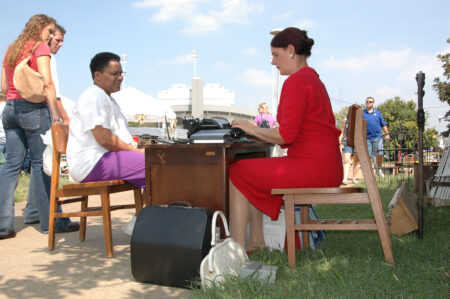
In 2004, artist Sheryl Oring donned a red, white, and blue outfit of a 1960s-era secretary and first performed her ongoing social practice project I Wish to Say. She asked participants, “If I were the president, what would you wish to say to me?” She typed their responses verbatim with a typewriter onto four-by-six-inch postcards. This »
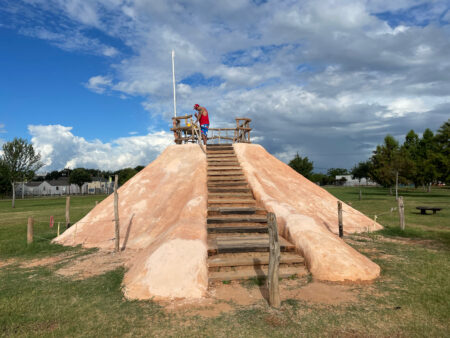
It was a two-hour drive from New Orleans to Hattiesburg, Mississippi, in the sweltering heat of summer 2024, when I first met Dr. Tammy Greer. Just the day before, I had taken an early morning walk to Nanih Bvlbancha at Lafitte Greenway, a project she helped bring to life alongside a collaborative group of artists »
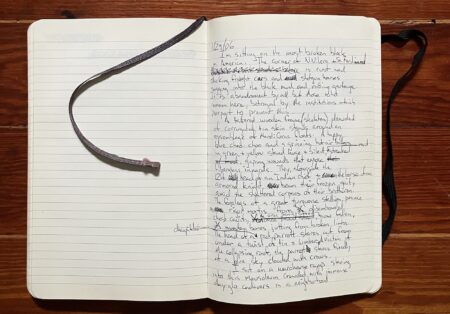
At the time Hurricane Katrina made landfall, Stephen Garofano was a twenty-eight-year-old professional musician living in New Orleans. He says, “In the aftermath of the storm, my diary began to feel like an important document of the historical tragedy unfolding around me, as well as a tether to reality and a lifeline to myself.” An opera »
I love New Orleans. If I’m going to live anywhere in America, as a matter of choice, then I choose New Orleans . . . I mean, I love New Orleans, yeah, but sometimes I hate it. Here we have both the best and the worst of the so-called New World coexisting in paradoxical symbiosis »
The Crescent City Connection and the Chinese Cajun Cowboy
by Robin McDowell
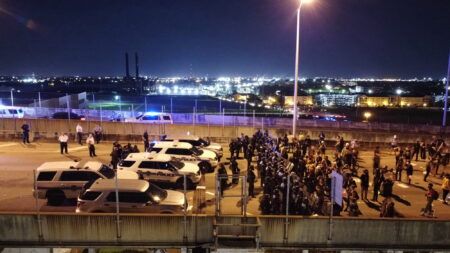
On September 1, 2005, three days after Katrina made landfall, a shotgun shell whizzed over the head of a young Black man holding his daughter in his arms. He was among hundreds of victims that day, eager to escape the flood by crossing the Crescent City Connection (CCC), a double span bridge over the Mississippi »
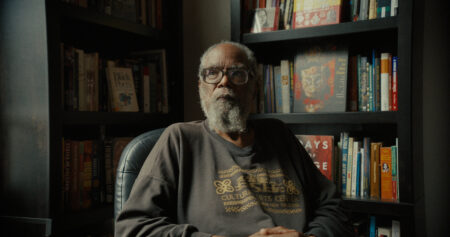
In the aftermath of Hurricane Katrina in New Orleans, Michael Mizell-Nelson (1965–2014) did what good public historians do: he looked for ways to help the city tell its own story. Mizell-Nelson, on the history faculty at the University of New Orleans, teamed up with colleagues at the Center for History and New Media at George »
When I was five, my father explained to me that our city, New Orleans, could fill up with water like a fishbowl. Not long after receiving this surprising news, I heard the story of Noah’s Ark at Sunday school and understood it to be the most useful tale of all. I was raised—home, school, and »
by Naya Jones,
Tianna Bruno,
Morgan P. Vickers,
shah noor hussein,
Danicia Malone
Introduction: Grounding shah noor: Like seeds braided in cornrows, grains of rice hidden into tendrils, maps stitched in quilts, and braid patterns weaving histories Ayana: There is always tea,something with garciniaand mint,and a little maté—for a kick. These are glimpses of how we craft Black ecologies. In the polyvocal piece that follows, we reflect on Black craft as both a practice and »
Calvin Yeomans (1938–2001) was in a depressive period in the middle of the 1970s. As he built up what he referred to as his “little island”—Crystal River in central Florida, where he grew up and returned to after a breakdown in 1974—he reflected on his life and artistic output. He was a queer southerner who, »
That Black joy real loudwhen it come from the other sideof benign neglect.A rebellious affirmation so beautifulyou can’t help but be takenin by the dark.Can’t help but give into a resounding amenblaring through the speakersof a candy-painted ‘lac,a heaven-hued DeVille.Ain’t no ignoring this peace.Ain’t no taming this revelry.Ain’t no turning down this song.All you can »
Southern hip-hop, thee I love, shawty. When writing Chronicling Stankonia, I heeded Toni Morrison’s challenge to make the book I wanted to read. My goal was for it to be a book that showed love to my place as a Down South Georgia Girl (though if I’m being honest, I think I’m really writing that book right now). »

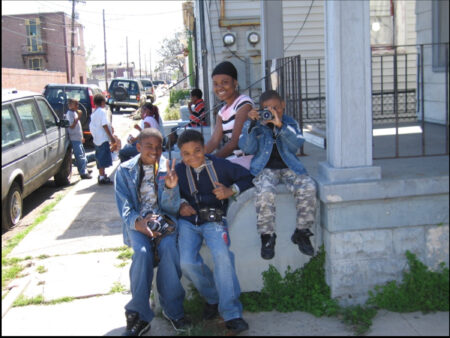 Photo Essay