In January 1941, literati tastemaker Carl van Vechten wrote in mock reproach to Gertrude Stein in Paris—whom he addressed as “Baby Woojums”—chastising her and her partner Alice B. Toklas for their absence when simply everyone else who mattered was there in Manhattan. To further pique the envy of author and art aficionado Stein, he noted »
The water in our creek and marsh on Virginia’s Eastern Shore grows colder by the day as a fading year slips away and the hopefulness of a new one approaches. Frost clings to browning marsh grasses, the tide runs winter clear, passing seabirds huddle on shoals and bars. Low tide. I wade out through the »
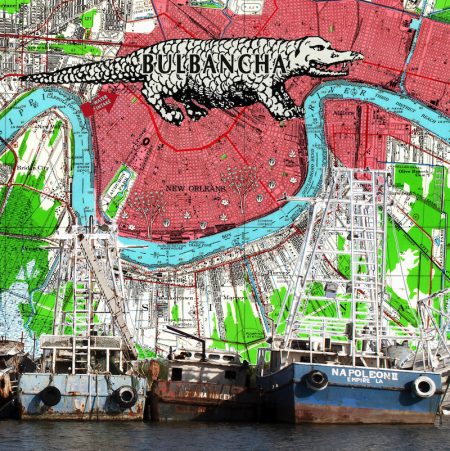
“We ride the waves of supply and demand on the banks of the Mississippi, furs and cypress, cotton and cane, oil and gas, corn and grain, coal and aluminum, commodities bought and sold, always en route, pushed up and down river.” They call it “Cancer Alley” because it’s got a reputation. The hundred-mile stretch between »
The Surprising Story of Apples in the South (An Excerpt)
by Dianne Flynt
Before cider, there were apples, and the story of how domestic apples came to the South includes unexpected characters and circuitous routes. Flowering plants, called angiosperms, originated in the fossil record at least 120 million years ago, and possibly as early as 170 million years ago. Around 100 million years ago, plants appeared that are »
A middle-aged white man in three-quarter-length view proudly fills the frame of the black-and-white photograph (fig. 1). He stands on a cracked cement landing beneath a leafless oak tree. Behind him, peeling plaster reveals a crumbling, low-slung brick wall, over which a tangle of brambles gives way to a field bounded on the left by »
Executive EditorAyşe Erginer Art Director & Deputy EditorEmily Wallace Managing EditorAnnie Lubinsky Associate EditorIrene Newman Assistant EditorWalker Livingston Contributing EditorScott Schomburg Poetry EditorsGabrielle Calvocoressi & Destiny Hemphill Music EditorAaron Smithers Founding EditorsJohn Shelton Reed & Harry Watson Print DesignHudd Byard Print ProductionSam Dalzell Web DeveloperJames White Center for the Study of the American SouthBlair LM »
In an essay published in our pages in 2000, our friend Jerry Leath Mills surveyed around 30 prominent twentieth-century southern authors, which led him “to conclude, without fear or refutation, that there is indeed a single, simple, litmus-like test for the quality of southernness in literature, one easily formulated into a question to be asked »
Lessons Learned from Studying the South at the University of Mississippi
by Charles Reagan Wilson
On the occasion of my retirement from the University of Mississippi in 2014, I knew I had to talk about the South, the topic I have spent my career studying, pondering, writing about, and teaching. The more I thought about what to present in a final, university-wide lecture, my personal journey seemed relevant, for I »
Art provides a powerful historical archive through which we can see our lost environmental past. In 1915, the artist Romare Bearden left the South at the age of four; decades later, he rendered evocative depictions of the southern natural world. His paintings and collages capture the lush bounty of city gardens and the women who »
Kris Kristofferson, Authenticity, and Country Music's "New Breed"
by Alex Macaulay
Attendees at the 1970 Country Music Association awards were startled when Roy Clark announced that Kris Kristofferson’s “Sunday Mornin’ Comin’ Down” beat out Merle Haggard’s “Okie From Muskogee” for Song of the Year. Amid applause and some gasps, a dazed, disheveled, long-haired Kristofferson stumbled up the steps of the Ryman Auditorium, looking an awful lot »
The Long History of Benevolence, Self-Help, and Parades in New Orleans
by Leslie Gale Parr
Even in a nation inclined to “constantly form associations,” as de Tocqueville observed in 1831, residents of New Orleans excelled in organizing lodges, religious groups, literary societies, charitable organizations, sporting clubs, social clubs, and, most of all, benevolent associations, the most popular—and practical—organizations to which New Orleans’ polyglot population flocked. By 1880, these organizations (also »
While researching his 1885 biography of Edgar Allan Poe for Houghton Mifflin’s American Men of Letters series, George E. Woodberry discovered that Poe had enlisted in the U.S. Army in 1827 under the name of Edgar Perry. As is now well known, Poe was shipped to Sullivan’s Island, South Carolina, a barrier island on Charleston »

 Essay
Essay