This essay is part of our Shutter art and photography series. “Called to the Camera: Black American Studio Photographers” is on view at the New Orleans Museum of Art, September 16, 2022–January 8, 2023, and “The Photographs of Ralph Eugene Meatyard” at the Ogden Museum of Southern Art, October 1, 2022–January 15, 2023. Because we can make »
Consider the evolution of cultural forms and our present role—whether active or passive—in shaping the folklore of the future. Folklorist Henry Glassie elaborates on his conception of tradition as “the creation of the future out of the past,” as, “A continuous process situated in the nothingness of the present, linking the vanished with the unknown, »
Thanksgiving gathers us around a table with mouths full of food, stories—and opinions. American Thanksgiving lore suggests that everyone from sea to shining sea enjoys the same iconic dishes: turkey, dressing, cranberries, and pie. In practice, that’s not the full picture. When it comes to a southern family’s (actual and/or chosen kin) T-Day table, most »
When Joshua Clark Davis and Seth Kotch began work on the Media and Movement project on behalf of the National Endowment for the Humanities and Southern Oral History Program at UNC–Chapel Hill, their starting place was easy: Durham’s WAFR. WAFR was the nation’s first public, community-based Black radio station, and, as Davis notes, “also the »
Embroidery: Threads and Stories from Alabama Chanin and the School of Making (Excerpt)
by Natalie Chanin
Natalie Chanin is the founder and head designer of Alabama Chanin, the 21-year-old company focused on sustainable design based in Florence, Alabama. Chanin’s latest book, Embroidery: Threads and Stories from Alabama Chanin and The School of Making (Abrams, October 2022) mixes lessons in sewing, design, and embroidery with her personal story and the evolution of »
Listen: no one can give you rights. You have to take them. Nobody—not your mother, not your partner, not your senator, not Jesus, or me—can tell you how to feel or what to think. I’m supposed to turn the stories we hear on the other end of the line into smoothed over, anonymized anecdotes that »
In the middle of a childhood marred by hard labor and an abusive father, Eddie Owens Martin got out. While Eddie had already been sharecropping cotton with his family for years, he was only fourteen years old when he took up sex work to support his travel from Glen Alta, Georgia, to New York City »
My family’s garden is a crazy quilt of vegetables scattered across a strip of land next to the blue house that my grandparents built for themselves sometime in the 1950s. I have vivid memories of our garden while growing up—of my Granddaddy wrangling a rototiller, of following my dad through the rows we made as »
They’d long forgotten to dance—mis abuelos,rigid as the simple white wooden screen door that snappedopen and shut into grandma’s kitchen Apache and Mexicanthey’d both long forgotten to dance—long forgotten any songslong forgotten the fire On Christmas Evemy grandpa and uncles would build a bonfirefrom broken wooden pallets and jagged three-legged chairs or tables,they’d douse them »
by Antonio José Martínez y Miera,
Theresa J. Córdova,
Karen R. Roybal
“Over four decades later, the existence of this archive allows us to contemplate and discuss what light these resolanas of the past shed on our present. It provides an important opportunity for collective memory to speak.” Over a decade ago, I was trained in preservation and digitization at the Center for Southwest Research (CSWR), and »
Elmer Beard and the Enduring Legacy of Roanoke Baptist Church
by Jajuan S. Johnson
“‘We don’t get where we are without a cost. Freedom is never free. So, we saw the church go up in flames and fall down in ashes.’” After a year of considering my interview request, Elmer Beard was ready to tell the story, but on one condition: we must meet at the church. For Beard, »
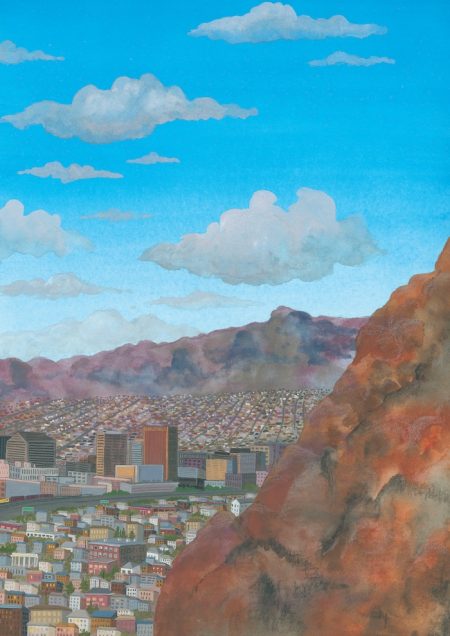
“Eight hundred miles or so west of the South Texas border, I also found the perfect place for me.” During the summer of 2009, I arrived at the El Paso–Ciudad Juárez borderplex as a teenager seeking sanctuary. I did not arrive from south of the border as most Americans might imagine but from the Texas »

 Art
Art