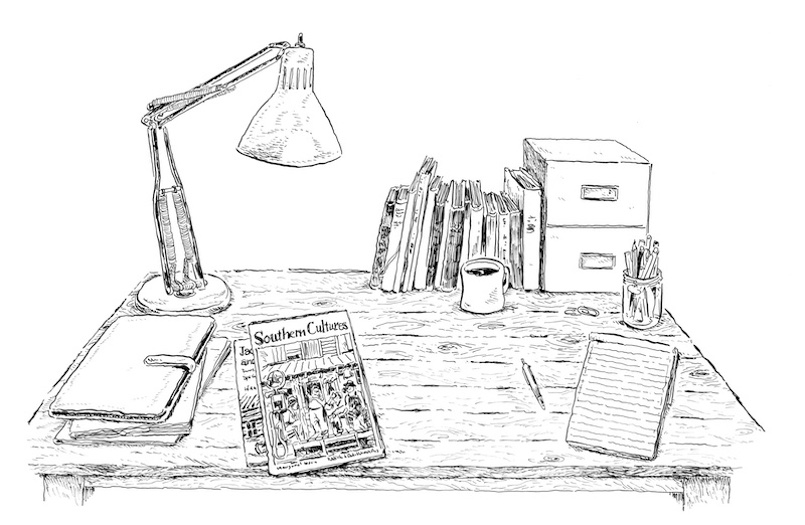
“Freezing time is a tricky science.” “Death suffuses all these pictures.” So says former fashion photographer Charlie Curtis, who has been working late on his time machine again. Readers of Southern Cultures will remember his “Signs of the South” photographic essay, which we published in our Summer 2000 issue. But unlike “Signs of the South,” »
Artists and critics long have considered the South to be a territory whose character and ethos depend, perhaps more than any other region in this country, upon sense of place. Former AP and UPI photographer Dan Sears, whose work we first published in our Fall 2000 issue, has logged hundreds of miles over the course »
University of Arkansas Press, 1997 This attractive and well-designed photographic history fulfills in admirable fashion Richard McCaslin’s objective: “to present a carefully selected array of images that convey the experience of many citizens of the North State” during the Civil War. A major strength of McCaslin’s volume is the narrative account of North Carolina during »
What could a former fashion photographer possibly have to offer Southern Cultures? A tour of the past and present. Charlie Curtis says that it was a deep love for preservation that led to this collection of the archival photography of Dorothea Lange and Marion Post, along with his own original pictures of the signs that »
Former AP and UPI photographer Dan Sears says that his “Southern Scenes” is “an on-going personal project to document vistas and sights that are disappearing from the South.” For Sears, photography is preservation. So far he has “logged over 1300 miles” in the course of his project, and he has found some of the most »
“These images chronicle a century of tradition.” The Gullahs are descended from African slaves taken to work on the cotton and rice plantations of the Sea Islands of South Carolina and Georgia. Isolated until recently from white and even other African American influences, the Gullahs developed a distinctive creole language and preserved many West African »
Before taking these photographs I had read an essay on how several decades ago the Atchafalaya and Mississippi rivers bent close enough to one another in Louisiana that they united. The Atchafalaya, being the lower of the two, took on the bulk of the flow, a distressing development for life on the Mississippi in lower »
Public Affairs, 2002 Henry Clay Anderson photographed the African Americans of Greenville, a majority-black town on the banks of the Mississippi River and at the edge of the Mississippi Delta, for close to forty years. His life’s work is presented for the first time in Separate, But Equal. Greenville was thoroughly segregated throughout most of »
University of North Carolina Press, in association with the Center for Documentary Studies, 2002. Sodom Laurel Album takes its name from an isolated North Carolina mountain-hollow community of ramshackle homesteads, deteriorating barns, worn-out tobacco fields, and tough, “ordinary” people. Rob Amberg could have breezed in for a photo-shoot, taken a few stereotypical or even romanticized shots »