Lincoln Beach and the Struggle over Black Public Space
by Shruti Gautam
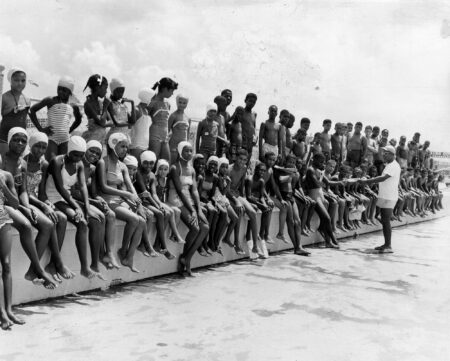
In the summer of 2023, I followed behind families toting floaties and foam coolers, trudging up an incline on the side of a levee. As I fumbled over a fence and down a ladder, the families walking ahead of me nimbly stepped over long and wide railroad tracks. In the distance, a canopy of oak »
From 1956 to 1965, the residents of the boom state of Florida were held hostage to a McCarthy-esque investigation with the power to declare anyone who opposed segregation—including Black integrationists and closeted queer teachers—to be Communists, perverts, and “enemies of the people.” Officially called the Florida Legislative Investigation Committee, this group of white lawmakers was »
In 1975, Joan Little was on tour. Media covering the story of her legal case—a first-degree murder charge, her ultimate acquittal, and her subsequent retreat from public life—tended to frame her life as a political and social cause. Many groups took up her case as a landmark gesture toward prison abolition, antirape activism, and civil rights »
Violence, Violation, and Black Women’s Struggles for Civil Rights
by Adriane Lentz-Smith
“Much changed over the course of the freedom struggle in how African Americans pursued rights and how segregationists defended white democracy, but sexual violence remained central to asserting white power.” On August 26, 1965, Henrietta Wright drove to the Winona, Mississippi courthouse and registered to vote. A few hours later, she was facing the barrel »
“In a purposeful inversion of the news headlines from the time, my work foregrounds individuals who fought for civil rights and who were victims of retaliatory violence.” It was a sweltering summer in 2002 and I was wandering downtown Montgomery, exploring and making photographs, when I found myself at a historical marker in front of »
The United Farm Workers in Florida Citrus, 1972–1977
by Terrell Orr
“If labor organizers had learned anything from decades of small victories and stubborn failures in the US South, it was that interracial unions were hard work.” “I have your letter of June 1 [1974] and suggest that if you really want to know what is involved in organizing a Union, you should put some time »
Chokwe Antar Lumumba in conversation with Kiese Laymon
by Chokwe Antar Lumumba,
Kiese Laymon
“We have to figure out how we go around [the mountain] or, like Hannibal, how we just run the troops up.” Kiese Laymon: Yo, man. It’s so good to talk to you, fam. I don’t even know how to ask somebody as busy as you how you doing. Are you less busy in the summer, »
Rosa Ortez-Cruz, interviewed by Lori Fernald Khamala
by Rosa Ortez-Cruz,
Lori Fernald Khamala
“At first, I thought three months was forever. I counted ninety-six days; “Oh God, that’s insane!” But imagine, now, I’ve already been here for more than four hundred days.” I have been living in this church for more than a year now, and it hasn’t been easy at all. It is exhausting, for me and »
VALERIE BOYD: Everybody I’ve talked with, when I’ve told them that I’m interviewing Stacey Abrams, they’re so excited—and especially Black women. Every time I tell a Black woman I’m interviewing you, they get a dreamy look in their eyes that’s usually reserved for Michelle Obama. Well, maybe Oprah. But now there are three Black women »
REV. DR. WILLIAM J. BARBER II: My father . . . said, “When you feel overwhelmed by your moment, go back and read the moments that people faced that are worse than yours. What courage and hope and truth did they find in that moment?” I go back and I read Henry McNeal Turner and »
It can be an odd undertaking to explore the meaning and mission of an American public university through the lens of history. The concept of a “university of the people”—especially for a southern state university—must begin with a great and unyielding asterisk. The University of North Carolina at Chapel Hill was all male until 1897, »
On August 14, 1970, Richard Nixon treated New Orleans, a city keen on parades, to a campaign-style motorcade. With Nixon standing and waving through the sunroof, his limousine moved slowly down wide Canal Street, then through narrow Chartres Street. Thousands of people lined the sidewalks to cheer and be near the President of the United »

 Essay
Essay