Art and Environment in the New Deal and New Millennial South
by Teresa Parker Farris
In late spring 2016, Louisiana artist Monique Verdin arrived in the Netherlands for the annual shareholders’ meeting of Royal Dutch Shell armed with an impassioned message and a collection of her black-and-white photographs. The images, displayed as individual large-scale banners, revealed petrochemical plants looming over the wasted landscape, seasonal floods inundating impoverished neighborhoods, and denuded »
This series of over-sized tintypes is a rumination upon a relationship with a person and a city. Using metaphor, allegory, and the re-interpretation of a few facts, these images re-stage events and themes, and recreate certain atmospheres from a period of sixteen years. They are an idealized record of my relationship with my partner Brian »
It may seem impossible, given climate change and ISIS, mass shootings and growing inequality and disregard for Black life, sexual assault and Russian hacking and the opioid epidemic, to worry about any other single thing, but history too is in trouble. I do not mean history as content. Beloved television shows and films take place »
“Past tropes never survive unless they adjust to changing times.” “Backward” and “forward” seem straightforward terms, but they have rich associations with the American South. Most obviously, they mean “past” and “future,” and that understanding shaped the outlook of this special issue of Southern Cultures. Allen Tate famously attributed the flowering of literature after 1920 »
“Everyone who is paying attention knows that the South is with us still.” With this issue, Southern Cultures turns twenty-five years old. It’s a source of wonder to recall a distant meeting with friends and supporters in John Shelton Reed’s old office at the Institute for Research in Social Science (now the Odum Institute) at »
Spacious skies. Alabaster cities. Shining seas. Purple mountain majesties. Fruited plains. Amber waves of grain. America is beautiful. That’s what I learned from singing Katharine Lee Bates’s unofficial national anthem as a child. Yet growing up in middle Georgia, I didn’t see much of that. I looked out on my native terrain, flat and worked-over, »
My great-grandfather was murdered by a white man in 1926, the night before New Year’s Eve. He was thirty-five years old—my grandmother Sara’s father. I call her Nana Boo. She doesn’t have any memories of him because he was killed when she was a baby. His wife, Nana Boo’s mama, Mary Jones Barkley, was the »
The following images were submitted by student photographers at the University of North Carolina at Chapel Hill in response to a call for photographs that depict the pursuit of social equality, the challenging of injustices, the strengthening of community, or the advancement of human rights. A collaboration with the Campus Y, the call coincides with »
Some women suffer themselves foolstrying to hold a man who floats between them like driftwood;whose happy tongue slicks his catfish back; who constrictshis lover’s bones as if a black rat snakewhile holding out magnolia blossom & eucalyptus branch offerings—except for Annie who is strong as a water oak; evergreen as pine. Bounty Everlasting: Poetry from »
“‘[Powwow is] how we stand up.’” At 7:00 a.m., the first students arrive at the gym. Sleepy but excited, they begin setting up, making sure there are chairs for dancers and tables for vendors, organizations, and T-shirts. Finally, it’s powwow weekend. It will be hours until the singers and dancers show up, but the vendors »
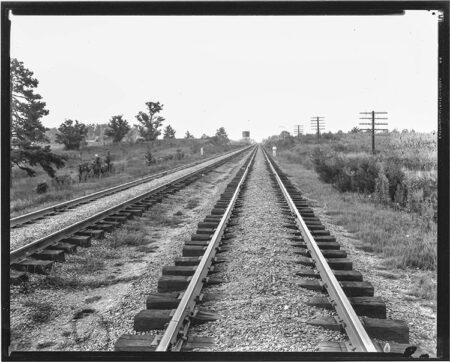
“A line of hope for some, the Gulf & Ship Island Railroad became, for others, a legendary site of death and cruelty, a place where modernization and opportunity clashed with archaic traditions and racial oppression.” An old railroad track runs through the Mississippi Piney Woods to the Gulf of Mexico, timeworn and unnoticed, but riddled »
I made these pictures with a 4×5 Horseman studio camera during the Reagan years of 1984 to about 1988, when I was fresh into pictures. View cameras have bellows and expose larger negatives than handheld cameras. The Horseman I used was designed for studio work, as opposed to other view cameras made for the field, »

 Art
Art